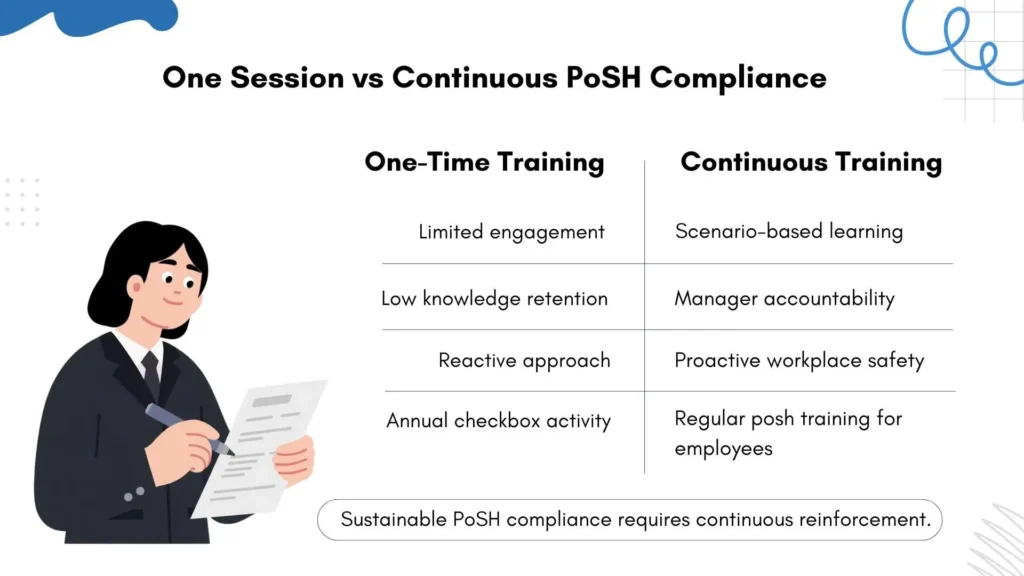
Creating a safe and respectful workplace is not only a regulatory obligation but also a cultural necessity. Many organizations offer PoSH training only once a year or during onboarding, assuming this fulfills their responsibility. However, a single session rarely leads to lasting awareness, behavioral change, or effective PoSH compliance.
Modern workplaces are dynamic, with shifting power structures, evolving communication styles, and emerging risks. Preventing harassment requires ongoing reinforcement, contextual understanding, and leadership accountability. A single workshop cannot maintain this momentum.
Compliance Is Not the Same as Culture
Under the Sexual Harassment of Women at Workplace (Prevention, Prohibition and Redressal) Act, 2013, employers must ensure awareness, sensitization, and the formation of an Internal Committee. However, many organizations interpret this requirement narrowly.
Many organizations conduct annual PoSH training, circulate the policy by email, and consider their obligation complete. However, true PoSH compliance goes beyond documentation. It requires:
- Ongoing employee awareness
- Active Internal Committee preparedness
- Transparent reporting mechanisms
- Regular policy reinforcement
- Consistent communication from leadership
Compliance provides legal protection, while culture safeguards employees’ emotional and psychological well-being. A one-time session may meet basic compliance but rarely shapes workplace culture.
Knowledge Retention Declines Without Reinforcement
Research shows that without reinforcement, employees forget much of what they learn within weeks. For PoSH training, this means:
- Employees may forget reporting procedures.
- Managers may not recognize subtle forms of misconduct.
- Bystanders may remain unsure about intervention steps.
Preventing harassment requires clear definitions of terms such as quid pro quo harassment, a hostile work environment, and inappropriate conduct. Employees also need practical knowledge of complaint processes, confidentiality, and safeguards against retaliation.
Regular micro-learning sessions, awareness drives, and scenario-based workshops help embed knowledge. Without reinforcement, it fades.
Workplace Structures Are Evolving
Today’s workplace has changed significantly, with hybrid models, remote collaboration, gig workers, consultants, and cross-border teams introducing new complexities.
Harassment can now occur through:
- Video conferencing platforms
- Team messaging tools
- Informal digital groups
- Social media interactions
A single PoSH training often fails to address digital misconduct or boundary violations in virtual environments. Ongoing prevention efforts must adapt to these realities. Continuous training helps organizations address emerging risks and clarify acceptable digital conduct.
New Employees Join Throughout the Year
Organizations experience continuous hiring. If posh training for employees is conducted only once annually, new hires may wait months before receiving formal awareness.
Onboarding sessions help, but they are often brief and information-heavy. Employees are simultaneously absorbing company policies, job responsibilities, systems training, and performance expectations. PoSH awareness may not receive the attention it deserves.
Regular refresher programs ensure that:
- New employees receive consistent messaging.
- Existing employees reinforce their understanding.
- Managers align on updated procedures.
This approach strengthens overall PoSH compliance and reduces the risk of uninformed misconduct.
Power Dynamics Change Over Time
Promotions, departmental transfers, and leadership restructuring alter workplace hierarchies. An employee who was once a peer may become a reporting manager. These shifts introduce new power dynamics.
Continuous gender sensitization training helps leaders understand:
- Responsible use of authority
- Avoidance of favoritism
- Boundaries in mentoring relationships
- Risks of informal communication patterns
One-time training does not address evolving interpersonal dynamics. Regular learning builds awareness of professional boundaries, respectful communication, and ethical leadership.
The Internal Committee Also Needs Ongoing Training
Organizations often focus on employee awareness and overlook the Internal Committee (IC). However, IC members need specialized training in:
- Complaint handling procedures
- Principles of natural justice
- Evidence evaluation
- Confidential documentation
- Conducting fair inquiries
Without ongoing training, IC members may mishandle complaints, exposing organizations to legal and reputational risks.
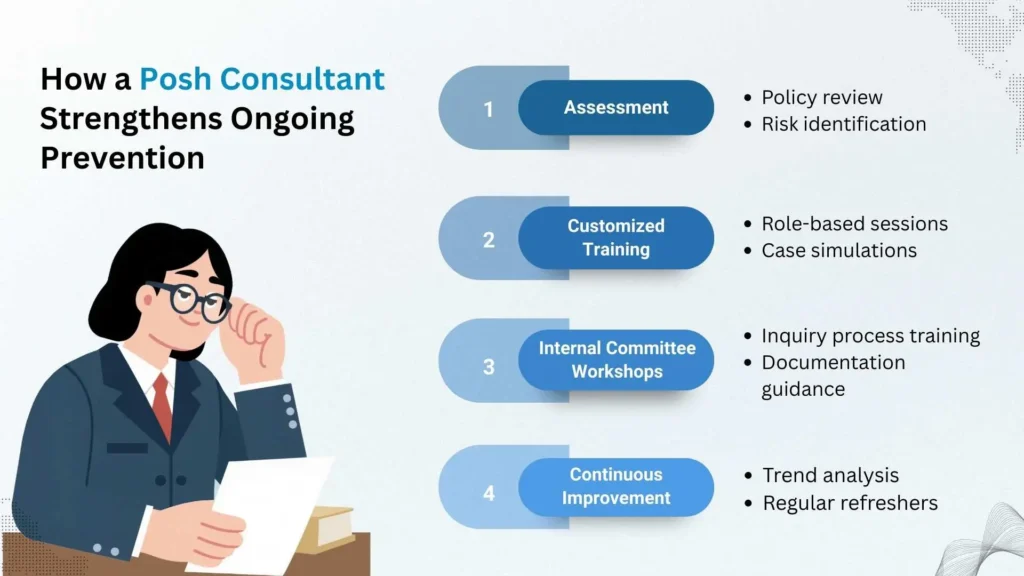
Experienced PoSH consultant recommends periodic IC workshops, mock inquiry simulations, and updates on judicial interpretations to ensure procedural integrity.
Legal Interpretations and Workplace Expectations Evolve
Workplace norms evolve with societal awareness. Behaviors once considered casual are now recognized as inappropriate. Language sensitivity, consent, and inclusion standards are continually changing.
Regular posh training ensures employees understand:
- What constitutes verbal harassment
- The impact of jokes or comments
- Non-verbal cues that create discomfort
- Responsibilities of bystanders
Ongoing awareness reinforces a culture of zero tolerance, rather than reactive compliance.
Fear of Retaliation Prevents Reporting
Employees may hesitate to report harassment due to fear of retaliation, stigma, or disbelief. One-time training often emphasizes policy but may not address psychological safety.
Continuous sensitization initiatives can:
- Normalize discussions around workplace safety
- Reinforce confidentiality assurances
- Clarify anti-retaliation safeguards
- Encourage early reporting
When leadership consistently reinforces respectful behavior and grievance redressal mechanisms, employee trust increases.
Managers Play a Critical Role
Supervisors and managers are often the first point of contact for informal complaints. Without consistent reinforcement, they may:
- Minimize concerns
- Attempt an informal resolution improperly.
- Fail to escalate complaints to the Internal Committee.
Ongoing posh training for employees, especially for managers, strengthens their understanding of complaint handling procedures and mandatory reporting obligations.
Managers must receive periodic training to ensure accountability.
Organizational Reputation Is at Stake
In today’s digital age, workplace misconduct can quickly become public. Employer branding, talent retention, and investor confidence rely on strong ethical practices.
Continuous PoSH compliance initiatives demonstrate:
- Commitment to employee safety
- Transparent governance
- Strong HR frameworks
- Responsible leadership
Investing in ongoing PoSH training is not only about legal protection; it also sustains credibility and trust.
Psychological Safety Requires Continuous Reinforcement
Creating a safe workplace involves more than preventing misconduct. It requires building psychological safety, where employees feel respected and heard.
Regular learning initiatives can integrate:
- Diversity and inclusion awareness
- Respectful communication practices
- Conflict resolution techniques
- Empathy-building exercises
If these conversations occur only once a year, they lose relevance. Continuous reinforcement strengthens organizational values.
Micro-Learning and Continuous Awareness Campaigns
Modern learning strategies favor shorter, recurring engagement formats such as:
- Quarterly refresher modules
- Scenario-based case studies
- Interactive quizzes
- Anonymous surveys
- Awareness posters and email campaigns
These methods reinforce knowledge without overwhelming employees and transform PoSH training from a compliance exercise into an ongoing cultural conversation.
Training Must Reflect Real Workplace Scenarios
Generic examples often fail to resonate. Employees need realistic scenarios that reflect:
- Office interactions
- Client meetings
- Travel situations
- Virtual collaboration
- Informal team gatherings
Repeated sessions allow deeper exploration of real-life contexts and improve decision-making. Over time, employees gain clarity on acceptable conduct and boundaries.
Building a Sustainable Prevention Framework
Effective prevention requires an integrated system:
- Updated PoSH policy
- Accessible reporting channels
- Trained Internal Committee
- Regular awareness programs
- Leadership accountability
- Continuous evaluation
A single annual session cannot sustain this ecosystem. Ongoing PoSH compliance efforts ensure that awareness remains active, relevant, and aligned with organizational growth.
Moving From Checkbox to Commitment
Organizations tOrganizations that treat PoSH training as a one-time event risk: retention
- Mishandled complaints
- Cultural disconnect
- Legal exposure
Those who invest in continuous engagement build resilient workplace cultures rooted in respect and accountability.
Engaging a qualified Posh consultant to design recurring learning frameworks, customized modules, and Internal Committee workshops ensures that awareness evolves alongside the organization.
Preventing harassment is not a static task. It requires vigilance, adaptation, and sustained commitment. In today’s workplaces, one-time posh training for employees is not enough to create the safe, compliant, and respectful environment that employees expect and deserve.
FAQ’s
Employees tend to forget policy details, reporting procedures, and definitions if training is not reinforced. Regular refresher sessions help improve retention and encourage responsible workplace behavior.
Best practice suggests annual formal training along with quarterly refreshers, micro-learning modules, or awareness initiatives to maintain consistent compliance and cultural alignment.
Yes. posh training must cover digital conduct, virtual meeting etiquette, and online communication risks to ensure safe work environments for remote and hybrid teams.
Risks include low awareness retention, mishandled complaints, reputational damage, regulatory penalties, and weakened workplace culture.
Yes. Ongoing communication about confidentiality and anti-retaliation safeguards builds trust and increases the likelihood of timely reporting.
Strong and consistent PoSH compliance reduces legal exposure, improves employee morale, enhances employer reputation, and supports sustainable workplace governance.