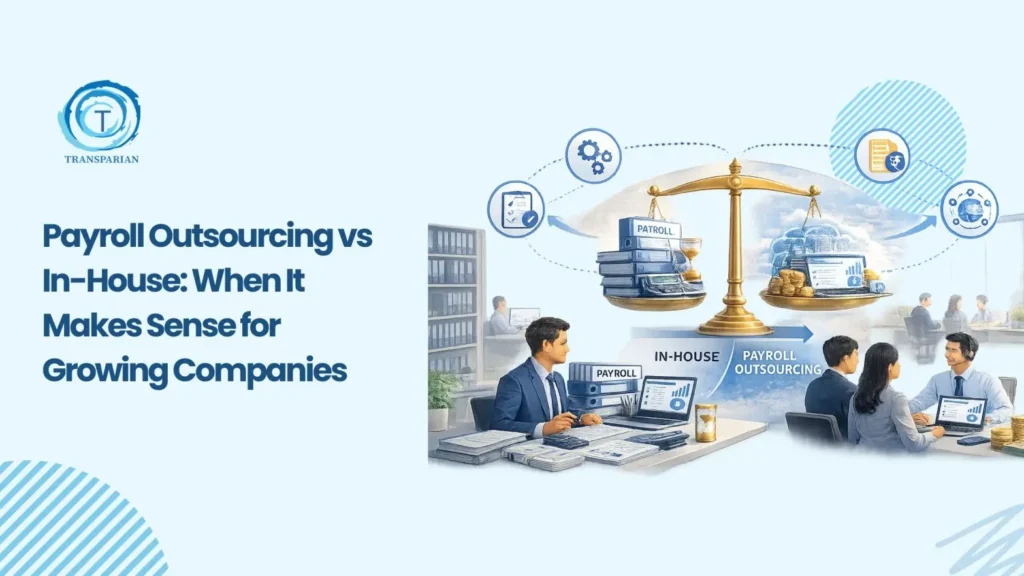
Somewhere between 50 and 150 employees, most growing companies hit the same wall: the payroll process that worked fine when everyone fit in one office starts breaking down. It’s usually not dramatic. It’s a missed PF deposit here, a TDS calculation that doesn’t quite match what the auditor expects there. By the time someone notices the pattern, the question on the table is whether to keep building payroll in-house or hand it to a payroll outsourcing partner.
There’s no clean answer that applies to every company. It depends on headcount, how many states you’re in, how messy your comp structures are, and honestly, how much your HR team can actually absorb without burning out. But the signals that point one way or the other are pretty consistent once you’ve seen a few companies go through this.
Why This Gets Harder as You Scale
Small-company payroll is simple because it has to be. A dozen people, one location, one pay structure, someone running it through a spreadsheet on the side of their actual job. That setup works right up until it doesn’t.
Growth is what breaks it. Employees spread across states, each with its own statutory compliance rules for PF, ESI, professional tax, and labour welfare fund contributions. Contractors mixed in with full-timers, taxed differently. Variable pay and bonuses that need to be calculated correctly every cycle, not just when someone remembers to double-check. The person who used to “handle payroll on the side” is now spending 20-plus hours a month on it, hours that used to go toward actual HR work.
This is usually the point where payroll outsourcing starts showing up in leadership conversations, not as a cost-cutting idea but as a way to stop the bleeding.
What Running Payroll In-House Actually Takes
It’s more than a software subscription. You need:
- Someone who understands the labour codes and keeps up as they change, not a part-time skill
- The software itself, plus whoever integrates it with your HRMS, attendance, and accounting systems
- A compliance calendar: monthly PF/ESI filings, quarterly TDS returns, annual returns, plus whatever your state adds on top
- A backup plan, because if your one payroll person is out sick during a filing deadline, someone else needs to know what to do
- Ongoing training, because tax slabs, PF wage ceilings, and labour law provisions don’t sit still
None of this is impossible. Plenty of companies run it well. But it takes real, sustained attention, and the cost of getting it wrong isn’t abstract, it’s penalties, and it’s employees who stop trusting that their paycheck will be right.
What Outsourcing Actually Solves
A payroll outsourcing partner takes the calculation, filing, and compliance work off your desk, usually for a per-employee or flat monthly fee. The real value isn’t “someone else does the math” it’s that the risk and the specialist knowledge move off your plate too.
A few things tend to change once companies make the switch. Compliance stops being your problem to track, when a state revises its professional tax slabs or a labour code gets amended, that’s the partner’s job to catch, not something your internal team finds out about after the deadline’s passed. The cost also gets more predictable, and often lower, at mid-scale: a full-time payroll hire plus software plus the occasional expensive mistake usually adds up to more than an outsourced arrangement costs per employee, especially somewhere in the 50-to-500 headcount range, before an internal team’s economics really kick in.
There’s also the simple fact that your HR people stop doing payroll math and start doing HR. Payroll processing is necessary. It’s not what your HR team should be spending most of its week on. And if you’re expanding moving into a new state, or needing employer of record support to hire somewhere you don’t have a legal entity yet, a partner that’s already set up there saves you months.
When In-House Still Makes Sense
Outsourcing isn’t automatically the right call for every growing company, and it’s worth saying that plainly. In-house tends to hold up better when you’re large enough that the per-employee cost of an internal team already beats outsourcing fees. It also holds up when your comp structures are so customized that handing them off would be more disruptive than helpful, or when data residency and confidentiality requirements make a third party a hard sell. If you’ve already built a mature payroll function that’s working fine, ripping it out for the sake of switching is a solution looking for a problem.
The real test isn’t “is outsourcing cheaper” on a spreadsheet. It’s whether your current setup is keeping up with compliance and leaving your HR team room to do anything else. If yes, there’s no rush. If no, that’s your answer.
The Middle Ground Most Companies Actually Land On
Few companies make this a clean either/or choice. It’s common to keep policy decisions, how bonuses work, how leave encashment is structured in-house, while handing the processing and filing to a specialist. You keep control over the decisions that matter and offload the operational grind that carries the most risk if it’s mishandled.
This tends to be the sweet spot for companies somewhere between 50 and 300 employees: too big for a spreadsheet, not big enough that a large internal payroll department pencils out.
Questions Worth Asking Before You Decide
How many hours a month is payroll actually eating, and what’s that time really costing you? How many deadlines got missed or handled late this past year? If a labour department audit happened tomorrow, would your current process hold up? Does your setup support expansion into new states or countries without a rebuild? Is HR spending more time on payroll mechanics than on people?
If those answers make you wince a little, it’s worth a serious look. If payroll is running fine with minimal drama, there’s no urgency here.
Making the Switch Without Breaking Anything
Companies that transition well tend to audit their payroll data before handover, so discrepancies surface before they become someone else’s problem. They avoid switching mid-quarter, right before a high-stakes filing period. And they keep one internal person who knows the company’s policies well enough to be the point of contact. Most of the friction shows up in rushed transitions with no clean data handover, not in outsourcing itself.
Where This Leaves You
There’s no headcount where outsourcing suddenly becomes the obviously correct move. It comes down to how much complexity has piled up in your payroll, how confident you actually are in your compliance posture, and how much internal bandwidth you want to keep spending on it. For a lot of growing companies, the shift isn’t about in-house payroll failing, it’s that outsourcing frees up time and cuts risk for less than it costs to keep scaling an internal team.
If you’re weighing this for your own company, Transparian’s payroll services team can walk through your compliance exposure and cost structure and map out what a transition full or hybrid would look like for your headcount and geography.
FAQ’s
Payroll outsourcing is when a company hands its payroll calculation, filing, and statutory compliance work to a third-party specialist rather than managing it with an internal team. The provider typically handles salary processing, PF and ESI contributions, TDS deductions, and the filings tied to each of these. Companies usually pay per employee or a flat monthly fee. The employer retains control over compensation policy and decisions; the provider handles the operational and compliance execution.
There’s no fixed threshold, but the shift tends to make sense once a company crosses roughly 50 employees or starts operating across multiple states. Below that, a spreadsheet or basic software often still works. Above it, the compliance surface area multiple state-specific PF, ESI, and professional tax rules, usually outpaces what one internal person can reliably track. Companies in the 50 to 300 employee range most often find outsourcing the more practical option.
For most companies in the small-to-mid size range, yes, a full-time payroll hire plus software licensing plus the cost of occasional compliance errors often exceeds what an outsourced arrangement costs per employee. The math flips at large scale, where an internal team’s per-employee cost can drop below outsourcing fees. The more reliable comparison isn’t cost alone; it’s cost combined with compliance risk and the HR time payroll consumes.
The main risks are compliance gaps and single points of failure. As headcount and geography grow, tracking PF, ESI, professional tax, and labour code changes across states becomes harder for one internal team to keep current. A missed filing or incorrect TDS calculation can lead to penalties, and if the one person who understands the process is unavailable during a deadline, there’s often no backup. These risks tend to grow faster than headcount does.
Before switching, it’s worth auditing existing payroll data for discrepancies, confirming the provider’s experience with the company’s specific states and industry, and clarifying what stays in-house versus what transfers. Timing matters too, transitions are smoother when they don’t overlap with a high-stakes filing period, such as year-end or a quarterly TDS deadline. Keeping one internal point of contact who understands company policy helps the handover go cleanly.