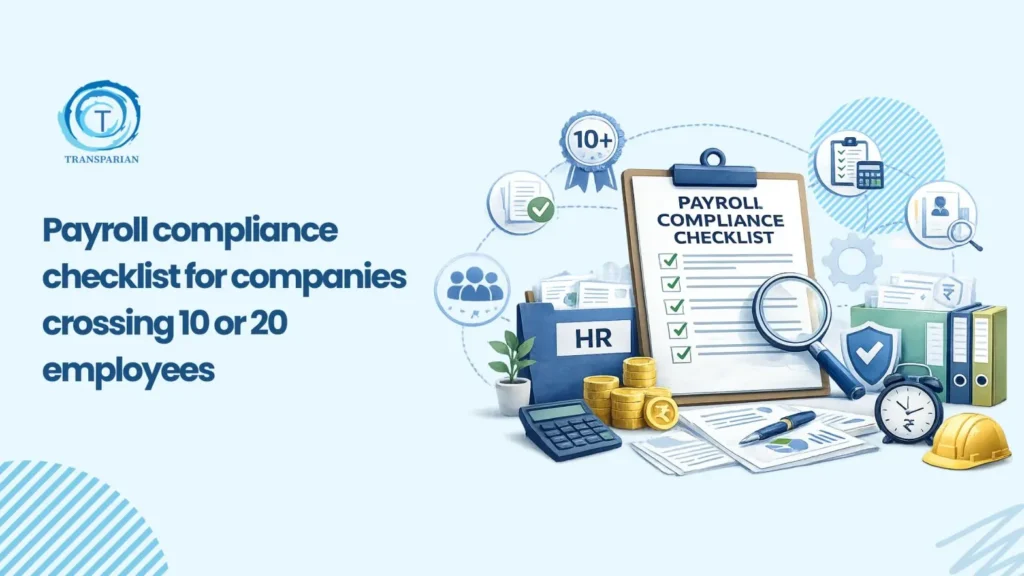
Most small companies run payroll on a spreadsheet and a bank transfer until the day they hire their tenth or twentieth person. Then the rules change. New registrations become mandatory, new benefits become legal entitlements, and filings that never applied before start landing on your calendar every month.
This payroll compliance checklist covers what changes at 10 employees, what changes at 20, and what to set up before you reach either number. Thresholds and wage limits are revised from time to time, and the four Labour Codes are still being rolled out state by state, so confirm current figures for your state before acting.
Why 10 and 20 Are the Numbers That Matter
Indian labour and social security laws are written around headcount. Cross a threshold and an Act that ignored you yesterday now applies to you. The two numbers that trigger the most obligations are 10 and 20.
| Obligation | Typical trigger | What it means for you |
|---|---|---|
| ESI registration | 10 or more employees (20 in some states) | Cover employees earning up to ₹21,000 a month |
| Payment of Gratuity Act | 10 or more employees | Gratuity after five years of service |
| Maternity Benefit Act | 10 or more employees | Paid maternity leave and related benefits |
| POSH Internal Committee | 10 or more employees | Constitute an ICC, file annual report |
| EPF registration | 20 or more employees | Cover employees with basic wage up to ₹15,000 |
| Payment of Bonus Act | 20 or more employees | Statutory bonus for eligible employees |
Counts include all employees on the rolls, so check how your state treats contract and part-time staff. A company at 9 people with two offers pending is already close.
What Changes When You Cross 10 Employees
At 10 employees, the focus shifts from basic salary processing to employee welfare and safety laws.
- Register under ESI. Once ESI applies, you deduct a share from employee wages, add the employer contribution, and deposit it every month. Employees covered under ESI get medical and cash benefits, so skipping registration creates liability, not just a penalty.
- Prepare for gratuity. The Payment of Gratuity Act applies once you have had 10 or more employees on any day in the preceding 12 months. Gratuity becomes payable after five years of continuous service, so start booking a provision now instead of facing a large payout later.
- Set up the maternity benefit process. Policies on leave duration, wage payment during leave, and crèche rules should be documented before the first request arrives.
- Constitute the POSH Internal Committee. A POSH Internal Committee is mandatory for workplaces with 10 or more employees. It needs a presiding officer, members, an external member, and an annual report. Many companies miss this one because it sits outside payroll, yet it is a frequent audit finding.
What Changes When You Cross 20 Employees
The jump to 20 brings provident fund and bonus obligations, which are the biggest recurring items on a payroll calendar.
- Complete EPF registration. EPF registration is mandatory at 20 employees. You register the establishment, obtain a code, enrol each employee with a UAN, and file a monthly return with the contribution challan. Employer and employee both contribute 12 percent of wages, with the wage ceiling applying for statutory coverage.
- Apply the Payment of Bonus Act. Eligible employees earning within the prescribed limit are entitled to a minimum bonus each year. The calculation depends on wage ceilings and the allocable surplus, so your payroll system must handle it correctly.
- Review contract labour exposure. If you use manpower agencies, check whether the Contract Labour framework applies and who carries the principal employer responsibility.
Some employers register for EPF voluntarily before 20 employees. That is allowed, and it can help with hiring, but it commits you to monthly filings from the first day.
Registrations to Complete at Any Size
Some items apply before you hit either threshold. If you have not done these, do them now.
- TAN and TDS registration. Any employer deducting tax from salary needs a TAN. You deduct TDS on salary, deposit it by the 7th of the following month, and file quarterly returns on Form 24Q.
- Professional tax registration. Professional tax registration is state-specific. Maharashtra, Karnataka, West Bengal, and Telangana, among others, require employers to register, deduct from salaries, and file returns on the state’s schedule. States such as Delhi and Rajasthan do not levy it.
- Shops and Establishments licence. Most states require this for commercial offices. It also governs working hours, weekly offs, and leave rules.
- Labour Welfare Fund. Several states require small half-yearly or annual contributions from employer and employee.
- GST and other business registrations. Not payroll items, but they sit on the same compliance calendar.
The Monthly and Annual Payroll Calendar
Registrations are the easy part. Staying on schedule is where small companies slip.
Every month
- Process salaries and issue payslips
- Deposit TDS (by the 7th) and EPF/ESI contributions (by the 15th)
- Pay professional tax and Labour Welfare Fund where applicable
- File the monthly EPF return and ESI contribution
Every quarter
- File the TDS return in Form 24Q
- Reconcile TDS deposited against deductions
Every year
- Issue Form 16 by June 15
- File annual returns under the applicable state and central Acts
- Review bonus, gratuity provision, and leave encashment liability
- File the POSH annual report
Missing a deposit date attracts interest and penalties, and some defaults also create trouble for employees trying to claim benefits later.
Documents and Records You Must Maintain
Inspectors and auditors ask for records, not explanations. Keep these in order from the first day.
- Appointment letters with a clear salary breakup
- Attendance and leave registers
- Wage registers and payslips
- Statutory challans and returns, with proof of payment
- Employee declarations for tax regime and investments
- Nomination forms for PF, ESI, and gratuity
Digital records are acceptable in most cases, but they must be retrievable. A folder structure that mirrors your compliance calendar saves hours during an inspection.
Common Mistakes Growing Companies Make
Waiting for a notice. Registrations are the employer’s responsibility. Back-dated contributions with interest cost far more than timely setup.
Splitting salary to stay under a threshold. Restructuring pay without a business reason is a risk, and the Labour Codes’ wage definition may undo the saving anyway.
Ignoring state differences. A checklist that works in Pune may fail in Bengaluru or Kolkata.
Treating payroll as an accounts task. Payroll touches HR policy, tax, and labour law. Ownership should be clear.
No backup person. If one employee knows the process and goes on leave, a filing date will be missed.
Build or Outsource: A Practical View
At 10 to 20 employees, many companies hire a payroll executive or hand the job to an accountant. That works until a rule changes, a state notification arrives, or the person resigns. Compliance knowledge is hard to hold in one head.
This is the stage where payroll compliance services or payroll outsourcing for small companies starts to make financial sense. You pay a predictable monthly fee, and a specialist team handles calculations, registrations, challans, and returns across states. Your HR lead keeps control of policy and employee communication.
If you are approaching either threshold and want the registrations and filing calendar set up correctly from the start, Transparian’s payroll services team can review your current setup, flag gaps, and take over the monthly processing.
Quick Pre-Threshold Checklist
Before you hire employee number 9 or 19, confirm that you have:
- A TAN, PAN, and active TDS filing process
- Professional tax registration in every state where you have staff
- A Shops and Establishments licence
- An ESI and EPF readiness plan, including payroll software that can handle both
- A POSH policy and a named Internal Committee
- Salary structures aligned with the Labour Codes’ wage definition
- A compliance calendar with owners and reminders
- A decision on whether to run payroll in-house or outsource
FAQ’s
ESI registration generally applies at 10 or more employees, along with the Payment of Gratuity Act, the Maternity Benefit Act, and the requirement to set up a POSH Internal Committee. Some states set a higher ESI threshold, so check the rule for your location.
EPF registration is mandatory once an establishment has 20 or more employees. Employers below that number can register voluntarily, which brings the same monthly contribution and filing duties.
The Act applies to establishments with 20 or more employees. Below that, bonus is a matter of company policy or contract unless a state-level rule says otherwise.
It depends on the specific Act and how the state defines an employee. Contract workers engaged through an agency are often counted differently from direct employees, so confirm before assuming you are below a threshold.
EPF, and ESI attract interest and penalties, and some defaults can lead to prosecution in serious cases. Missed contributions can also leave employees without benefits they are entitled to claim.
Outsourcing makes sense when you operate in more than one state, cross the EPF or ESI thresholds, or depend on a single person to run compliance. A provider of payroll compliance services covers registrations, calculations, and filings without the risk of one person leaving.