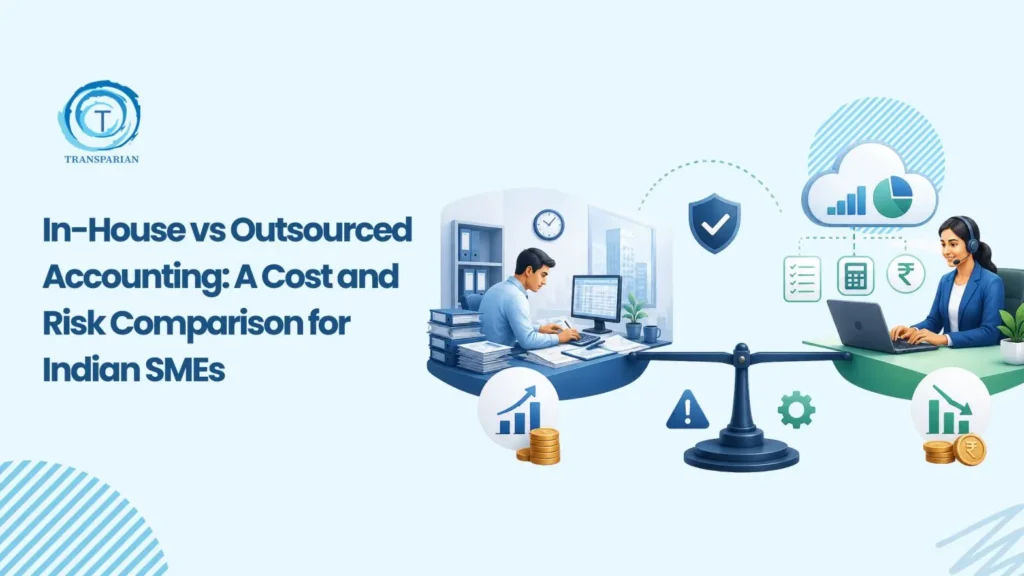
At some point, every growing business hits the same decision. The books are getting messier, GST deadlines are piling up, and the founder is still the one approving every entry. Do you hire an accountant, or hand the work to an outside firm?
Most comparisons stop at salary versus monthly fee. That misses half the picture. The real difference between in-house vs outsourced accounting shows up in hidden costs, in what happens when someone leaves, and in how exposed you are when a notice arrives.
This guide compares both options on cost and risk, so you can decide based on your own numbers and not on a hunch.
The Real Cost of In-House Accounting
An accountant’s salary is the visible part. Here is what sits underneath it:
- Cost to company (CTC): salary, plus employer PF and ESI contributions, gratuity provisions, bonus, and leave encashment
- Software: Tally, Zoho Books, or similar licences, plus GST filing tools and e-invoicing utilities
- Hiring costs: recruiter fees, interview time, and the weeks when the seat is empty
- Training: keeping up with GST amendments, TDS changes, and new compliance rules
- Backup: someone must cover leave, resignation, and sick days
- Supervision: a junior accountant needs review, and that review usually falls on the founder or a finance head
A useful formula is: true monthly cost = CTC + software + training + hiring cost spread over the year + cost of supervision time.
Most SMEs that run this calculation honestly find the number is noticeably higher than the salary they had in mind.
The Real Cost of Outsourced Accounting
The cost side of outsourced accounting for SMEs is simpler, but it has its own fine print. Most firms charge a fixed monthly fee based on transaction volume, number of GST registrations, and scope. What you should confirm before signing:
- Whether bookkeeping, compliance filings, and reporting are bundled or priced separately
- The transaction volume band, and what happens if you exceed it
- Charges for backlog cleanup, data migration, or one-time projects
- Whether software licences are included
- Who pays penalties if a filing is delayed because of the partner
When it is structured well, the fee is predictable and the scope is written down. That predictability is a big part of the appeal.
Cost Comparison at a Glance
| Cost factor | In-house accountant | Outsourced partner |
|---|---|---|
| Salary and statutory benefits | Fixed, rises with experience | Built into the monthly fee |
| Software and tools | Bought and maintained by you | Usually included or shared |
| Hiring and replacement | Recurring cost and time | None |
| Training on rule changes | Your responsibility | Partner’s responsibility |
| Cover for leave or exit | Needs a backup plan | Team handles continuity |
| Scaling up | Another hire | Scope or volume band revised |
| Founder supervision time | High for junior hires | Low once processes are set |
The pattern is consistent. In-house costs are fixed and mostly hidden. Outsourced costs are variable and mostly visible.
Risk Comparison: Where the Real Difference Lies
Cost is easy to compare. Risk is where decisions are usually won or lost.
Key person risk
When you have one in-house accountant, all your financial knowledge sits in one head. If that person resigns without notice, you lose the context behind every ledger, every vendor arrangement, and every pending reconciliation. This key person risk is the single most underestimated danger in small finance teams.
A partner with a team removes it. Work is documented, shared, and handed over within the firm.
Compliance risk
Missed GST returns and TDS deposits cost you late fees and interest, and repeated lapses can trigger notices. Staying current on amendments is a job in itself.
GST and TDS compliance services run by a specialist firm are built around deadlines and rule changes. For a lone in-house accountant, compliance competes with daily entries for attention.
Quality and error risk
A single accountant has no one checking their work. Errors in coding, GST credit claims, or reconciliations can sit undetected for months. Outsourced teams usually have a maker-checker structure, where one person records and another reviews.
Control and visibility risk
This is where in-house has a real edge. Having someone in the office means you can walk over and ask a question. With outsourcing, you depend on the partner’s responsiveness and reporting discipline. A weak partner can leave you with delayed reports and slow replies.
Data security risk
Both models carry data risk, just of different kinds. In-house, a single laptop or an unprotected shared file can be the weak link. With a partner, you are sharing bank statements, invoices, and payroll details with an outside firm, so access controls and confidentiality terms matter.
Audit readiness risk
Statutory auditors, tax authorities, and investors all expect clean, reconciled books on short notice. Audit readiness depends less on who does the work and more on whether the process runs on a fixed monthly schedule. Many SMEs find outside partners enforce that rhythm better than a stretched internal team.
Side-by-Side Risk Summary
| Risk | In-house | Outsourced |
|---|---|---|
| Key person dependency | High | Low |
| Compliance deadlines | Depends on one person | Handled by specialists |
| Error detection | Limited review | Built-in review layers |
| Day-to-day control | High | Depends on partner |
| Data security | Depends on internal practices | Depends on partner’s controls |
| Audit preparation | Often rushed | Continuous if scheduled |
Struggling to Choose Between In-House and Outsourced Accounting?
Compare costs, reduce financial risks, and get reliable accounting support for your business.
When In-House Accounting Makes Sense
Outsourcing is not always the answer. In-house works well when:
- Your transaction volume is high and constant, so a full-time person is always busy
- You need real-time, on-the-spot financial input, as in a trading business with daily cash movement
- Your processes are heavily customised, for example a specialised ERP setup
- You already have a finance head who can supervise, train, and review
At a certain scale, usually a larger SME or a mid-sized company, building an internal finance team becomes the better investment.
When Outsourcing Makes Sense
Outsourcing tends to win when:
- Your transaction volume is moderate and does not justify a full-time hire
- You operate in multiple states and each GST registration needs separate filing
- You are a startup preparing for funding and need investor-ready books
- You have lost an accountant before and felt the disruption
- The founder is still doing finance work that should be delegated
For most small and mid-sized businesses, outsourced bookkeeping and accounting services deliver professional-grade work without the fixed overhead of a full team.
The Hybrid Option Most SMEs Overlook
You do not have to pick one side entirely. A hybrid model keeps day-to-day entry with an internal executive while an outside partner handles:
- GST and TDS filings
- Monthly reconciliations
- Management reports
- Audit and due diligence support
This works well when the internal person is competent at transactions but lacks depth in compliance or analysis. The key is a clear split of who owns each task, so nothing falls between the two teams.
Five Questions to Decide
Before choosing, answer these honestly:
- What is my true monthly cost of an in-house accountant, using the formula above?
- If this person left tomorrow, how long would it take to recover?
- How many GST registrations and entities do I run, and how many are planned?
- Who currently reviews the accountant’s work?
- Is accounting something that differentiates my business, or something that simply has to be done correctly?
If your answers point to high dependency on one person, multi-state complexity, or founder time being consumed, outsourcing deserves a serious look.
Take the Next Step
If you are weighing the options, start by comparing the scope of a real engagement against your checklist. Transparian’s Outsourced Accounting Services page explains how bookkeeping, compliance, and reporting are structured for growing businesses.
Deciding between in-house and outsourced accounting?
Transparian handles bookkeeping, GST and TDS compliance, reconciliations, and monthly reporting for Indian SMEs, so you can compare a real scope against your in-house costs. See our Outsourced Accounting Services.
FAQ’s
It often is once you count the full cost of an in-house hire. That includes salary, employer PF and ESI, gratuity and bonus provisions, software, training, and replacement hiring. Outsourced accounting converts these into a predictable monthly fee. The saving depends on your transaction volume and scope, so compare the fee against the true monthly cost of an employee, not salary alone.
Hidden costs include employer statutory contributions, software licences, recruiter fees, training on GST and TDS changes, and the cost of covering leave or resignation. There is also the founder’s time spent supervising and reviewing work. These are easy to overlook when you only compare a salary against a service fee.
Key person risk is the exposure created when one employee holds most of your financial knowledge. If that person leaves suddenly, you lose context on ledgers, vendors, and pending reconciliations. It is common in small finance teams with a single accountant. Outsourced teams reduce it because work is documented and shared within the firm.
Both can work, but specialist partners are usually stronger on deadlines and rule changes because compliance is their core job. A lone in-house accountant has to balance daily entries with GST, TDS, and ROC obligations. If compliance slips often in your business, outsourcing or a hybrid model is worth considering.
Most use a maker-checker structure, where one person records transactions and another reviews them. They also follow standard monthly checklists for reconciliations and compliance. This catches coding mistakes and GST credit errors earlier than a single in-house accountant working without review.
Common triggers are missed or late filings, books running weeks behind, expansion into new states, a funding round on the horizon, or the founder spending time on finance tasks. Moving before a problem forces the issue keeps the handover simple, because the records are still clean.