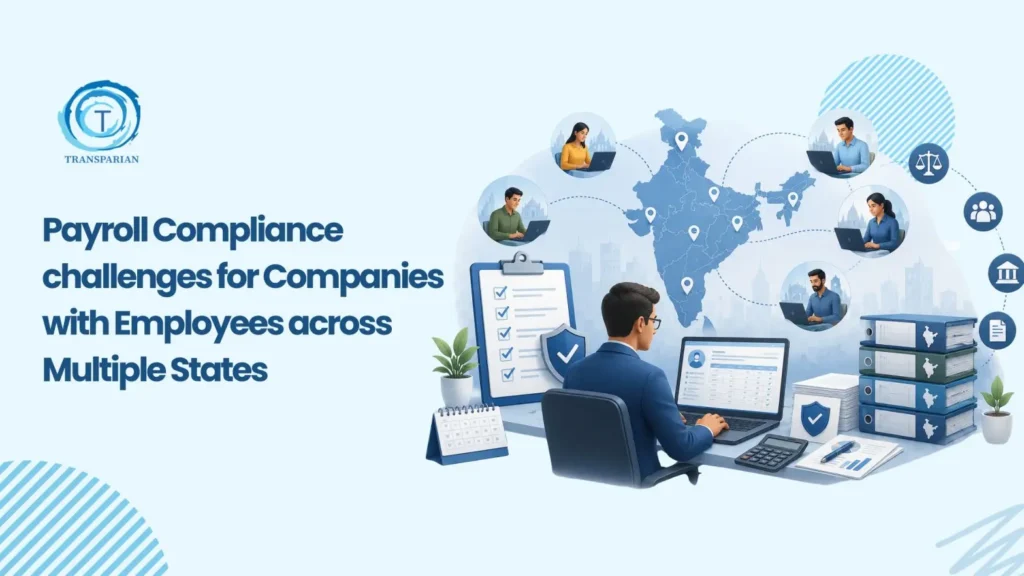
A company with 40 employees in Pune can run payroll with one set of rules. Add a sales team in Bengaluru, a support office in Kolkata and a few remote hires in Hyderabad, and the same payroll now follows four sets of rules. Salaries still need to go out on the same date, but the deductions, registrations and filings behind them no longer match.
Multi-state payroll compliance is one of the most common reasons growing companies end up with notices, back payments and unhappy employees. This post covers where the problems come from, how they show up, and how to bring them under control.
Why Multi-State Payroll Gets Complicated
India’s labour and tax framework is part central, part state. Income tax, EPF and the Labour Codes sit at the centre. Professional tax, minimum wages, the Labour Welfare Fund, and Shops and Establishments rules are decided by each state.
That means a single employee’s payslip depends on where they sit, not where your head office is. Two people with the same CTC can have different take-home pay because of the state they work in.
The central rules also get applied differently on the ground. The four Labour Codes are being rolled out in phases, and states are notifying their own rules at different speeds. Some provisions are live in one state while another is still waiting for its rules.
The Biggest Multi-State Payroll Challenges
Professional Tax Differs in Almost Every State
Professional tax is the most visible difference. Each state sets its own slabs, rates, due dates and registration process, with the annual amount per employee capped by law at ₹2,500. Some states do not levy it at all.
Registration is needed in each state where you have staff
Slabs and thresholds vary by state, and some vary by gender
Filing can be monthly, quarterly or annual, depending on the state
Remote employees raise the question of which state’s rule applies
A company that registers only in its home state often finds out years later that it owes back professional tax elsewhere, with interest.
Minimum Wages Vary by State, Zone and Skill
Minimum wages are not one national figure. States notify rates by zone, industry and skill category, and revise them on their own schedule, often twice a year with a dearness allowance component.
If your pay structure is built around a basic salary that falls close to the minimum in a lower-cost state, an upward revision can put you out of compliance overnight. Payroll teams need a way to track each revision and update salary components before the next cycle.
Labour Welfare Fund and Other State Levies
The Labour Welfare Fund is a small contribution from employer and employee, but it comes with its own rules. States differ on whether it applies, how much is deducted, and whether it is paid monthly, half-yearly or yearly.
Because the amounts are small, this one is easy to forget. The penalties for missing it are not small.
Shops and Establishments Rules Change With the State
Working hours, overtime, weekly offs, leave entitlements and holiday lists come from the state’s Shops and Establishments Act or its equivalent. A leave policy written for Maharashtra may not meet the minimum in Karnataka or Tamil Nadu.
This affects payroll directly. Leave encashment, overtime pay and holiday wages all feed into the monthly calculation, so a policy gap becomes a payroll error.
ESI and EPF Coverage Gets Harder to Track
EPF and ESI compliance is mostly a central matter, but multi-state employers still run into trouble. ESI coverage depends on whether the area is notified, and some states apply different thresholds. Employees move between locations, cross wage limits, or join from a previous employer with an existing UAN.
You also need to check that each location is registered correctly, that contributions are deposited against the right code, and that new joiners are linked on time.
Different Registers, Returns and Due Dates
Each state brings its own forms, registers and filing portals. One compliance calendar quickly turns into several.
| Area | What varies by state |
|---|---|
| Professional tax | Slabs, due dates, return format |
| Labour Welfare Fund | Applicability, rate, frequency |
| Minimum wages | Rates, zones, revision cycle |
| Shops and Establishments | Registration, leave, working hours |
| Registers and returns | Format, frequency, filing portal |
7. Salary Structures That Do Not Fit Every State
A single salary template looks tidy but often hides risk. Allowances that are exempt or treated one way in one state can attract a levy in another. The Labour Codes’ wage definition, which expects basic pay and certain components to make up at least 50 percent of total remuneration, adds another layer when you operate across states with different implementation timelines.
8. Remote and Hybrid Employees
Remote work has made location harder to pin down. An employee who works from home in another state may trigger professional tax, Labour Welfare Fund or Shops Act obligations there, even if you have no office in that state.
Payroll needs a clear record of each employee’s work location, and a process to update it when they move.
Facing Payroll Compliance Challenges Across Multiple States?
Manage multi-state payroll, tax deductions, and statutory filings with expert support.
What These Challenges Cost When Handled Poorly
Most multi-state payroll errors are not dramatic. They are small and quiet, and they add up.
- Interest and penalties on late or missed deposits
- Back payments for registrations that should have been done earlier
- Employee grievances when deductions look wrong or a benefit is missing
- Audit findings that pull senior time away from other work
- Reputation risk if an employee escalates to a labour authority
Compliance gaps also affect hiring. Candidates notice when payslips are inconsistent or when statutory benefits are delayed.
How to Bring Multi-State Payroll Under Control
You do not need a large team to fix this. You need a process that treats each state as a separate set of rules.
- Build a state-wise compliance matrix. For each state, list registrations, deductions, due dates, forms and the person responsible.
- Keep an accurate employee location master. Record the actual work location, not just the office the employee reports to.
- Set up state-specific salary components. Configure professional tax, Labour Welfare Fund and minimum wage checks inside your payroll system rather than handling them outside it.
- Track notifications. Subscribe to updates on minimum wage revisions, professional tax changes and Labour Code rules for every state you operate in.
- Run a monthly reconciliation. Match payroll deductions with challans and returns before month-end closes.
- Document a backup process. At least two people should know how each state’s filings work.
- Review once a year. Check registrations, salary structures and policies against the latest state rules before the new financial year begins.
When to Bring in Outside Support
Doing this well in-house needs a payroll lead who follows rule changes in several states and a system that can handle state-wise logic. Many mid-sized companies reach a point where the compliance workload grows faster than the team.
That is the moment to look at multi-state payroll services or broader payroll compliance services. A specialist provider maintains the state registrations, applies the right deductions, files returns on time and tracks rule changes, so your HR team can focus on people decisions instead of due dates.
If you have employees in two or more states and are unsure whether every registration and filing is in place, Transparian’s payroll services team can audit your current setup, close the gaps and manage payroll across locations.
Key Takeaways
- Payroll obligations depend on where each employee works, not where your head office is
- Professional tax, minimum wages, Labour Welfare Fund and Shops Act rules vary by state
- Labour Code rules are being notified at different speeds, so check each state’s current position
- A compliance matrix, a clean location master and a monthly reconciliation prevent most errors
- Outside support makes sense once state count and headcount outgrow one person’s capacity
FAQ’s
It is the process of running payroll while meeting the registration, deduction and filing rules of every state where you have employees. Central laws such as income tax and EPF apply everywhere. Professional tax, minimum wages, Labour Welfare Fund and Shops and Establishments rules are set by each state. A company with staff in several states therefore follows several rulebooks at once.
In states that levy it, yes. Registration, slabs, rates and due dates are set by each state, and a few states do not charge professional tax at all. Check the rule for each location where you have staff, including remote employees working from home in another state. Skipping a registration can lead to back payments with interest.
Their work location can trigger professional tax, Labour Welfare Fund or Shops Act obligations in that state, even if you have no office there. Payroll needs an accurate record of where each employee actually works. Update it whenever someone relocates, so deductions and filings follow the right state’s rules. Without this, errors tend to surface only during an audit.
The Codes change wage definitions and social security rules, and states are notifying their own rules at different speeds. The same provision may be live in one state and pending in another. Employers should review salary structures against the current position in each state instead of assuming one national timeline.
Common outcomes include interest and penalties on late deposits, back payments for missed registrations, and employee complaints about incorrect deductions. Audits and labour authority inquiries can follow, and they take senior time away from other work.
Consider outside support when you operate in two or more states, add locations regularly, or rely on one person to track state rules. A provider of payroll compliance services maintains registrations, applies state-wise deductions and files returns on time. It also tracks rule changes across states, which lowers risk and frees up HR time.