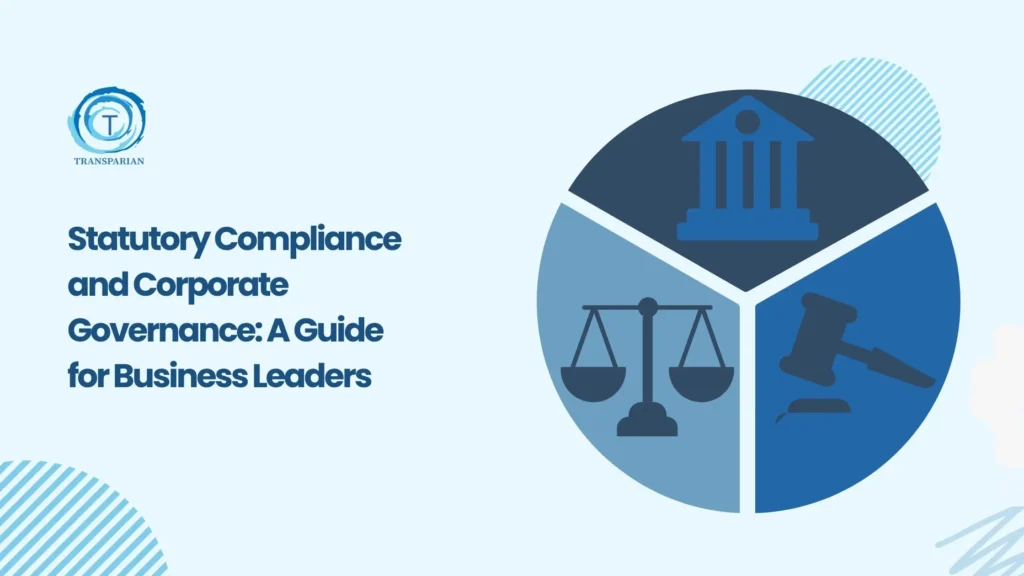
Statutory compliance and corporate governance have progressed to operational checkboxes in 2025, to be a strategic requirement of any Indian business, in particular the ones conducting operations in more than one state or expanding at a high rate. The MCA, SEBI, RBI, and EPFO have become stricter in their regulation, increased the disclosure standards, digitalized filings and came up with new accountability standards. The recent updates on Companies Act, increased SEBI attention to listed organizations, and the increased significance of ESG-consistent reporting have compelled organizations to reconsider their approach to risk management, transparency, and ethical leadership.
For CHROs, CFOs, Compliance Heads, and business founders, this shift demands a governance approach that goes far beyond traditional regulatory compliance. Credibility, investor confidence and long-term growth today all rely on the ability of leaders to develop systems of compliance, ethics, accuracy in reporting and reduction of risks.
This guide will help you understand the new compliance landscape, decode the evolving governance frameworks, and provide the latest best practices so you can safeguard your organization and strengthen stakeholder trust in 2025 and beyond.
Understanding Statutory Compliance in India
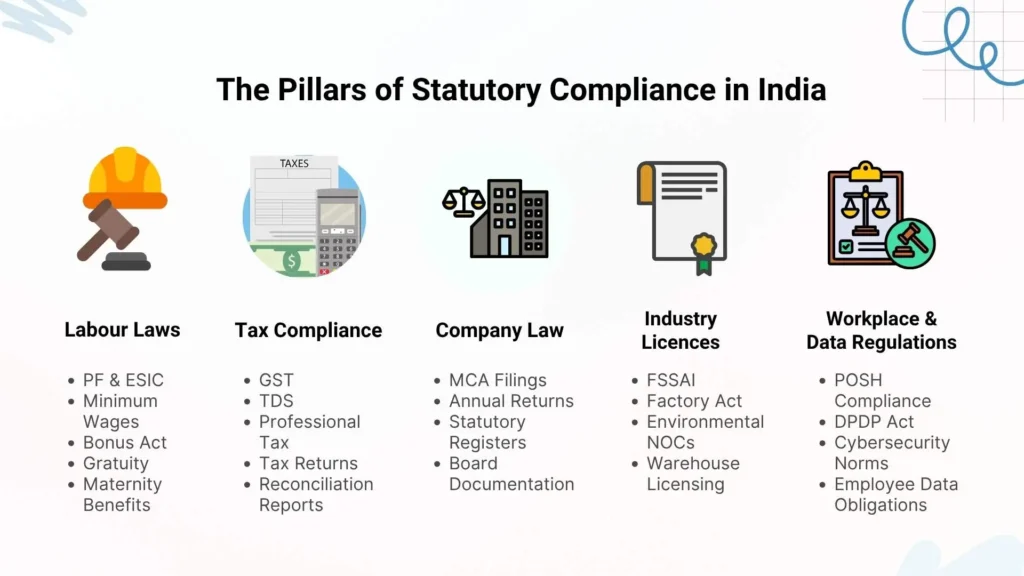
Statutory compliance refers to an organization’s obligation to operate within the legal frameworks defined by central, state, and industry-specific regulators. In India, compliance obligations span multiple domains, including:
1. Labour & Employment Laws
From PF & ESIC compliance, gratuity, bonus, minimum wages, and maternity benefits to state-specific labour rules, businesses must ensure accurate filings, payment timelines, employee data maintenance, and benefits alignment as part of their overall labour law compliance framework.
2. Taxation & Finance
TDS, GST compliance, PT filing, corporate tax returns, and reconciliation reports all contribute to the tax-related compliance ecosystem.
3. Company Law Compliance
Includes filing annual returns, maintaining registers, recording board meetings, updating directorship details, and managing digital filings on the MCA portal.
4. Regulatory & Industry-Specific Compliance
FSSAI licensing, environmental clearances, POSH compliance, factory licences, warehousing compliance, and industry permits also fall under statutory essentials.
Recent Developments:
- Digital compliance reporting through MCA’s V3 portal, including e-forms and tighter validation checks.
- Labour code updates, pushing businesses toward centralized employee data, standardised definitions, and unified returns.
- Increased penalties for late filing, incorrect reporting, and non-submission of employee contributions.
Why Non-Compliance Is Now Riskier Than Ever
Failure to meet statutory obligations can lead to:
- Costly regulatory penalties
- Business disruptions or licence cancellations
- Loss of investor trust
- Damage to corporate reputation
- Increased litigation and employee disputes
For multi-location companies, coordinating filings across states without a PAN India compliance agency or digital management system amplifies the risk further.
What Corporate Governance Really Means Today
Corporate governance, traditionally viewed as the domain of boards and shareholders, has expanded dramatically. In the modern business landscape, governance is no longer limited to oversight, it reflects a company’s integrity, transparency, and capability to sustain ethical and responsible growth.
Modern Corporate Governance Now Includes:
- ESG (Environmental, Social, Governance) principles
- Risk management frameworks across operations, cybersecurity, people, and finance
- Ethical leadership and zero-tolerance policies
- Code of conduct and conflict of interest policies
- Transparent reporting and disclosures
- Stakeholder accountability, including employees, vendors, investors, and customers
Governance Frameworks Gaining Adoption in India
- OECD Governance Guidelines
- SEBI’s LODR framework
- MCA’s Corporate Governance Recommendations
- Integrated Reporting (IR) models
- ESG and Business Responsibility & Sustainability Reporting (BRSR)
Case Insight
Following SEBI’s 2024 focus on enhanced audit trail requirements, a major Indian conglomerate revamped its internal reporting. By integrating automated compliance tracking and governance dashboards, the company reduced reporting errors by 60% and significantly improved investor confidence.
Interconnection Between Governance and Compliance
Governance and compliance are not separate systems, they are deeply interconnected pillars that influence organizational integrity and long-term sustainability.
How Compliance Strengthens Governance
- Accurate statutory records support reliable board reporting
- Compliance risk assessment feeds into enterprise risk management
- Audit trails strengthen accountability
- Standardised processes reduce governance gaps
- Transparency in operations enhances stakeholder trust
How Governance Supports Compliance
- Governance frameworks define the code of conduct, avoiding conflict of interest scenarios
- Leadership accountability ensures that compliance receives the budget, tools, and manpower it needs
- Board reviews lead to improved internal controls and preventive policies
Example: Tech-Driven Compliance for Better Governance
Compliance automation tools now generate real-time dashboards that integrate:
- Filing status across states
- Upcoming deadlines
- Risk scoring
- Department-wise compliance mapping
- Automated alerts
This visibility directly supports board discussions, governance oversight, and risk management planning.
Latest Industry Insights for 2025
Key compliance and governance trends shaping Indian businesses this year include:
- RegTech & AI: Advanced digital tools automate compliance, track deadlines, and instantly flag inconsistencies or risks, reducing manual effort.
- ESG Integration: Corporate governance frameworks are converging with sustainability mandates, emphasizing climate impact, diversity, and anti-corruption.
- Recent Regulatory Updates: Digital Personal Data Protection Bill, new labor codes, board diversity directives, and revised SEBI governance listing obligations have all come into effect.
- Board Priorities: Diversity, data privacy, and ethical leadership now top the agenda, going beyond financial compliance to address reputational and sustainability risks.
Best Practices for Business Leaders
To future-proof your organization, leaders need a systematic approach to both governance and compliance. Here are actionable strategies:
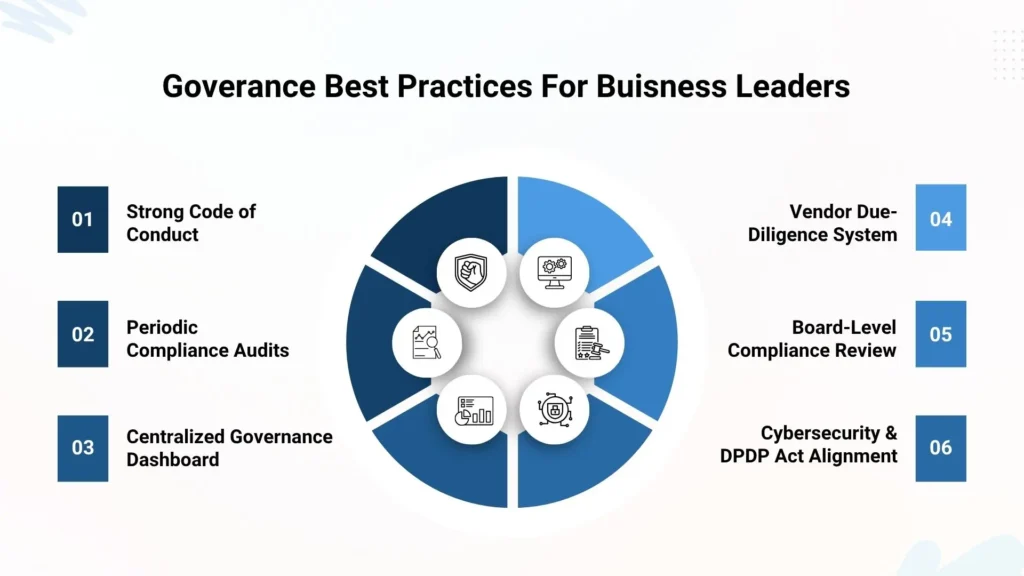
1. Build a Compliance-Driven Culture
- Train employees regularly on policies
- Reinforce the company code of conduct
- Encourage transparent reporting
- Set up mechanisms to report conflict of interest issues
2. Conduct Regular Compliance Audits
Internal and external audits help:
- Identify gaps
- Prevent penalties
- Ensure regulatory alignment
- Strengthen governance data
Integrate audit results into board discussions.
3. Use Digital Dashboards & Automation Tools
A single platform should enable:
- Compliance reporting
- Deadline reminders
- Document storage
- Multi-state compliance visibility
- Risk scoring
- Vendor compliance tracking
Such dashboards empower CHROs, CFOs, and governance leaders to make timely decisions.
4. Strengthen Vendor & Data Compliance
With the DPDP Act and global privacy expectations, leaders must ensure:
- Vendor due-diligence
- Data protection frameworks
- Cybersecurity policies
- Third-party compliance documentation checklist availability
5. Choose the Right Compliance Partners
A reliable compliance services provider or PAN India compliance agency can simplify:
- Labour law adherence
- MCA filings
- PF & ESIC compliance
- Regulatory documentation
- Multi-location compliance coordination
Outsourcing helps reduce internal workload and improve accuracy.
Conclusion
As India enters a new era of regulatory precision and governance excellence, business leaders must embrace compliance-driven governance as a strategic capability, one that enhances trust, reduces risk, and strengthens long-term brand credibility. Companies that proactively adopt digital compliance systems, ethical leadership principles, and board-aligned governance models will lead the next decade of sustainable growth.
FAQ’s
Statutory compliance refers to a company’s legal responsibility to follow labour laws, tax rules, company law requirements, and sector-specific regulations mandated by Indian authorities.
Corporate governance helps organizations build transparency, ethical leadership, risk controls, and investor trust key priorities in India’s evolving regulatory environment.
Compliance provides the legal foundation and reporting accuracy needed for strong governance, while governance defines the oversight, ethics, and monitoring framework to sustain compliance.
Key areas include labour laws, PF & ESIC compliance, GST/TDS, MCA filings, POSH, data protection, industry licences, and state-specific operational permits.
Non-compliance may lead to monetary penalties, legal actions, licence suspension, reputational loss, investor distrust, and operational disruptions.
By setting a clear code of conduct, training teams, enabling transparent reporting, and reinforcing conflict-of-interest and ethical behaviour norms.