
Labour laws in India balance employee welfare with business sustainability. Yet for many employers, especially growing businesses, startups, and multi-location organizations, compliance often feels complex, fragmented, and risky. Non-compliance can lead to penalties, inspections, litigation, and reputational damage. This makes it critical for employers to understand both the legal framework and the operational realities of compliance.
This guide explains statutory compliance requirements in India, clarifies employers’ obligations, highlights commonly overlooked areas, and answers the most frequently asked questions businesses face when navigating labour laws.
What Is Labour Law Compliance in India?
Labour law compliance refers to an employer’s legal responsibility to adhere to central and state labour legislations governing wages, working conditions, social security, employee welfare, and industrial relations.
These laws apply across the employee lifecycle from hiring and payroll to termination and post-employment records, and vary depending on:
- Number of employees
- Nature of business
- Industry classification
- State-specific rules
For employers operating in multiple locations, compliance becomes more complex because of differing state rules. This makes PAN India compliance agency support increasingly relevant.
Why Labour Law Compliance Matters for Employers
Labour compliance is not just about avoiding penalties. It directly impacts:
- Business continuity
- Investor confidence
- Employer branding
- Employee trust and retention
- Operational scalability
Failure to meet statutory compliance requirements can result in fines, prosecution, license cancellation, or restrictions on business operations. Repeated non-compliance signals poor governance and can affect funding and partnerships.
Core Labour Laws Every Employer Must Know
Most employers are aware of the major acts, but understanding their practical application is where confusion often begins.
1. Minimum Wages Act
Mandates payment of wages as notified by state governments based on skill level, industry, and geography. Employers often miss:
- Frequent wage rate revisions
- Special allowances
- Category-wise classification errors
2. Payment of Wages Act
Regulates wage disbursement timelines and permissible deductions. Delays or undocumented deductions often trigger employee complaints.
3. Employees’ Provident Funds and Miscellaneous Provisions Act
Applies to establishments with 20 or more employees. Compliance includes:
- Timely monthly contributions
- Correct wage ceiling application
- Accurate UAN linking
4. Employees’ State Insurance Act
Provides medical and social security benefits to eligible employees. Errors usually arise in wage threshold calculations and employee eligibility mapping.
5. Payment of Bonus Act
Applicable to establishments with 20 or more employees. Employers often miss:
- Eligibility thresholds
- Allocable surplus calculations
- Set-on and set-off rules
6. Payment of Gratuity Act
Gratuity liability accrues even if payment is made later. Many employers fail to provision correctly or issue formal gratuity notices.
Labour Codes and Their Compliance Impact
India has consolidated 29 labour laws into four labour codes:
- Code on Wages
- Industrial Relations Code
- Occupational Safety, Health, and Working Conditions Code
- Social Security Code
While full implementation varies by state, employers must prepare for:
- Uniform wage definitions
- Expanded social security coverage
- Increased digital filings
- Enhanced compliance transparency
Understanding these changes early helps businesses future-proof their compliance strategy.
State-Wise Complexity: The Hidden Compliance Challenge
One of the most misunderstood aspects of compliance is state-specific variation. Even when central laws apply, states issue:
- Separate rules
- Local notifications
- Compliance formats
- Filing timelines
For companies operating across India, managing registrations, returns, and inspections without centralized oversight often leads to inconsistencies. Many businesses rely on compliance services from a PAN India compliance agency to maintain uniformity.
Registers, Returns, and Documentation Employers Miss
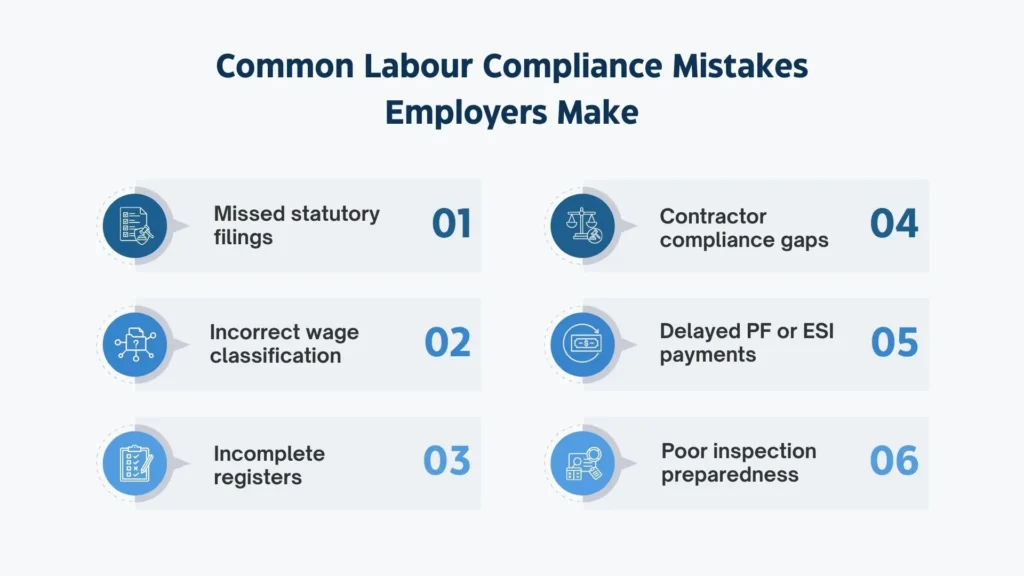
Most penalties occur not because of non-payment, but because of missing documentation. Commonly overlooked records include:
- Attendance registers
- Leave registers
- Wage and deduction registers
- Overtime records
- Contract labour documentation
Digital maintenance is allowed in many states, but format compliance and audit readiness remain essential for statutory compliance.
Contract Labour and Vendor Compliance Risks
Employers engaging contractors remain legally responsible for vendors’ compliance failures. Frequently missed areas include:
- Contractor license verification
- PF & ESI contribution tracking
- Wage parity checks
- Labour welfare fund applicability
Non-compliance by contractors can expose the principal employer to penalties. Vendor audits are a crucial part of labour law compliance.
Inspections, Audits, and Notices: How Employers Should Respond
Labour inspections have shifted toward risk-based, digital mechanisms, but surprise audits still occur. Employers should:
- Maintain updated records
- Assign a compliance SPOC
- Respond to notices within timelines
- Avoid informal or verbal submissions
Engaging professional compliance services ensures responses are legally sound and documentation aligns with regulatory expectations.
Employee Lifecycle Compliance: Beyond Payroll
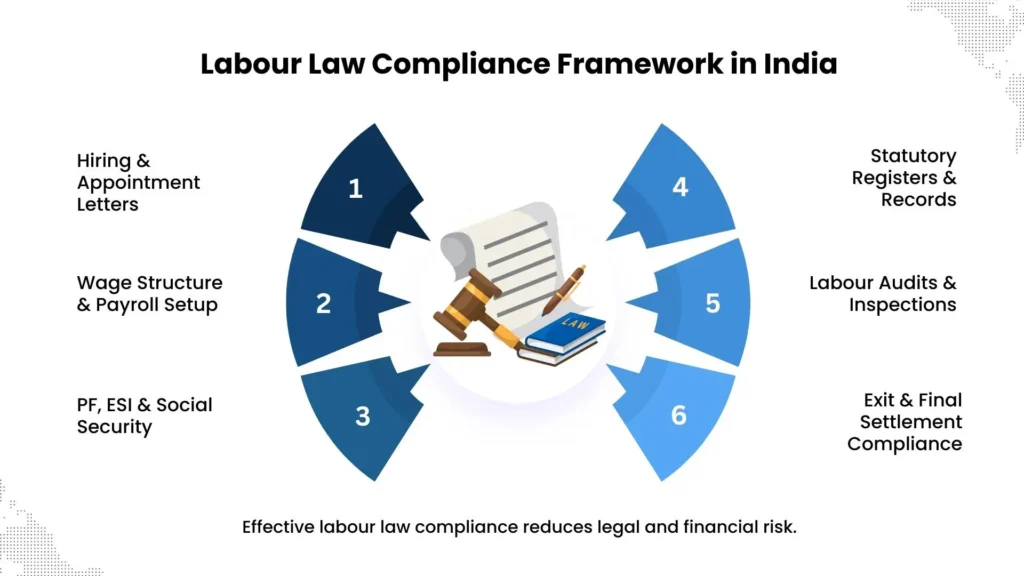
Many employers focus only on payroll compliance, but labour laws apply at every stage:
Hiring
- Appointment letters
- Wage structure compliance
- Statutory disclosures
During Employment
- Working hours and overtime
- Leave entitlements
- Social security deductions
Exit and Termination
- Final settlement timelines
- Gratuity eligibility
- Experience and service certificates
Missing any of these can lead to employee disputes and claims.
Penalties and Consequences of Non-Compliance
Non-compliance can attract:
- Monetary fines
- Imprisonment (for serious violations)
- Backdated statutory dues
- Interest and damages
- Blacklisting or license suspension
Under new labour codes, penalties may increase, making proactive compliance more critical than ever.
When Should Employers Consider Professional Compliance Support?
Businesses often underestimate compliance until they face:
- Multi-state expansion
- Rapid workforce growth
- Foreign investment or due diligence
- Employee complaints or inspections
At this stage, partnering with a PAN India compliance agency offering end-to-end compliance services helps employers:
- Centralize filings
- Reduce legal exposure
- Stay updated with law changes
- Focus on core business operations
Building a Sustainable Labour Compliance Framework
Effective labour law compliance is not reactive; it is systematic. Employers who succeed typically:
- Maintain centralized compliance calendars
- Conduct internal audits
- Digitize documentation
- Track state-wise changes
- Seek expert compliance services support
This structured approach not only minimizes legal risk but also strengthens governance and employee confidence.
FAQ’s
Yes. Statutory compliance applies to all employers based on employee count, business activity, and state regulations, regardless of company size or industry.
Non-compliance can result in penalties, interest, legal notices, inspections, prosecution, and reputational damage for the organization.
Yes. While central laws apply nationwide, states issue their own rules, notifications, wage rates, and filing formats, making labour law compliance more complex for multi-state employers.
Key laws include Minimum Wages, Payment of Wages, Provident Fund, ESI, Bonus, Gratuity, and Contract Labour regulations, depending on workforce size and nature of work.
Inspections may be routine, complaint-based, or risk-based. Employers should always keep records updated and inspection-ready.
Employers must maintain attendance, wage, leave, overtime, deduction, and statutory registers, either digitally or physically as per state rules.