

India runs significantly on contract labour. Across manufacturing, IT, retail, logistics, hospitality, and construction, a substantial share of the workforce is not directly employed by the company where they work, they’re placed there through contractors, manpower agencies, or staffing firms.
The Contract Labour (Regulation & Abolition) Act, 1970, the CLRA Act is the central law governing this arrangement. It sets out what both companies and contractors must do: how to register, what licenses are required, what welfare facilities contract workers are entitled to, and in some cases, whether contract labour can be used for a particular type of work at all.
This guide explains in plain language what the law requires, what it means for statutory compliance in practice, and where companies typically get it wrong.
Who Does the CLRA Act Apply To?
The Act applies to two parties: the company engaging contract workers (called the principal employer) and the contractor supplying them.
For principal employers: the Act applies when 20 or more contract workers are employed on any day in the preceding twelve months. This is a combined count across all contractors working at your establishment.
For contractors: the Act applies when they employ 20 or more workers in total. A contractor with a workforce spread across multiple client sites counts all workers together to determine whether they cross this threshold.
If your headcount sits below 20, the Act technically doesn’t apply but it’s worth tracking carefully. Headcounts fluctuate, and crossing the threshold without realising it is one of the more common compliance gaps.
Key Definitions Worth Understanding
The Act uses three terms with specific legal weight:
Principal employer — the company or individual in whose premises the contract work is carried out. Legal obligations under the Act fall on the premises-holder, not just the business that arranged the staffing.
Contractor — the entity that recruits, employs, and provides workers to the principal employer. This includes manpower agencies, staffing firms, and individual labour suppliers. The contractor is the legal employer of the workers they supply.
Contract labour — workers hired in connection with the work of an establishment through a contractor. Employed by the contractor, but working for the principal employer.
These three definitions matter because the Act distributes obligations between principal employer and contractor differently depending on what’s being regulated and when the contractor fails, some of those obligations shift back to the principal employer.
Registration: What Principal Employers Must Do
Before engaging contract labour, the principal employer must register with the appropriate government authority under Form I. Registration is required for each establishment separately, not a single registration that covers multiple sites or offices.
What registration involves:
- Filing Form I with the appropriate licensing officer (usually the labour department of the state where the establishment is located)
- Paying the prescribed fee, which varies by state
- Displaying the registration certificate at the establishment
Registration must be renewed as applicable under state rules, and any change in the nature or volume of contract work should be updated.
One practical point: registration is a precondition for engaging contract workers, not something to do after the fact. Yet many businesses especially those growing quickly and adding contract staff on short notice end up registering late or not at all.
Licensing: What Contractors Must Do
Contractors who employ 20 or more workers need a license under Form IV before commencing work at any establishment. The license is establishment-specific and contractor-specific, meaning a contractor working at three client sites needs separate validation covering each engagement.
The license specifies the nature and location of work, the maximum number of workers allowed, and the period for which it’s valid. It also sets the conditions welfare facilities, wage payment timelines, that the contractor must maintain.
Contractors must renew licenses on time. An expired license means the contractor is operating without legal authorisation, and the principal employer engaging them takes on additional exposure. Checking contractor license validity before signing agreements and again at each renewal cycle is a basic due diligence step that many businesses skip.
Welfare and Wage Obligations
The CLRA Act sets out specific welfare requirements for contract workers depending on headcount thresholds. These obligations initially fall on the contractor, but where the contractor fails to provide them, the Act allows the principal employer to step in and recover the cost from the contractor, but the obligation to ensure they exist sits with the principal employer too.
Required welfare facilities include:
- Canteens where 100 or more workers are employed
- Rest rooms where workers are required to halt at night
- Sufficient supply of wholesome drinking water
- Latrines and urinals in prescribed ratios
- Washing facilities
- First aid facilities
On wages, the contractor is required to pay workers before the expiry of the wage period either weekly, fortnightly, or monthly. The principal employer must ensure a representative is present when wages are being disbursed. If the contractor delays or short-pays, the principal employer can be held liable for the shortfall and recover it from the contractor.
This is the Act’s approach throughout: it uses joint accountability as an enforcement mechanism. When the contractor defaults, the obligation doesn’t disappear, it moves.
Labour law compliance for businesses using contract staff is structured around this same principle responsibility layered between the two parties, with the principal employer carrying residual liability.
The “Abolition” Part of the Act
The Act’s full name includes “abolition” and that word has a specific meaning. The government can prohibit the use of contract labour for any category of work if it finds the work is:
- Perennial in nature (ongoing, not temporary)
- Incidental or necessary to the core work of the establishment
- Of sufficient scale to employ a considerable number of workers
- Previously performed by regular employees
Abolition notifications have been issued for categories like security, cleaning, and loading/unloading in certain sectors where contract labour was effectively substituting permanent employment. For businesses, this matters when a role has been continuously filled by contract workers with no genuine reason for it being temporary. Courts have ordered regularisation in several such cases.
What the CLRA Act Does Not Cover
The Act regulates the relationship between principal employer, contractor, and contract worker but it doesn’t replace other labour laws that apply independently to those workers.
Contract workers also remain covered under:
- PF and ESIC — contributions must be deposited regardless of employment type
- Minimum wages applicable to the state and sector
- The Payment of Wages Act and Equal Remuneration Act
- PoSH — the ICC must be accessible to contract workers on site
- Gratuity once qualifying thresholds are met
Managing contract and temporary workers across these overlapping laws means tracking both the CLRA-specific obligations and the broader labour law stack simultaneously.
What Commonly Goes Wrong
Most CLRA violations fall into a few predictable patterns:
- Late or missing registration — businesses that cross the 20-worker threshold gradually without triggering a formal registration process
- No check on contractor license validity — the contractor’s license expires mid-engagement and nobody notices until an inspector does
- Missing wage disbursement representative — the requirement for a principal employer representative to be present during wage payment is routinely skipped
- Welfare facilities not in place — especially on sites where the contractor is responsible but there’s no actual check by the principal employer
- Assuming all liability sits with the contractor — which the Act explicitly does not support
What happens when statutory compliance goes wrong in real business contexts illustrates how liability finds its way back to the principal employer in ways that weren’t anticipated when the contract was signed.
What’s Changing Under the New Labour Codes
The four new labour codes currently pending state notification will consolidate the CLRA Act and related laws into the Occupational Safety, Health and Working Conditions Code (OSH Code). The core structure of principal employer registration and contractor licensing is retained, but the thresholds, procedures, and definitions are updated.
Notably, the OSH Code recognises fixed-term employment as a distinct category providing a formal route for temporary staffing without going through a contractor intermediary. For businesses that rely heavily on temporary workers, this may become a cleaner option than traditional contract labour arrangements once the codes are enforced.
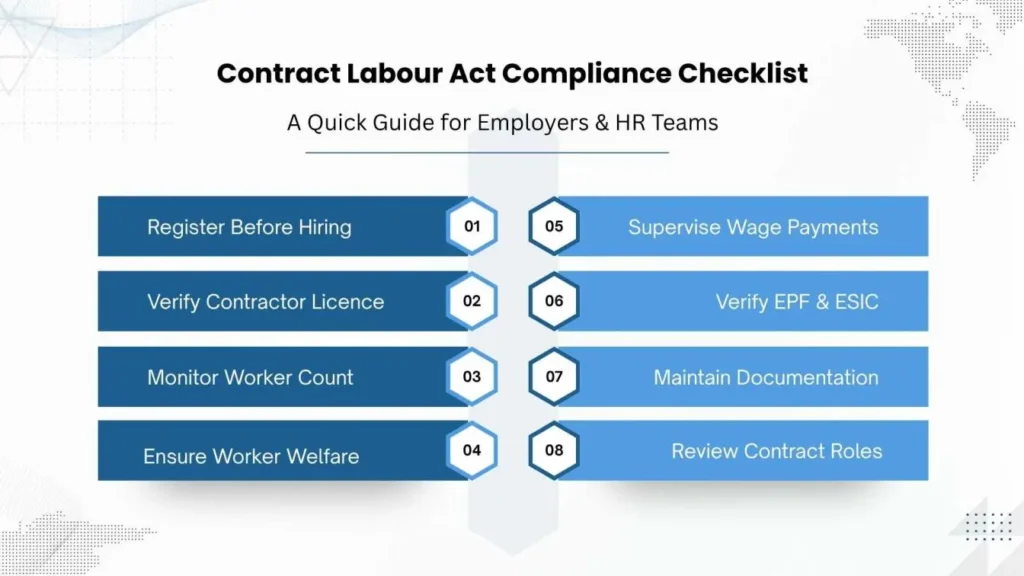
Quick Compliance Checklist: CLRA Act
- Registration as principal employer (Form I) obtained before engaging contract workers
- Registration covers each establishment separately
- Contractor license (Form IV) verified before commencing work
- Contractor license validity checked at renewal date each year
- Welfare facilities confirmed in place; canteen, drinking water, restrooms, first aid
- Company representative present during contractor wage disbursement
- Wage registers and attendance records maintained by contractor and accessible
- Contract workers covered under contractor’s EPF and ESIC registrations
- Principal employer verifying monthly EPF/ESIC remittance by contractors
- Nature of contract work reviewed periodically to assess regularisation risk
- Combined contract worker headcount tracked across all contractors
A broader labour law compliance checklist is useful to run alongside this, since CLRA obligations don’t replace the other statutory compliance requirements that apply to contract workers. Businesses that find this scope difficult to manage in-house often benefit from dedicated compliance services that cover both the CLRA layer and the broader labour law stack together.
Let Transparian Simplify Your Contract Labour Compliance
From managing PF and ESIC filings to ensuring PoSH and state-specific statutory obligations are never missed, Transparian provides expert Labour Law Compliance support for HR teams and business owners. Through reliable compliance services and experienced statutory compliance consultants, Transparian helps growing businesses stay audit-ready, penalty-free, and fully aligned with every regulatory requirement.
FAQ’s
The Contract Labour (Regulation and Abolition) Act, 1970 is an Indian labour law that regulates the employment of contract workers. It defines the responsibilities of principal employers and contractors, including registration, licensing, wage payments, welfare facilities, and overall labour law compliance.
A principal employer must register under the Contract Labour Act if 20 or more contract workers are employed on any day during the preceding 12 months. Contractors employing 20 or more workers must also obtain a valid licence before starting work.
A principal employer is the organisation where contract workers perform their duties, while the contractor recruits, employs, and supplies those workers. Both have separate legal responsibilities under the Contract Labour Act and share certain compliance obligations.
No. The Contract Labour Act works alongside other labour laws. Contract workers must still receive benefits under EPF, ESIC, minimum wage regulations, PoSH compliance, gratuity (where applicable), and other statutory requirements.
Common issues include failing to register on time, engaging contractors with expired licences, missing wage payment supervision, inadequate welfare facilities, and assuming the contractor alone is responsible for statutory compliance.
Professional compliance services help businesses manage registrations, contractor verification, statutory filings, labour law documentation, audits, and ongoing compliance monitoring. This reduces compliance risks while ensuring adherence to labour laws across multiple locations.