In today’s tightly regulated business environment, statutory compliance is no longer a formality limited to large enterprises. Startups, SMEs, and growing organizations are equally exposed to serious consequences when statutory obligations are delayed, overlooked, or misunderstood. From employee-related filings to payroll-linked contributions, ignoring compliance responsibilities can quietly build risks that eventually surface as penalties, disputes, and operational paralysis.
While many businesses understand compliance in theory, they often underestimate how deeply Non-Compliance affects legal standing, financial stability, workforce trust, and long-term scalability. This is where structured Statutory compliance management, professional compliance services, and guidance from specialists such as a PF & ESIC Consultant or a PAN india compliance agency become critical.
Why Statutory Compliance Is Not Optional for Any Business
In its essence, legal compliance is one that allows an organization to work within the context of the labour laws, tax, and social security provisions that are established by authorities. These are laws that are meant to safeguard workers, control equitable business activities and transparency in industries.
A disregard of compliance will not normally have an immediate consequence. Rather, they build up silently, by omitting or making wrong decisions in filings, or an outdated process, until they are detected by inspection, employee grievances or audit.
Businesses often ask:
- What really happens if statutory filings are delayed?
- Can small compliance lapses trigger major penalties?
- Is compliance risk limited only to finance teams?
The answer lies in understanding the layered impact of Non-Compliance.
Legal Risks: How Non-Compliance Escalates into Serious Exposure
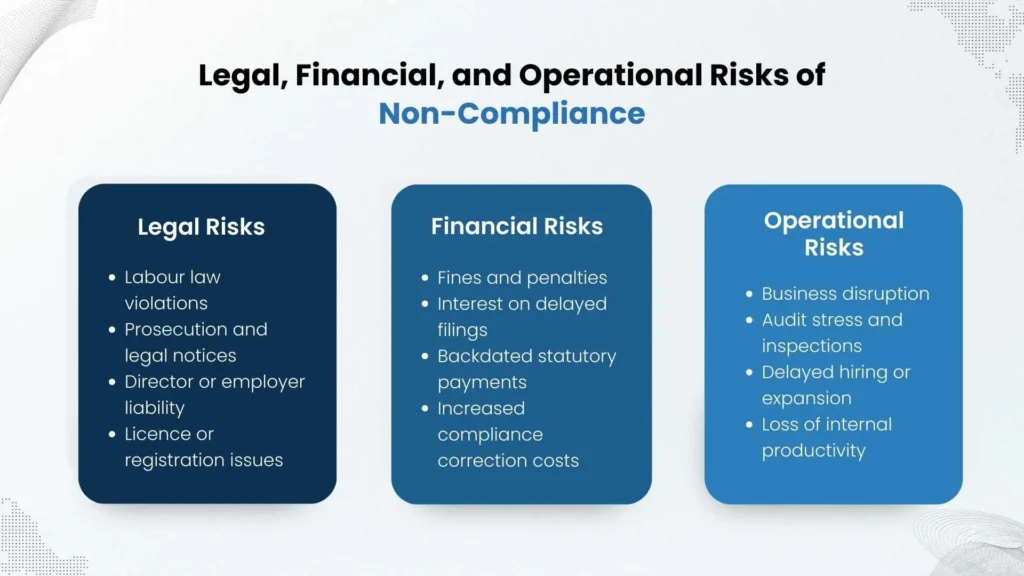
The most visible consequence of ignoring statutory obligations is legal action. Labour law violations, incorrect employee classifications, or non-payment of statutory dues can attract scrutiny from enforcement authorities.
Key legal risks include:
- Notices from labour departments or social security authorities
- Prosecution under labour and employment laws
- Personal liability for directors or authorised signatories
- Restrictions on business expansion, licensing, or registrations
With the evolving Labour codes impact, enforcement mechanisms are becoming more integrated and data-driven. This means inconsistencies between payroll records, filings, and statutory payments are easier to detect.
A qualified PF & ESIC Consultant helps organisations interpret changing regulations, assess exposure, and ensure filings align with the latest legal framework, reducing the chances of litigation or enforcement actions.
Financial Consequences: The True Cost of Ignoring Compliance
Many businesses only associate compliance failure with fines. In reality, the financial impact goes far beyond basic penalties.
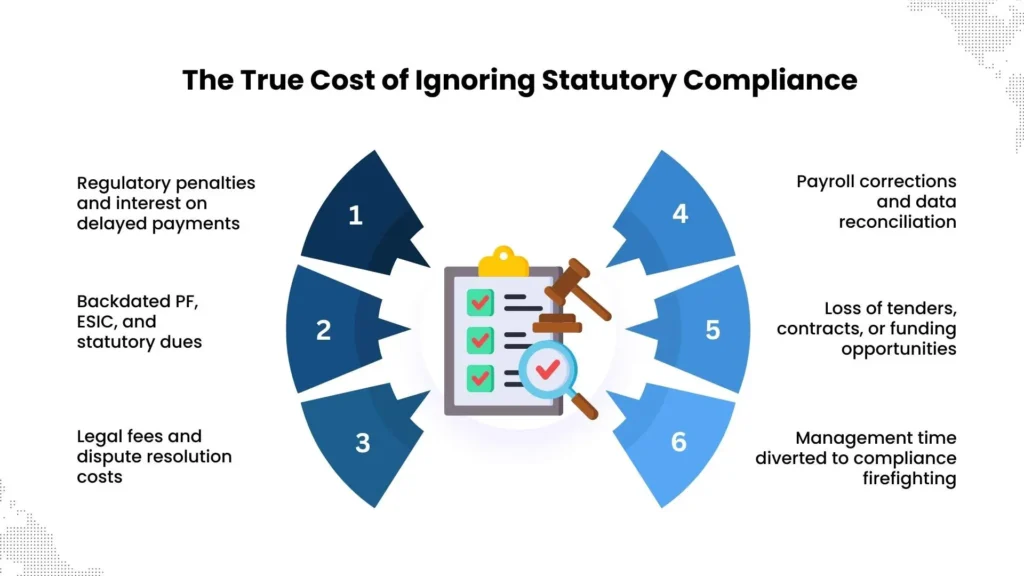
Direct financial losses include:
- Regulatory penalties and interest on delayed payments
- Backdated statutory contributions with compounding interest
- Legal expenses for representation and dispute resolution
Indirect financial damage often includes:
- Loss of eligibility for government tenders or large contracts
- Delayed funding or failed due diligence during investments
- Increased cost of compliance correction under time pressure
Poor Payroll compliance is one of the most common triggers of financial exposure. Errors in wage calculations, incorrect PF or ESIC contributions, or mismatches between payroll and statutory filings create red flags during inspections and compliance audits.
Effective compliance risk management focuses not only on preventing penalties but also on forecasting and mitigating long-term financial leakage caused by inconsistent compliance practices.
Operational Risks: When Compliance Failures Disrupt Daily Business
While legal and financial risks are well known, operational damage caused by compliance failures is often underestimated. Business disruption occurs when compliance issues interfere with normal workflows, employee management, or strategic initiatives.
Common operational consequences include:
- Time diverted from core business to respond to notices and audits
- Leadership bandwidth consumed by compliance firefighting
- HR and payroll teams forced into reactive corrections
- Freezing of operations due to unresolved statutory issues
In extreme cases, unresolved compliance failures can lead to partial shutdowns, licence suspensions, or restrictions on hiring new employees.
Structured Statutory compliance management ensures that compliance processes are predictable, auditable, and integrated into daily operations, rather than handled as last-minute tasks.
Employee Trust and Workforce Risks of Non-Compliance
Employee welfare is directly associated with statutory compliance. Any delay or mistakes in social contributions will have a direct effect on the access to benefits that include insurance cover, retirement savings, and statutory security amongst the employees.
Ignoring Social security compliance can result in:
- Employee complaints to labour authorities
- Loss of trust and reduced morale
- Higher attrition and reputational damage
- Escalation into collective disputes or litigation
The current employees are more conscious of their rights and in most cases check the statutory deductions using online portals. Any discrepancy in payroll deductions and actual contribution would send out red flags.
This is where a knowledgeable PF & ESIC Consultant plays a critical role by ensuring accuracy, transparency, and timely reconciliation between payroll data and statutory filings.
Compliance Audits: Why Ignoring Early Warnings Is Risky
Compliance audits are a fear amongst many businesses but the fear is not with audit, rather the fear is with not being prepared. Audits are usually occasioned by:
- Inconsistent filings across departments
- Employee grievances or whistleblower complaints
- Sudden changes in workforce size without updated registrations
- Data mismatches across government systems
Ignoring early audit signals or notices significantly worsens outcomes. Audits that could have resulted in corrective actions often escalate into penalties when responses are delayed or incomplete.
Professional compliance services assist companies in preparing audit ready documents, keeping of statutory registers and in responding appropriately to enquiries- minimising chances of escalation.
The Hidden and Long-Term Risks
While most discussions focus on fines and legal notices, several critical risks are often overlooked.
Impact on Fundraising, M&A, and Due Diligence
Investors and acquirers closely examine compliance history. Even minor instances of Non-Compliance can:
- Delay transactions
- Reduce company valuation
- Trigger indemnity clauses or escrow requirements
Cumulative Risk of Small Errors
Repeated minor errors such as rounding differences, late filings, or incomplete records can collectively form a significant compliance exposure during audits.
Dependency on Individuals Instead of Systems
Many businesses rely on one payroll or HR executive to “handle compliance.” When that person leaves, undocumented processes collapse, exposing the company to risk.
Robust compliance risk management replaces individual dependency with documented workflows, review mechanisms, and professional oversight.
Role of Professional Compliance Support in Risk Prevention
Handling legal requirements in various points, the fluctuating legislation, and the rising number of employees demand more than in-house work. Retaining a PAN india compliance firm will make sure there is uniformity, localisation and regulatory sensitivity across states and jSpecialised compliance services typically include:
- End-to-end Statutory compliance management
- Payroll-to-compliance reconciliation
- Periodic compliance health checks
- Advisory on evolving Labour codes impact
- Ongoing audit and inspection support
The proactive strategy turns compliance to a predictable load instead of a reactive one that helps to grow in a sustainable way.
Compliance as a Business Stability Tool
When implemented correctly, statutory compliance does far more than simply help businesses avoid penalties. It plays a critical role in improving payroll accuracy and building employee confidence by ensuring that salaries, deductions, and statutory contributions are handled transparently and on time. A strong compliance framework also strengthens governance by keeping documentation, filings, and records audit-ready, which reduces stress and uncertainty during inspections or reviews.
Over time, consistent compliance enhances brand credibility with investors, partners, and regulators, positioning the organisation as reliable and well-governed. It also enables smoother scaling across locations, as standardised processes make it easier to expand operations without creating regulatory gaps. In this way, strong Payroll compliance and structured Statutory compliance management become foundations for long-term business resilience rather than being treated as mere administrative overhead.
FAQ’s
Ignoring statutory compliance can lead to regulatory penalties, legal action, payroll disruptions, audits, and long-term damage to business credibility.
Yes, statutory non-compliance often attracts fines, interest on delayed payments, and backdated statutory dues imposed by authorities.
Non-compliance can delay or deny employee benefits such as PF and ESIC, reduce trust, and lead to complaints or disputes with labour authorities.
Yes, statutory compliance applies to startups and SMEs as soon as they meet legal thresholds, regardless of company size or revenue.
Authorities may issue notices, conduct inspections, initiate prosecution, or hold directors personally liable for labour law violations.
Businesses can reduce risk through regular compliance reviews, accurate payroll systems, and professional compliance management support.