
Statutory compliance is often treated as a back-office obligation, something to be handled later or managed externally. But when statutory compliance goes wrong, the consequences extend far beyond missed filings or penalties. Businesses experience operational disruption, financial strain, leadership stress, reputational damage, and in extreme cases, long-term survival risks.
Across industries, organizations, startups, MSMEs, and large enterprises alike face growing exposure due to statutory non-compliance, poor compliance management, and rapidly evolving regulations. Understanding what actually happens when compliance breaks down helps businesses move from reactive firefighting to proactive governance.
Understanding Statutory Compliance and Why It Fails
At its core, statutory compliance refers to adherence to laws, regulations, and rules mandated by government authorities covering labour laws, tax laws, social security, corporate filings, and sector-specific requirements.
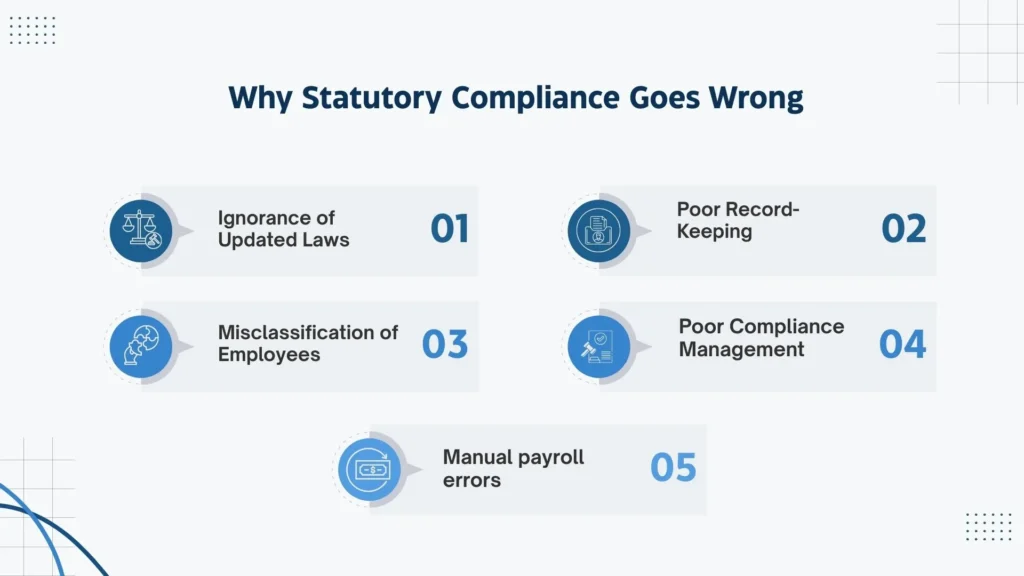
Failures typically arise not from intent, but from systemic weaknesses such as:
- Ignorance of Updated Laws
- Poor Record-Keeping
- Misclassification of Employees
- Fragmented compliance ownership
- Overdependence on manual processes
- Inadequate compliance risk management
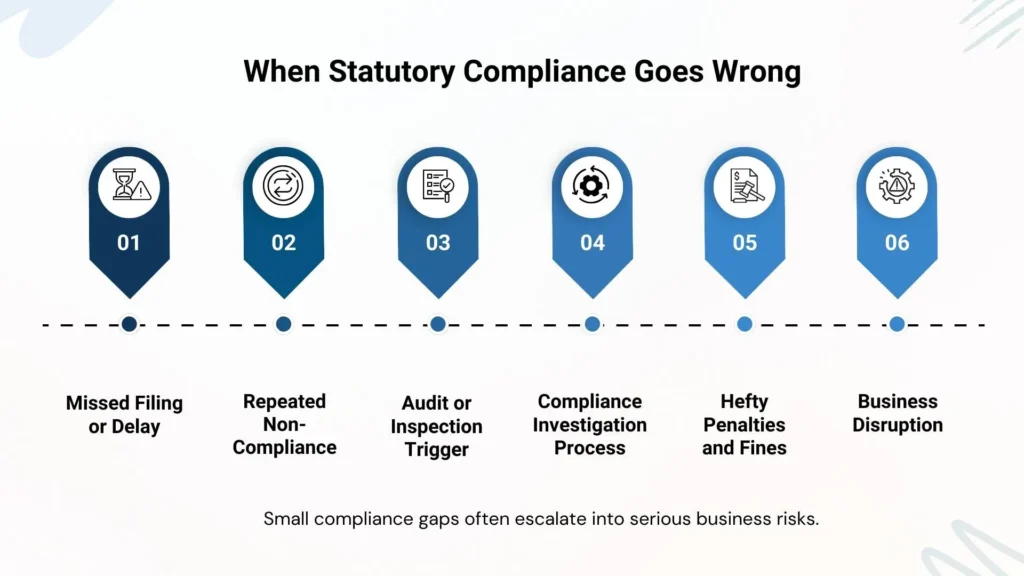
Over time, these gaps compound into serious statutory compliance risks.
Real-World Scenario 1: Payroll Non-Compliance and Social Security Exposure
A mid-sized company expands rapidly across multiple states. Payroll operations grow, but compliance systems don’t.
What Went Wrong:
- Delayed PF and ESIC registrations
- Incorrect wage ceilings applied
- Contractor workforce treated as consultants
- Absence of a qualified PF & ESIC Consultant
Outcome:
- Backdated PF & ESIC dues for multiple years
- Accumulated interest and Hefty Penalties and Fines
- Labour department inspections
- Loss of employee trust
This is a classic case of statutory non-compliance triggered by growth without governance.
Real-World Scenario 2: Misclassification of Employees
Many organizations misclassify workers to reduce cost, intentionally or unknowingly.
Common Triggers:
- Treating full-time workers as independent contractors
- Paying retainers instead of salaries
- Skipping benefits and social security
This Misclassification of Employees exposes businesses to:
- Labour law violations
- Retrospective benefit liabilities
- Litigation risk
- Increased scrutiny during audits
Such missteps often surface during compliance audit failures, especially when workforce structures scale faster than HR policies.
Real-World Scenario 3: Ignorance of Updated Laws and Regulatory Changes
Labour laws, tax provisions, and corporate regulations evolve frequently. Companies relying on outdated knowledge or legacy systems face compounding risks.
Examples of Ignored Changes:
- Revised wage definitions impacting PF calculations
- Mandatory audit trail requirements
- Changes in filing timelines
- New disclosure requirements
Ignorance of Updated Laws does not exempt businesses from penalties. Authorities treat non-compliance as strict liability, regardless of intent.
The Compliance Investigation Process: What Businesses Experience
When compliance failures surface, the compliance investigation process usually follows a predictable pattern:
- Notice or inspection trigger
- Demand for records and explanations
- Data reconciliation and discrepancy identification
- Penalty assessment
- Corrective action or prosecution
Poor documentation and Poor Record-Keeping significantly worsen outcomes during investigations, prolonging resolution and increasing liability.
Financial Impact: More Than Just Fines
Most businesses underestimate the true cost of non-compliance.
Beyond Hefty Penalties and Fines, organizations incur:
- Legal and consultancy fees
- Operational downtime
- Payroll restructuring costs
- Management distraction
- Cash flow disruptions
Repeated compliance audit failures also increase the probability of future inspections.
Reputation and Trust Erosion
Compliance failures are not invisible. Employees, investors, clients, and vendors eventually feel the impact.
Common Fallout:
- Employee attrition due to benefit irregularities
- Investor due diligence red flags
- Vendor contract terminations
- Client confidence erosion
For growing companies, a damaged compliance reputation can stall expansion and funding opportunities.
Department-Wise Impact of Poor Compliance Management
One critical but often overlooked aspect of poor compliance management is how deeply it affects every department within an organization:
HR:
- Employee disputes
- Benefit backlogs
- Attrition and low morale
Finance:
- Restated liabilities
- Unplanned cash outflows
- Audit qualifications
Operations:
- Hiring freezes
- Vendor delays
- License disruptions
Leadership:
- Personal liability risk
- Decision paralysis
- Reputational exposure
Compliance failures ripple across the organization, not just the legal team.
Vendor and Third-Party Compliance Risks
Even companies that manage internal compliance well may fail through partners.
Common Risks:
- Outsourced payroll errors
- Non-compliant staffing agencies
- Incorrect filings by consultants
- Weak SLAs with vendors
Engaging a PAN India compliance agency with standardized controls reduces dependency risk and ensures uniform compliance across locations.
The Role of Compliance Services in Damage Control
When things go wrong, specialized compliance services play a critical role in recovery and stabilization.
Effective support includes:
- Regulatory gap assessments
- Backdated filings and corrections
- Authority representation
- Process redesign
- Compliance calendar rebuilding
Early intervention significantly reduces penalties and restores operational continuity.
Why Growing Businesses Are More Vulnerable
Startups and fast-growing firms are more exposed to compliance since they have limited compliance budgets and are more concerned with growth than control. Statutory requirements are normally left in bits or weakly followed as teams focus on the hiring, sales and expansion. This results in delayed filings, inconsistency of practices and gaps in compliance that typically manifest through audits or inspections.
Most of the expanding companies also operate under unfinished policies regarding payroll, the classification of employees, retention of records, and statutory reporting. These loopholes, together with disjointed advisory services in which various consultants handling tax, labour and corporate compliance operate in silos, introduce areas of blindness that lead to the risk of committing statutory offences. The absence of an organized statutory compliance framework can only increase the risk rather than the opportunity in the rapid growth.
Building Resilience After Compliance Failure
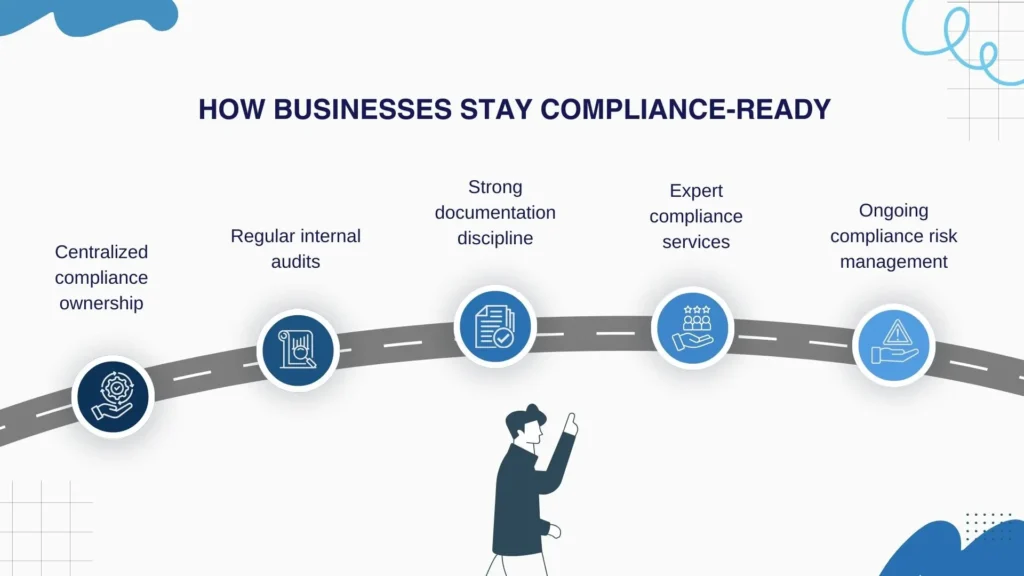
Coming out of compliance failure needs to be changed systemically and not fixed temporarily. Enabling compliance ownership through centralization with periodic internal audits will assist these organizations to identify problems in the initial stage and eliminate growth. Enhancing documentation discipline and automation enhance accuracy and audit-ready documentation particularly in times of regulatory examination.
It is possible to achieve this by engaging a qualified and experienced PF and ESIC Consultant, keeping abreast of the regulations via regular review of regulations, and putting in place structured compliance risk management frameworks, so that business can once again be in control, minimise future exposures and be able to conduct business with confidence. When organizations restore compliance on the offensive, they usually come out as stronger, more believable and well-adjusted to grow sustainably.
Why Proactive Compliance Is a Strategic Advantage
Compliance is no longer a checklist function. It is a business enabler that:
- Protects leadership
- Builds employee trust
- Strengthens investor confidence
- Enables scalable growth
- Reduces long-term cost
Businesses that invest early in structured compliance services avoid firefighting and operate with confidence in an increasingly regulated environment.
FAQ’s
When statutory compliance fails, businesses may face penalties, audits, operational disruption, legal notices, and long-term reputational damage. Issues often escalate if not addressed early.
Common causes include ignorance of updated laws, poor record-keeping, misclassification of employees, delayed filings, and weak compliance management processes.
Poor compliance management can lead to hiring freezes, payroll disruptions, blocked registrations, increased audits, and loss of employee and stakeholder trust.
Compliance audits help detect gaps in statutory filings, documentation, and processes. Audit failures often trigger investigations and regulatory scrutiny.
Recovery involves correcting filings, paying dues, strengthening documentation, engaging compliance experts, and implementing structured compliance risk management.
Businesses can reduce risk by maintaining updated compliance calendars, conducting internal audits, ensuring proper record-keeping, and using professional compliance services.