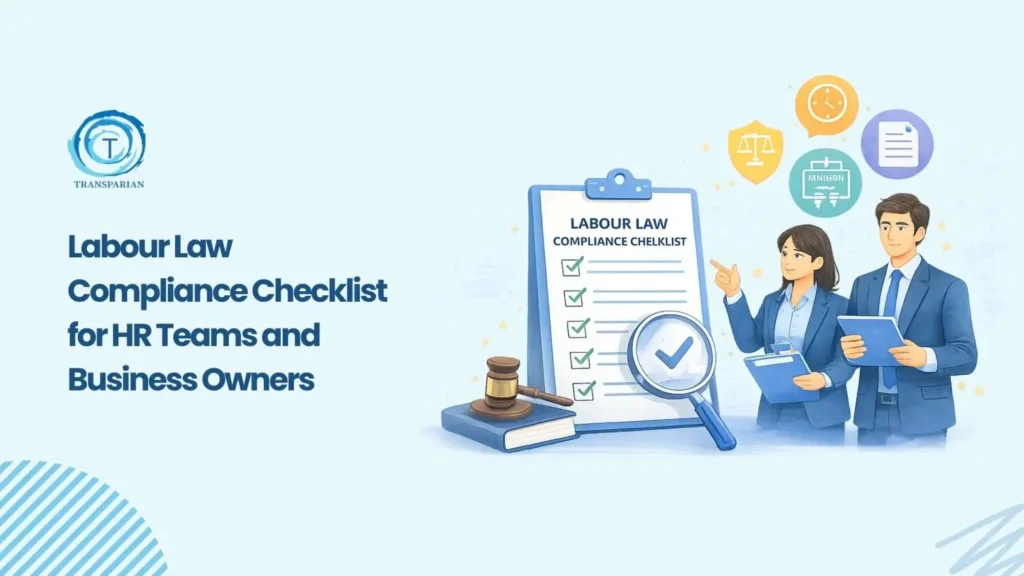
Operating a business in India implies operating under a thick web of employment laws constantly changing, depending on the state, and with severe consequences in case of non-conformity. However, the vast majority of HR teams continue to use incomplete spreadsheets or old SOPs. It is not just a guide, but it goes beyond the bare essentials in what the majority of checklists overlook, the areas that cost businesses on a consistent basis, the areas of dispute, and sanctions during audits.
Why Labour Law Compliance Is Not Optional
All employers, regardless of size (five persons to 500 persons), are subject to a group of federal and state labour laws. Labour Law Compliance is not just about avoiding fines It keeps the employees safe, lowers the chances of attrition, enhances the employer brand, and maintains a business audit-ready at any given time.
Failure to comply would lead to:
- Prosecution under the relevant Act, with fines and imprisonment provisions
- Disqualification from government contracts and tenders
- Reputational damage during fundraising or due diligence
- Employee grievances escalating to the Labour Commissioner
The best thing that an HR team can do is not to make compliance a one-time yearly activity but a compliance management process that is part of monthly HR activities.
The Core Compliance Framework: What Every Employer Must Track
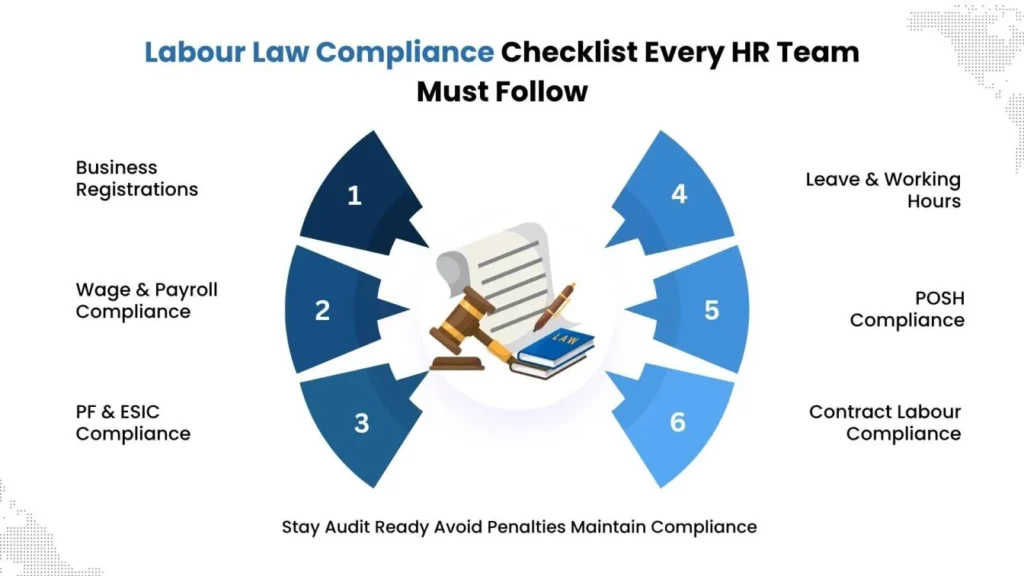
1. Registration and Licensing
Before any work begins, businesses must complete all mandatory registrations under applicable laws. These include:
- Shops and Establishment Act registration (state-specific, required within 30 days of starting operations)
- ESIC registration for establishments with 10 or more employees earning up to ₹21,000/month
- EPF registration under the Employees’ Provident Fund Organisation for establishments with 20 or more employees
- Professional Tax registration (applicable in states like Maharashtra, Karnataka, and West Bengal)
- Contract Labour Act licence if using contract workers (applicable where 20+ contract workers are deployed)
- Factory licence under the Factories Act for manufacturing units
- CLRA principal employer registration for companies engaging contractors
Most businesses get the primary registrations right but miss Professional Tax enrolment (the employer’s own liability) or fail to update registrations when they open new branches or change their address.
2. Wages and Salary Compliance
This is where most payroll compliance errors originate. The key obligations are:
- Pay minimum wages as notified under the Minimum Wages Act, these are revised periodically and vary by state, industry, and skill category
- Ensure wages are paid on time, the Payment of Wages Act mandates wages be paid by the 7th of the following month (10th for larger establishments)
- Maintain wage registers in the prescribed format, including Form I and Form II under the Minimum Wages Act
- Deduct and deposit TDS correctly under Section 192 of the Income Tax Act
- Ensure the basic wage component is compliant for EPF calculation, many businesses suppress basic salary to reduce PF contributions, which is a known litigation trigger
A commonly missed issue: companies that revise CTC but do not update the wage registers and payslip structures accordingly are technically non-compliant, even if the employee receives the right amount.
3. Provident Fund (PF) and ESIC Compliance
Both EPF and ESI compliance are heavily scrutinised during assessments.
- Deposit PF contributions (12% employer + 12% employee) by the 15th of every month
- File monthly ECR (Electronic Challan cum Return) on the EPFO portal
- File ESIC returns bi-annually (April–September and October–March cycles)
- Issue UAN to every eligible employee from the date of joining
- Update KYC (Aadhaar, PAN, bank account) for all employees on the UAN portal
- File Form 3A and 6A for PF annual returns
What most checklists miss: ensuring international workers and contractual staff are correctly handled, many businesses exempt them incorrectly, creating liability during audits.
4. Gratuity, Bonus, and Statutory Deductions
- Employees completing five or more years of continuous service are entitled to gratuity under the Payment of Gratuity Act, this needs to be funded or provisioned
- Annual bonus under the Payment of Bonus Act applies to establishments with 20 or more employees; eligible employees earn between ₹7,000/month to ₹21,000/month in basic wages
- Maintain Form A to E under the Bonus Act for proper record-keeping
- Deduct and remit Labour Welfare Fund (LWF) contributions where applicable, contributions and cycles vary significantly by state
5. Leave and Working Hours Compliance
The Shops and Establishment Act of each state governs leave entitlements, working hours, overtime, and rest days. Typical requirements include:
- Earned leave (EL) / privilege leave (PL) accrual and encashment policies
- Casual leave and sick leave as per state rules
- Maximum working hours (generally 48 hours per week for shops and establishments)
- Overtime payment at double the ordinary rate of wages under the Factories Act
- Maintenance of attendance and leave records in prescribed registers
What Most Compliance Checklists Miss
This is where the real compliance gaps live, the areas even experienced HR teams overlook.
Sexual Harassment (POSH) Compliance
Every organisation with 10 or more employees must constitute an Internal Complaints Committee (ICC) under the Prevention, Protection and Redressal of Sexual Harassment of Women at Workplace Act, 2013. Annual POSH reports must be submitted to the District Officer. Most HR teams form the committee but forget to:
- Conduct mandatory annual POSH training for all employees
- File the annual report with the local authority by January 31 each year
- Ensure ICC composition meets the legal requirements (external member mandatory)
Maternity Benefit Act Amendments
The 2017 amendment extended paid maternity leave to 26 weeks for the first two children. Additionally, establishments with 50 or more employees must provide a crèche facility. Very few businesses have updated their leave policies or HR manuals to reflect these changes.
Contract Labour and Gig Worker Compliance
Principal employers are liable for ensuring their contractors comply with all applicable laws on the premises. This means:
- Verifying that the contractor holds a valid CLRA licence
- Ensuring contract workers are enrolled under EPF and ESIC
- Maintaining Form XII (register of contract workers) at the worksite
Gig workers and platform workers are increasingly coming under labour law scrutiny. Businesses using freelancers on a regular basis should review their employment classification policies.
Equal Remuneration and Anti-Discrimination Obligations
The Equal Remuneration Act mandates equal pay for equal work irrespective of gender. Registers in Form D must be maintained. This is almost never checked in internal compliance audits but comes up frequently during labour inspections.
The Role of Company Compliance Services and Statutory Compliance Consultants
Managing this landscape in-house is increasingly difficult, especially for growing businesses. This is where company compliance services add significant value, they take over the registration, filing, return submission, and audit-readiness work so that HR teams can focus on people strategy.
Statutory compliance consultants bring jurisdiction-specific knowledge that generic HR teams cannot match. For example, a consultant handling Maharashtra compliance will know the exact LWF contribution cycles, the revised minimum wages for different industries, and the current status of state-specific amendments under the Labour Codes four new codes that are expected to consolidate and replace most existing central labour laws once notified.
When evaluating company compliance services, look for:
- End-to-end management of PF, ESIC, PT, LWF, and CLRA filings
- State-specific expertise across all your operating locations
- A compliance calendar with automated reminders
- Representation during labour inspections and audits
- Regular updates on regulatory changes and new state notifications
Statutory compliance consultants are especially valuable during audits, M&A due diligence, and geographic expansion, situations where the compliance liability needs to be mapped and remediated quickly.
Monthly and Annual Compliance Calendar: Key Deadlines
Monthly obligations:
- PF deposit: 15th of every month
- ESIC deposit: 15th of every month (for the previous month)
- TDS deposit: 7th of every month (for the previous month)
- Professional Tax: state-specific (monthly or annual)
Quarterly and annual obligations:
- ESIC half-yearly returns: May 11 and November 11
- PF annual return (Form 3A/6A): April 30
- POSH annual report: January 31
- Bonus payment: Must be paid within 8 months from the end of the accounting year
- Labour Welfare Fund: varies by state, typically December 31 or June 30
Building a Compliance-Ready HR Function
Three pillars support a compliant HR function; these are; accurate documentation, timely filings and proactive monitoring. The checklist is a mere beginning, what makes business safe in the long run is a corporate culture of HR compliance governance where:
- All employee records are maintained for the prescribed statutory retention period (generally 5–10 years depending on the Act)
- Compliance dashboards are reviewed every month by HR leadership
- Any changes in headcount, CTC structures, locations, or employee category trigger a compliance impact assessment
- Annual labour law audits are conducted proactively, not just when an inspector arrives
In multi-state operations or other complex workforce structures, engaging experienced statutory compliance counsel and engaging strong company compliance services is not an option, but rather an essential structural component that helps to minimize risk and provide a business with the ability to grow without a built-up compliance debt.
Let Transparian Simplify Your Labour Law Compliance
From managing PF and ESIC filings to ensuring POSH and state-specific statutory obligations are never missed, Transparian provides expert Labour Law Compliance support for HR teams and business owners. Through reliable company compliance services and experienced statutory compliance consultants, Transparian helps growing businesses stay audit-ready, penalty-free, and fully aligned with every regulatory requirement.
FAQ’s
Labour law compliance is typically managed by HR teams, compliance officers, or company compliance services. However, the employer or business owner is ultimately responsible for ensuring all statutory requirements are met.
Non-compliance can result in penalties, fines, legal prosecution, employee disputes, reputational damage, and disqualification from government tenders or contracts.
Yes, labour law compliance applies to businesses of all sizes. Even companies with fewer employees must comply with basic laws like Shops and Establishment, minimum wages, and statutory deductions where applicable.
Common monthly compliance requirements include:
PF contribution deposit
ESIC contribution deposit
TDS filing and deposit
Professional tax payments
Payroll and wage register maintenance
Statutory compliance consultants help businesses manage registrations, filings, audits, and regulatory updates. This reduces compliance risks and ensures businesses stay audit-ready at all times.