

India’s labour law framework is going through its most significant overhaul since independence. For decades, businesses had to manage 29 separate central labour statutes each with its own rules, definitions, and filing requirements. The government has now consolidated all of these into four Labour Codes, covering wages, industrial relations, social security, and occupational safety.
This is not just a repackaging exercise. Definitions have changed, new categories of workers now fall under statutory protection, and employer obligations around payroll, contributions, and workforce structure have been rewritten in meaningful ways. Whether you run a 50-person startup or a multi-location enterprise, these codes will affect how you hire, pay, and manage people.
Here is what every employer needs to understand.
Why India Needed This Consolidation
The old framework was built layer by layer over seven decades. Laws piled on top of laws, each defining key terms differently. The word “wages,” for example, had a different meaning under the Minimum Wages Act, the Payment of Wages Act, and the EPF Act. That alone created genuine confusion for payroll teams trying to calculate the right contributions.
Beyond definitions, the compliance load was heavy. Businesses had to file multiple returns across multiple departments, maintain separate registers for each act, and deal with overlapping inspections from different authorities. For growing businesses without large compliance teams, this was a real operational burden.
The four Labour Codes aim to fix this by:
- Standardising key definitions like wages, worker, and employer across all laws
- Consolidating multiple returns into a single unified return per state
- Reducing the compliance burden for small and mid-sized businesses
- Creating a more consistent framework that applies across industries and sectors
The intent is a cleaner, more enforceable system, not less compliance, but smarter compliance.
The Four Labour Codes Explained
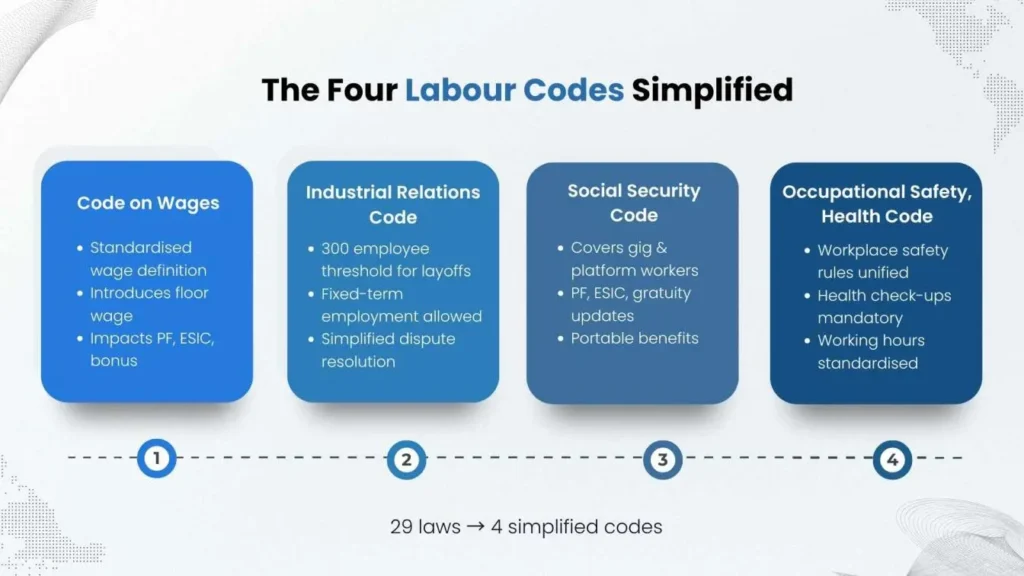
1. The Code on Wages, 2019
The Code on Wages consolidates four laws: the Minimum Wages Act (1948), the Payment of Wages Act (1936), the Payment of Bonus Act (1965), and the Equal Remuneration Act (1976).
The biggest change here is the redefinition of wages. Under the new code, wages include:
- Basic pay
- Dearness allowance
- Retaining allowance
Allowances like HRA, conveyance, overtime, and bonuses are excluded from this definition. However, there is a catch: if all excluded allowances together exceed 50% of total remuneration, the excess is treated as wages. This is a direct challenge to salary structures that use high allowances to keep statutory contribution bases low.
The code also introduces a floor wage, a national baseline below which no state can set its minimum wage. This is a first in Indian labour law. Until now, states had full freedom to set minimum wages as they saw fit, leading to wide variation across geographies. The floor wage creates a minimum floor of protection for all workers, regardless of where they are employed.
What this means for employers:
- PF, ESIC, and gratuity calculations will need to be revisited against the new wage definition
- Salary structures with heavy allowance loading will need to be audited
- Bonus calculations under the Payment of Bonus Act will also be affected
- Companies operating across states need to recheck minimum wage compliance in each location
2. The Industrial Relations Code, 2020
This code brings together the Trade Unions Act (1926), the Industrial Employment (Standing Orders) Act (1946), and the Industrial Disputes Act (1947). It deals with how businesses manage workforce relationships, hiring structures, and dispute resolution.
Two changes stand out.
First, the retrenchment and layoff threshold has been raised from 100 to 300 workers. Previously, any establishment with 100 or more employees needed prior government approval before retrenching workers or shutting down operations. Under the new code, this requirement only kicks in at 300 employees. For mid-sized businesses, this significantly reduces administrative friction when restructuring the workforce.
Second, the code formally introduces fixed-term employment as a recognised category of direct engagement. Employers can now hire workers on a fixed-term basis without routing them through a contractor. This is useful for project-based or seasonal work. But the code comes with clear obligations for fixed-term employees:
- Same wages and working conditions as permanent employees doing similar work
- Same statutory benefits during the period of employment
- Proportionate gratuity, even if the tenure is less than five years
That last point is worth paying close attention to. Gratuity was previously available only after five continuous years of service. Fixed-term employees will now earn proportionate gratuity from day one, which changes the total cost of this type of employment in a meaningful way.
3. The Code on Social Security, 2020
This is the most far-reaching of the four codes. It consolidates nine separate laws, including:
- The Employees’ Provident Funds and Miscellaneous Provisions Act (1952)
- The Employees’ State Insurance Act (1948)
- The Payment of Gratuity Act (1972)
- The Maternity Benefit Act (1961)
- The Employees’ Compensation Act (1923)
- The Building and Other Construction Workers’ Welfare Cess Act (1996)
The headline change is the extension of social security coverage to gig workers, platform workers, and the unorganised sector. This is new territory. For the first time, someone delivering food through an app or driving for a ride-hailing platform may be entitled to provident fund, health insurance, and welfare benefits funded through contributions from the aggregator, the worker, and potentially the government.
The specific contribution rates and scheme details for gig and platform workers are still being notified. But businesses in the platform economy cannot afford to wait. The obligation is coming, and the classification of workers as “gig” rather than “employee” will not by itself remove contribution liability once the schemes are finalised.
For employers in traditional sectors, the practical changes include:
- ESIC applicability now extends to establishments with 10 or more employees in specified categories, down from the previous threshold
- The wage ceiling for ESIC coverage has been revised upward
- Social security benefits will be portable, employees can carry their PF and ESIC history when they change jobs or move states
- Fixed-term employees earn proportionate gratuity regardless of tenure length
4. The Occupational Safety, Health and Working Conditions Code, 2020
This code consolidates 13 laws, including the Factories Act (1948), the Contract Labour (Regulation and Abolition) Act (1970), the Inter-State Migrant Workmen Act (1979), the Building and Other Construction Workers Act (1996), and the Plantations Labour Act (1951), among others.
For manufacturing businesses, this code is particularly relevant. It retains the core provisions of the Factories Act but updates the thresholds and requirements. Establishments with 20 or more workers using power, or 40 or more without power, fall within its scope. Required welfare facilities, canteens, restrooms, creches, first aid are now standardised across industries, with thresholds varying by headcount.
On working hours, the code sets a maximum of 8 hours per day and 48 hours per week for most establishments. States can permit up to 12-hour workdays in compressed 4-day work weeks in specific sectors, but overtime must be paid at double the ordinary wage rate in all cases. There is also a cap on total weekly overtime.
Key changes for employers managing factory compliance:
- Annual health check-ups are mandatory for workers in hazardous processes
- Occupational disease reporting obligations are more stringent
- Multiple legacy compliance registers are consolidated into a single unified record-keeping format
- The principal employer carries greater accountability for ensuring contractor workers receive their statutory entitlements
The contract labour threshold has been raised from 20 to 50 workers, so smaller establishments previously covered under the old CLRA will no longer fall within scope. But for those that do, the code increases principal employer responsibility for contractor compliance closing a gap that was frequently exploited.
Inter-state migrant workers also receive stronger protections under this code. Employers and contractors engaging migrant workers must register with the relevant authorities and provide journey allowances, displacement allowances, and equal access to welfare facilities.
Is Your Business Labour Law Ready?
Stay compliant with updated regulations and avoid risks with expert support.
What Changes for Employers Across All Four Codes
Taken together, the four Labour Codes create a new compliance baseline that every employer will need to meet. The most immediate areas of impact are:
- Salary structure review: The 50% cap on excluded allowances will force many businesses to restructure compensation. If your current structure keeps PF contributions low through high allowances, it needs a relook before the codes are enforced in your state.
- PF and ESIC recalculation: Contributions will need to be recalculated against the new wage definition. Payroll systems must be updated to reflect this.
- Fixed-term employment costs: Proportionate gratuity from day one changes the economics of fixed-term hiring. Budget and HR policy need to account for this.
- Gig and platform worker obligations: If your business engages gig workers or operates a platform, start tracking worker relationships now to assess future contribution exposure.
- Compliance documentation: Multiple registers are being consolidated, but businesses still need to ensure their records are audit-ready. The consequences of non-compliance — penalties, backdated dues, prosecution remain serious.
- Employment contracts and standing orders: Fixed-term employment provisions, revised notice period norms, and new grievance redressal requirements may need to be reflected in your standard employment documentation.
Where Does Implementation Stand?
All four codes have received Presidential assent. The central government has published its rules. However, because labour is a concurrent subject under the Indian Constitution, state governments must notify their own rules before the codes take effect in their jurisdiction. Several major states are still finalising those rules as of early 2026.
This phased implementation has led some businesses to take a wait-and-see approach. That is a risky position. Reviewing payroll structures, auditing salary components, updating employment contracts, and training HR teams all take time. Businesses that begin now will be in a far stronger position than those who scramble once a state notification is issued.
The future of statutory compliance in India is moving toward broader coverage, digital enforcement, and less tolerance for structural workarounds. The four Labour Codes are the clearest signal of that direction. Aligning early is not just about avoiding penalties, it is about building a compliance foundation that holds up as your business scales.
Let Transparian Simplify Your Labour Law Compliance
From managing PF and ESIC filings to ensuring POSH and state-specific statutory obligations are never missed, Transparian provides expert Labour Law Compliance support for HR teams and business owners. Through reliable company compliance services and experienced statutory compliance consultants, Transparian helps growing businesses stay audit-ready, penalty-free, and fully aligned with every regulatory requirement.
FAQ’s
The four Labour Codes are the Code on Wages (2019), Industrial Relations Code (2020), Code on Social Security (2020), and Occupational Safety, Health and Working Conditions Code (2020). They consolidate 29 existing labour laws into a simplified framework.
The Labour Codes will come into effect once individual states notify their rules. While central rules are ready, full implementation depends on state-level notifications.
Wages now include basic pay, dearness allowance, and retaining allowance. If allowances exceed 50% of total compensation, the excess is added to wages for statutory calculations like PF and gratuity.
Fixed-term employment allows companies to hire employees for a specific duration directly, with the same wages and benefits as permanent employees, including proportionate gratuity.
The new framework consolidates multiple registrations, returns, and registers into unified systems, reducing duplication and simplifying compliance processes.
Businesses should review salary structures, update payroll systems, revise employment contracts, ensure compliance documentation, and train HR teams to align with new rules.