
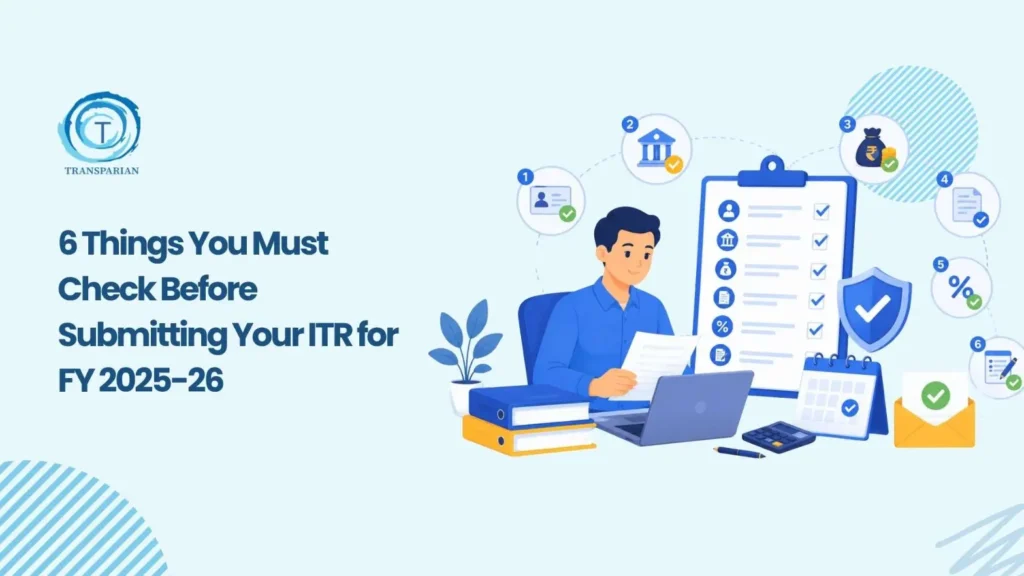
If you are a salaried professional, self-employed or a business person in India, your Income Tax Return (ITR) for the FY 2025-26 may be ready for filing.Tax filing season is on, and if you are a salaried professional, self-employed or a business person in India, chances are that you are ready with your Income Tax Return (ITR) for FY 2025-26. Although it might appear simple, a single mistake could lead to it being reviewed by the IT department, lead to a penalty notice, or even worse, it could be rejected and you’ll have to resubmit.
Reality is that a majority of tax issues are not deliberately malicious, they’re merely forgotten details, missing information, or missing alignment of data in documents. Regardless of whether you’re doing it yourself or with the assistance of a Tax Consultant in India, it is essential to know what to check before you hit that submit button.
ITR filing requires meticulousness from one’s part as errors could result in warnings, delay or even fine. As per our vast experience helping people in ITR filing and tax consultation, here are some of the issues which come across frequently while filling ITR forms. These are some of the key issues which one must keep in mind for successful ITR filing for FY 2025–26.
1. Verify Your Form 16 and TDS Deduction Details
Your Form 16 is the foundation of your income tax return. This certificate of TDS (Tax Deducted at Source) submitted by your employer should be your first checkpoint.
Start by downloading your Form 16 from your employer’s portal or the income tax website.
Cross-check the following:
- Name, PAN, and Address: Even slight errors in spelling could result in a mismatch during verification. Make sure that your name is consistent in all documents.
- Salary Breakup: Ensure that basic salary, HRA, DA, allowances and deductions are correctly shown.
- TDS Amount: Total Tax deducted should be as shown in your salary slips throughout the year (April 2025 to March 2026).
- Multiple Form 16s: If you had more than one job, or more than one employer, you will receive more than one Form 16 certificate. All of them must be declared in your ITR for FY 2025-26.
Numerous experts find that their employer made mistakes related to the calculation of HRA exemptions or house property income deduction. In case of any sort of mismatch, please inform your human resource department as soon as possible and ask for a new form 16 before submitting your form.
2. Double-Check Your Bank Account Information
The information about your bank account is more important than ever. The IT Department matches your bank account details with your ITR to look for any mismatch or discrepancies in the income sources.
Before submitting:
- Correct IFSC and Account Number: There can be mismatch if any digit is wrong in IFSC + Acc Number. Check if the details like your account number, IFSC code, and bank name are correct.
- Linked Aadhaar to Bank Account: Make sure that all bank accounts mentioned are associated with your Aadhaar. This way, there’s no chance for the IT department to be asked to look into unlinked accounts.
- Account Holder Name: Bank account should be in your name (or jointly held if applicable). Update the name on the account if it is not in sync with PAN, before filing.
- Updated Bank Information: If you have opened a new account or closed an old account in FY 2025-26, please make sure to only include those accounts that are still active.
One of the most frequent tax return mistakes is giving an incorrect or outdated bank information. It may lead to verification notices and delays in ITR processing for FY 2025-26 needlessly.
3. Review All Income Sources and Tax-Saving Investments
There are other income sources besides salary. If you have other income sources, or tax saving investments, this section will need to be carefully considered.
Income Sources to Consider:
- Interest from Savings Accounts: Report interest income on Savings Accounts over ₹40 per annum.
- Fixed Deposit Interest: Interest earned on a fixed deposit, bonds, and recurring deposits should be added.
- Rental Income: If you have a property, make sure that you’ve deducted depreciation and maintenance expenses from your rental income.
- Capital Gains: If you sell stocks, mutual funds, or property, any increase or decrease in your value is a capital gain or loss, and should be reported.
- Income from Digital Assets: From cryptocurrency, NFT sales and income from YouTube/blogging is considered income and should be reported.
Tax-Saving Investments:
- Section 80C Deductions: Investments in PPF, ELSS, NSC and life insurance premiums up to ₹1.5 lakh can be claimed as deduction.
- Section 80D (Health Insurance): State the premiums paid towards your health insurance, along with your family members.
- Section 80E (Education Loan): If you have an education loan, you should declare interest payments.
- Section 80G (Charitable Donations): Donations to eligible charitable organizations are deductible.
If you do not take the tax deductions to which you are entitled, you are paying more than you should. A professional Tax Consultant in India can assist in uncovering any missed deductions and ensure that your ITR for FY 2025-26 reflects all eligible tax benefits.
4. Confirm Foreign Income and NRI Status (If Applicable)
For those of you who are income earners from abroad, worked out of India for a part of the year or are classified as NRI (Non-Resident Indian) then your ITR for FY 2025-26 deserves special attention.
Key Considerations:
- Residential Status: Check whether you are a Resident, Not Ordinarily Resident (NOR) or Non-Resident on the basis of your stay in India in the financial year.
- Foreign Income Declaration: If you are a resident of India, then all your foreign income will have to be declared. This includes wages, rent or any capital gains from overseas.
- Foreign Tax Credit: If you paid tax on foreign income in a foreign country, then you should claim foreign tax credit to avoid double taxation.
- FEMA Compliance: All foreign income has been earned and brought back in accordance with Foreign Exchange Management Act.
The taxation of non-residents is more complicated than taxation of residents. This may lead to harsh repercussions. One of the most valuable services of the Professional ITR Filing Services and Tax Consultancy Services is for those who have foreign income.
5. Validate Claimed Deductions and Exemptions
Many taxpayers miss out in making deductions and exemptions, either by deducting unallowable expenses or by not claiming allowable expenses.
Common Deductions to Validate:
- Standard Deduction: If a person is a salaried person then he/she can get around ₹50,000 as standard deduction from gross income.
- Professional Tax: If paid in your state, list it as a deduction (amounts vary state to state, usually between ₹2,500 and ₹10,000).
- Home Loan Interest: Home loan interest paid in the financial year (upto ₹2 lakh per year now).
- Loss from House Property: Wherever there is a loss in the property you can carry it forward for 8 years.
Exemptions to Check:
- House Rent Allowance (HRA): If you’re claiming HRA exemption, make sure that your rent payment receipts are available. Actual HRA received or 50% of salary (or 40% if outside metro) or rent paid minus 10% of salary are the lowest figures that qualify for exemption.
- Leave Travel Allowance: LTA exemptions to be declared within limits.
Double check deductions with supporting documentation. While a deduction that is too high can draw attention, too low and you’ll be losing out on valuable deductions.
6. Check for Outstanding Tax Notices and Compliance Requirements
Not only before filing the ITR for FY 2025-26, but also prior to filing, check if you are under the radar of the IT department or if there are compliance requirements.
Steps to Take:
- Check IT Portal: Login to the IT e-filing portal and look for any outstanding notices / queries from the previous year. Make sure all demands or notices outstanding have been answered.
- Verify TDS Certificates: Make sure that all the payers (employers, banks, brokers) have issued and uploaded all the required TDS Certificates to your account.
- Check Processing Status: If you already returned a form for the previous year, find out if the previous year’s return has been processed. Errors in the previous year’s return may impact the year’s return.
- Pending Dues: Confirm you have no outstanding tax payments or penalties that need to be cleared before or during filing.
- Updates to PAN Records: If there is any change in the address, contact information, or change in income pattern, then such changes should be reflected in your PAN records.
The India Tax Consultant can assist you in compliance, particularly if you have a complicated tax profile, or have received such a notice before.
Conclusion
Filing your ITR for FY 2025-26 doesn’t have to be stressful. By verifying essential details such as Form 16, bank information, income sources, deductions, and tax compliance, you can ensure an accurate and error-free return. Our experienced Tax Consultants in India provide reliable ITR Filing Services to help you file on time, maximize tax savings, and stay fully compliant. Contact us today for expert assistance and hassle-free ITR filing.
Let Transparian Make Your ITR Filing Simple and Stress-Free
From verifying your income details and claiming eligible deductions to ensuring complete tax compliance and error-free filing, Transparian offers expert ITR Filing and Tax Consultancy Services for individuals, professionals, and businesses. Our experienced tax professionals help you maximize tax savings, avoid costly filing mistakes, and ensure your Income Tax Return is submitted accurately and on time. Whether you’re filing your first return or managing complex tax situations, Transparian provides reliable guidance and end-to-end support for a smooth, hassle-free ITR filing experience.
FAQ’s
Before submitting your ITR, verify your Form 16, TDS details, bank account information, income sources, eligible deductions, and personal details. Also, ensure there are no pending tax notices and complete the e-verification process after filing.
Form 16 contains your salary income and TDS details reported by your employer. Checking it carefully helps prevent mismatches, reduces the risk of tax notices, and ensures accurate ITR filing.
Yes. Incorrect bank account numbers, IFSC codes, or inactive accounts can delay your income tax refund or lead to verification issues. Always confirm that your bank details are accurate before filing your return.
You should report all taxable income, including salary, savings account interest, fixed deposit interest, rental income, capital gains, freelance income, business income, cryptocurrency transactions, and foreign income, if applicable.
If you qualify as a resident taxpayer under Indian tax laws, you generally need to disclose your global income, including salary, investments, rental income, and capital gains earned outside India, subject to applicable tax rules.
Common reasons include mismatched TDS details, undisclosed income, incorrect deduction claims, inaccurate bank information, failure to report capital gains or foreign income, and inconsistencies between your ITR and official tax records. Reviewing your return carefully before submission can significantly reduce the chances of receiving a notice.