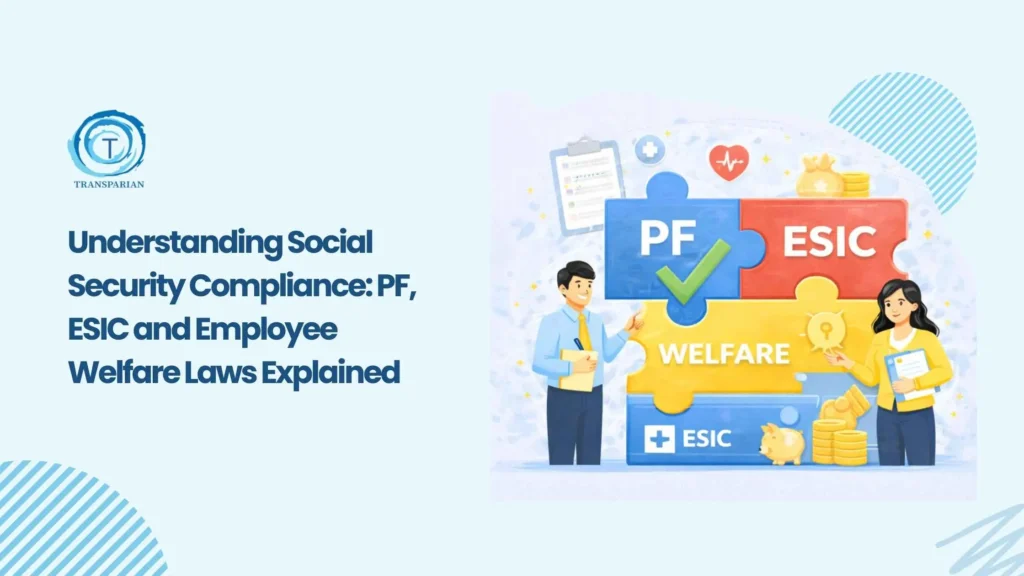
In India, employers must protect employees by complying with welfare and insurance schemes required by labour laws. These regulations are essential for employee protection, financial security, and workplace welfare. Understanding Social Security Compliance ensures businesses not only meet legal obligations but also provide employees with the benefits they are entitled to.
Many organizations pay attention to basic payroll tasks but miss out on other important employee benefit rules. This can result in penalties, inspections, or legal trouble. Having strong compliance practices is important. When companies match their payroll, HR policies, and paperwork with labour laws, they can stay compliant and protect their employees.
This guide outlines the key elements of Social Security Compliance in India, including Provident Fund (PF), Employees’ State Insurance (ESIC), and other essential employee welfare regulations.
What Is Social Security Compliance in India?
Social Security Compliance means employers must follow laws that give employees financial security, insurance, and retirement support. These laws ensure workers receive benefits such as pensions, medical insurance, maternity leave, and compensation if they are injured on the job.
In India, several labour laws make up the social security system. These have been brought together under the Code on Social Security, which was introduced by the government.
For HR teams and employers, social security compliance involves:
- Registering employees under applicable schemes
- Calculating and depositing statutory contributions
- Maintaining labour law records and registers
- Filing statutory returns on time
- Ensuring employee eligibility for benefits
Many organisations use specialised compliance services or work with a PF & ESIC Consultant to ensure these tasks are completed correctly and in compliance with the latest rules.
Key Components of Social Security Compliance
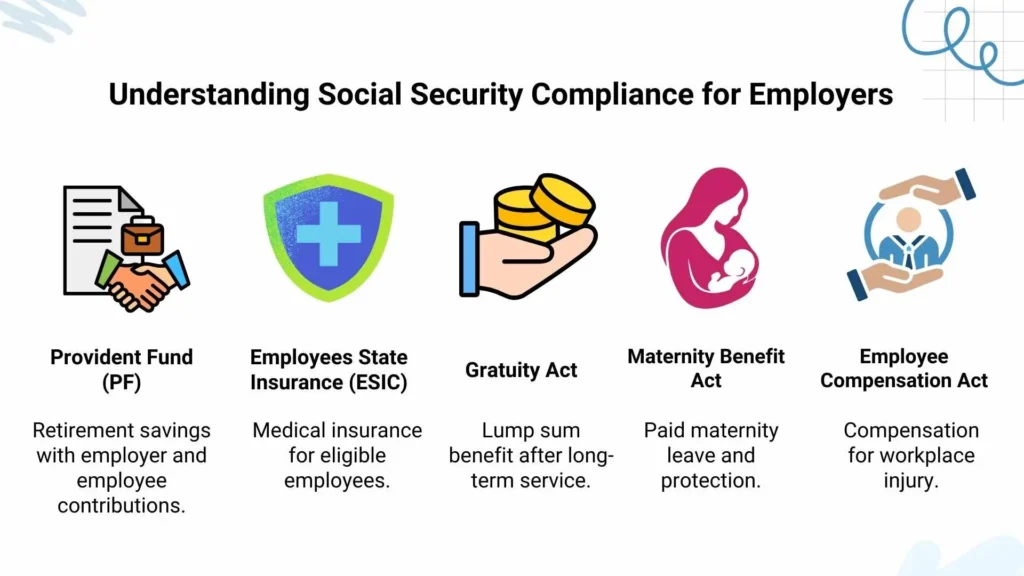
Social security laws in India include several programs that protect employees’ finances and health. The main ones are PF, ESIC, gratuity, maternity benefits, and other welfare laws.
The two most widely applicable schemes are:
- Provident Fund (PF)
- Employees’ State Insurance (ESIC)
These programs help employees save for the future and get healthcare support.
Provident Fund (PF) Compliance Explained
The Employees’ Provident Fund (EPF) is a key retirement benefit for employees in India. It is managed by the Employees’ Provident Fund Organisation (EPFO).
To comply with PF rules, employers must pay a part of each employee’s wages into a retirement fund. Employees can take out this money after they retire or in special cases.
Applicability of PF
PF registration is generally mandatory for establishments with:
- 20 or more employees
- Organisations that voluntarily opt for PF coverage
After registering, employers need to keep making provident fund payments for all eligible employees.
PF Contribution Structure
The standard contribution structure includes:
- Employer contribution – 12% of employee wages
- Employee contribution – 12% of wages
These payments go into the employee’s PF account, which is connected to their Universal Account Number (UAN).
PF Compliance Responsibilities for Employers
Employers must follow several EPF compliance requirements, including:
- Employee registration under EPFO
- Generating UAN for employees
- Filing Electronic Challan Cum Return (ECR)
- Maintaining PF records and wage registers
- Depositing monthly PF contributions
If employers do not follow these rules, they may face penalties, extra charges, or legal action.
Managing PF correctly helps employees get retirement savings, pension benefits, and financial security. This makes PF a key part of employee welfare compliance.
ESIC Compliance Explained
The Employees’ State Insurance Corporation (ESIC) gives medical insurance and social security benefits to employees who earn below a certain wage limit.
This scheme ensures employees and their families receive healthcare benefits and financial protection during medical emergencies.
Applicability of ESIC
ESIC applies to organizations with:
- 10 or more employees (varies by state and sector)
- Employees earning within the ESIC wage eligibility limit
After registering, employers need to make sure all eligible employees are signed up for the scheme.
ESIC Contribution Rates
The current ESIC contribution structure includes:
- Employer contribution – 3.25% of wages
- Employee contribution – 0.75% of wages
These contributions fund a wide range of employee insurance schemes that support workers during illness, maternity, disability, or workplace injury.
Benefits Provided Under ESIC
Employees covered under ESIC compliance receive benefits such as:
- Medical treatment for employees and families
- Maternity benefits
- Disability compensation
- Sickness benefits
- Dependents’ benefits in case of death due to employment injury
These benefits make ESIC an important part of India’s social welfare system.
Other Employee Welfare Laws Employers Must Know
PF and ESIC are the main parts of Social Security Compliance, but employers also need to follow other employee welfare laws to keep the workplace safe.
Gratuity Act
The Payment of Gratuity Act provides a lump-sum retirement benefit to employees who complete a minimum service period with an organization.
Gratuity gives employees financial support after they have worked for a company for a long time.
Maternity Benefit Act
The Maternity Benefit Act ensures women employees receive:
- Paid maternity leave
- Medical bonus
- Protection against termination during maternity leave
This law is important for supporting gender equality and protecting employees at work.
Employee Compensation Act
This legislation provides compensation to employees who suffer workplace injuries or occupational diseases.
Employers must ensure proper insurance coverage and maintain records to comply with these requirements.
Social Security Compliance Under the New Labour Codes
India’s labour laws are slowly being combined into new frameworks like the Code on Social Security.
The objective of this reform is to:
- Simplify labour law compliance.
- Expand social security coverage.
- Include gig workers and platform workers
- Improve statutory compliance management.
The new labour codes are meant to include millions more workers in the formal social security system, so it is even more important for employers to follow the rules.
Companies should keep up with changing rules and make sure their HR systems adjust as needed.
Common Social Security Compliance Mistakes Employers Make
Many organizations have trouble with compliance because they are not aware of the rules or have weak internal processes.
Some common mistakes include:
Incorrect Wage Calculations
If salary calculations are not done correctly, it can affect PF and ESIC payments and cause compliance mistakes.
Delayed Contribution Payments
Late PF or ESIC payments can result in:
- Interest charges
- Legal notices
- Compliance penalties
Incomplete Employee Registration
Failing requirements to register eligible employees under PF or ESIC violates labour law compliance.
Poor Documentation
Employers need to keep accurate records, payroll details, and employee data to show they are following the rules during inspections.
Compliance Process Employers Should Follow
To manage Social Security Compliance well, organizations need a clear and organized process.
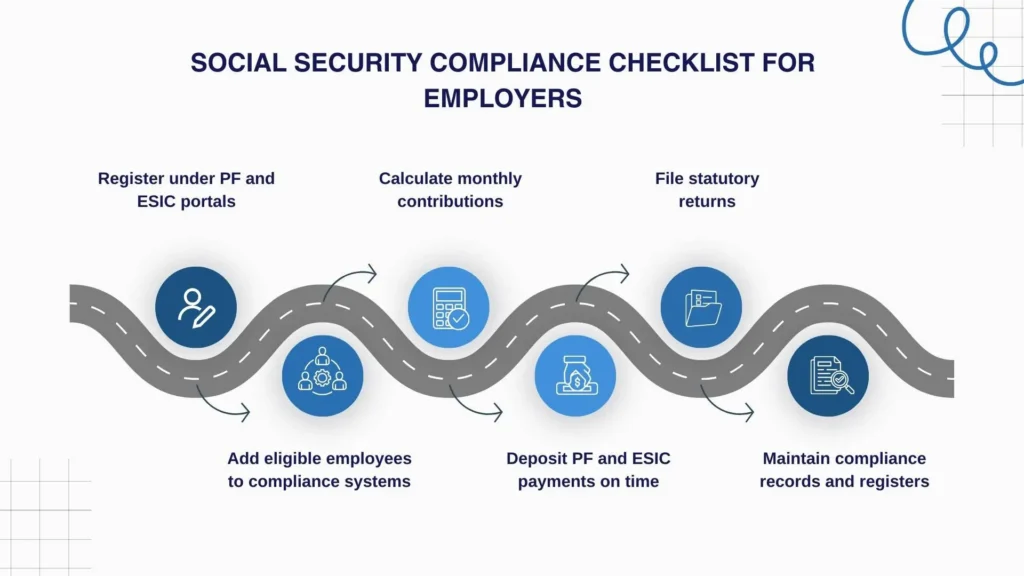
Organisations should implement processes such as:
Employee Onboarding Compliance
During onboarding, HR teams must:
- Verify employee eligibility for PF and ESIC.
- Generate UAN numbers
- Register employees under the ESIC portal.
Payroll Compliance Integration
Payroll systems should match legal requirements and make sure PF and ESIC contributions are calculated correctly.
Timely Filing of Returns
Employers need to file required documents on time to avoid penalties.
This includes:
- Monthly PF ECR filing
- ESIC contribution filings
- Maintaining compliance documentation
Compliance Monitoring and Audits
Regular internal audits help identify compliance issues and ensure records are accurate.
Many organizations hire a PF & ESIC Consultant to help with audits and keep up with compliance rules.
Role of Compliance Services in Managing Social Security Laws
Handling many labour laws can be complicated, especially for businesses that are growing and have employees in different states.
Professional compliance services help organisations manage responsibilities such as:
- PF and ESIC registration
- statutory filings and documentation
- compliance monitoring
- labour law advisory support
Many businesses work with a PAN India compliance agency to make sure they follow the rules in all their locations.
These agencies make processes simpler, reduce paperwork, and help organizations stay in line with labour laws.
Social Security Compliance for Startups and Growing Companies
Startups sometimes miss labour compliance when they are just starting out. But once they have enough employees, they must follow PF, ESIC, and other welfare rules.
Ignoring compliance can result in:
- Government inspections
- Financial penalties
- legal disputes with employees
Startups should establish HR compliance frameworks early to avoid complications as their workforce grows.
Digital Transformation in Social Security Compliance
Technology is changing the way organizations handle statutory compliance.
Modern HR systems now support:
- Automated payroll calculations
- PF and ESIC contribution tracking
- digital compliance documentation
- online statutory filings
Automation helps cut down on mistakes and makes compliance management clearer.
Digital compliance tools also help businesses track labour law deadlines, employee contributions, and regulatory updates, making it easier to manage Social Security Compliance effectively.
Why Social Security Compliance Matters for Businesses
Maintaining strong compliance practices benefits both employers and employees.
For employees, compliance means they get financial security, medical benefits, and retirement savings.
For employers, proper compliance:
- reduces legal risks
- improves workforce trust
- enhances company reputation
- ensures smooth labour inspections
Organizations that actively manage employee welfare compliance create better workplace cultures and long-term stability.
Let Transparian Handle Your Social Security Compliance
From PF and ESIC registrations to filings and documentation, Transparian manages complete compliance support for your organization. As a trusted PF & ESIC Consultant and reliable PAN india compliance agency, Transparian helps businesses stay compliant while ensuring smooth management of employee welfare and statutory obligations.
FAQ’s
Social security compliance ensures employees receive benefits like retirement savings, medical insurance, and workplace protection. It also helps companies avoid penalties, legal issues, and labour law violations.
A company must register for PF once it reaches 20 employees, while ESIC registration usually becomes mandatory when an organization has 10 or more employees, depending on the state and industry.
Yes, contract workers are generally covered under PF and ESIC if they meet eligibility criteria. Employers are responsible for ensuring compliance even when employees are hired through contractors.
Modern payroll systems automate calculations for PF and ESIC contributions, maintain compliance records, generate reports, and ensure timely statutory filings.
Organizations should conduct periodic internal compliance audits, typically annually or semi-annually, to verify statutory filings, payroll records, and employee benefit compliance.
Businesses can simplify compliance by implementing structured HR processes, automating payroll systems, maintaining accurate records, and partnering with experienced compliance professionals.