Most companies treat PoSH compliance as a one-time event. A policy gets drafted, a training session runs, the Internal Complaints Committee (ICC) gets formed and then nothing happens for the rest of the year. No documentation updates. No follow-up training. No annual report filed.
This approach works fine, until a complaint is filed, an investor asks questions, or a labour inspector shows up.
A PoSH audit can be triggered by an employee complaint, a court order, a regulatory inspection, or due diligence from a prospective investor or client. When it happens, organisations that treat compliance as a formality are often caught underprepared. What follows is not just a fine, the consequences run deeper.
Here’s an honest breakdown of what failing a PoSH audit actually means for your organisation.
What Does a PoSH Audit Actually Check?
Before getting into consequences, it helps to understand what auditors look for. A PoSH audit typically covers:
- Whether a written sexual harassment policy exists and has been shared with all employees
- Whether the ICC is properly constituted, with at least one external member, 50% women representation, and a senior woman employee as Presiding Officer
- Whether ICC members have received training on conducting inquiries
- Whether PoSH training for employees was conducted at least once in the year
- Whether any complaints were resolved within the 90-day window required by law
- Whether the PoSH annual report was submitted to the District Officer
- Whether the PoSH policy is displayed at the workplace
Failing even a few of these is enough to attract penalties. And failing most of them which is more common than organisations want to admit can have serious consequences.
1. Financial Penalties Under Section 26
The Prevention of Sexual Harassment (PoSH) Act, 2013 carries clear monetary penalties for non-compliance. Under Section 26 of the Act:
- A first-time violation can attract a fine of up to ₹50,000
- Repeat violations can double the penalty
- Continued non-compliance can put the organisation’s business licence or registration at risk
That last point is the one most employers miss. A PoSH failure can, in principle, affect operating licences. Regulators have become more active about this in recent years, particularly in sectors like IT, manufacturing, and healthcare where labour inspections are more frequent.
2. Personal Liability for the Employer
The PoSH Act does not only hold companies liable, it holds employers personally accountable. If the employer:
- Has not constituted an ICC
- Has failed to act on a filed complaint
- Has retaliated against a complainant
- Has not filed the mandatory annual report
…they can be prosecuted individually, separate from the company as an entity. Founders, CHROs, and senior HR heads have been named in PoSH-related litigation, not just as witnesses, but as respondents.
This is something many business owners genuinely do not factor in when setting up their compliance framework. PoSH is not purely an HR department responsibility.
3. ICC Failure: The Most Common Audit Gap
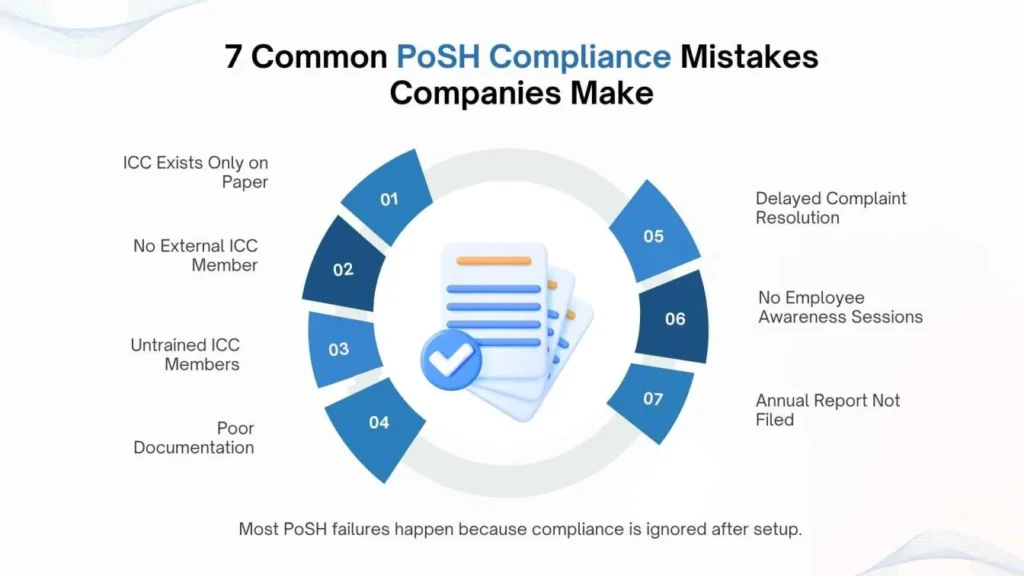
Of all the compliance gaps auditors find, ICC-related failures are the most frequent. Common issues include:
- The ICC was formed but never met
- The external member was never actually appointed or trained
- The ICC composition does not meet the legal requirement (no senior woman as Presiding Officer)
- Members have no understanding of how to conduct an inquiry
An ICC that exists only on paper does not provide legal protection. In fact, a poorly constituted ICC can make things worse, complaints get mishandled, which leads to larger legal exposure than if no process had been followed at all.
Role-based PoSH training for ICC members, managers, and employees is not optional, it is the difference between a functional committee and one that creates more risk than it prevents.
4. Court-Ordered Inquiry and LCC Escalation
If an employee files a complaint with the Local Complaints Committee (LCC) which handles cases where the employer has either not formed an ICC or where the ICC has failed to act, the LCC can:
- Conduct its own inquiry into the matter
- Direct the employer to pay compensation to the complainant
- Recommend action against the employer for non-compliance with the Act
Courts have also intervened directly in cases of employer negligence. In several High Court rulings, employers who delayed or mishandled PoSH complaints and investigations were ordered to pay compensation and face contempt proceedings.
The legal costs that follow an LCC escalation or a court-ordered inquiry far exceed what a proper compliance programme would have cost in the first place.
5. Annual Report Non-Filing: A Missed Obligation
This is one of the most overlooked compliance requirements. Under the PoSH Act, every organisation with 10 or more employees must submit an annual report to the District Officer. The report must include:
- Number of complaints received during the year
- Number of complaints disposed of
- Complaints pending beyond 90 days
- Training programmes conducted
The deadline is January 31 of the following year. Non-filing is itself a violation and it applies every year, regardless of whether a complaint was received. Many companies assume the report is only required when something has happened. It is not.
A PoSH compliance checklist with clear deadlines for documentation and reporting can prevent this from slipping through the cracks every year.
6. Investor and Due Diligence Risk
PoSH compliance is now standard in HR due diligence by PE firms, VCs, and corporate acquirers. Investors typically check:
- Is a written PoSH policy in place?
- Is the ICC properly constituted with documented appointments?
- Have annual reports been filed?
- Were complaints, if any, resolved within 90 days?
A company that cannot answer these questions cleanly creates friction in a funding round or M&A process. Valuations can be affected, deal timelines extended, and in some cases, compliance has been made a condition precedent to closing. If your organisation is planning to raise funds or go through an acquisition in the next 12–18 months, this is worth addressing well in advance.
7. Reputational Risk That PR Cannot Fix
Employment law failures rarely stay internal. An employee who did not receive a fair hearing on a harassment complaint has multiple channels available social media, Glassdoor, industry networks, journalists. The narrative travels fast, especially in sectors like tech, finance, and consulting where professional communities are close-knit.
The organisations that handle this well are not necessarily ones where incidents never occurred. They are ones with a working ICC, clear documentation, trained employees, and a process that people trust. That trust is built through consistent training and visible commitment from leadership, not through a policy document sitting in a shared drive.
Is Your PoSH Compliance Audit-Ready?
Strengthen your policies, training, and documentation before issues arise.
What Should Companies Do Now?
If your organisation has not reviewed its PoSH compliance recently, start with an honest internal check:
- Is the ICC currently constituted with the right composition, including an external member?
- Have ICC members been trained in the last 12 months?
- Have all employees, including contractual and remote staff, received PoSH training?
- Is the PoSH policy displayed and accessible at the workplace?
- Has the annual report been filed for the last financial year?
If the answer to any of these is uncertain, that is the answer.
Many of the most common PoSH compliance mistakes are not difficult to fix, they are just easy to overlook when compliance is not being tracked actively. A structured review, with the right documentation in place, is usually enough to bring an organisation back to a defensible position.
Working with an experienced PoSH consultant is the most efficient way to close gaps, train the right people, and build a framework that holds up when it matters.
Final Word
Failing a PoSH audit is rarely about ignorance of the law. Most HR teams know the basics. The gap is usually in follow-through, the ICC that was formed but never trained, the annual report that was due in January but never filed, the training that ran once in 2022 and never happened again.
The consequences of that gap penalties, personal liability, LCC escalations, due diligence failures, and reputational damage are real and increasingly common. None of them are inevitable with a well-documented, consistently maintained PoSH compliance framework.
Let Transparian Simplify Your PoSH Compliance
From managing ICC constitution and employee training to annual reporting and audit support, Transparian provides expert PoSH Compliance support for HR teams and business owners. Through reliable compliance services and experienced PoSH consultants, Transparian helps growing businesses stay audit-ready, penalty-free, and fully aligned with every requirement under the PoSH Act, 2013.
FAQ’s
If a company fails a PoSH audit, it may face financial penalties, legal action, reputational damage, and scrutiny from labour authorities. Under the PoSH Act, repeated non-compliance can even impact business licences and registrations.
The first violation under the PoSH Act can attract a penalty of up to ₹50,000. Repeat violations may lead to higher fines, cancellation of licences, or additional legal consequences for the employer.
Yes. PoSH training for employees is considered an essential compliance requirement under the PoSH Act. Organisations are expected to create awareness among employees and train ICC members regularly.
Yes. Every organisation with 10 or more employees must submit a PoSH annual report to the District Officer, even if no complaints were received during the year.
Yes. Employers, HR heads, founders, and senior management can face personal liability if they fail to form an ICC, ignore complaints, retaliate against employees, or neglect mandatory compliance obligations.
Companies can prepare by conducting regular compliance reviews, updating documentation, training employees and ICC members, filing annual reports on time, and working with an experienced PoSH consultant for audit readiness.