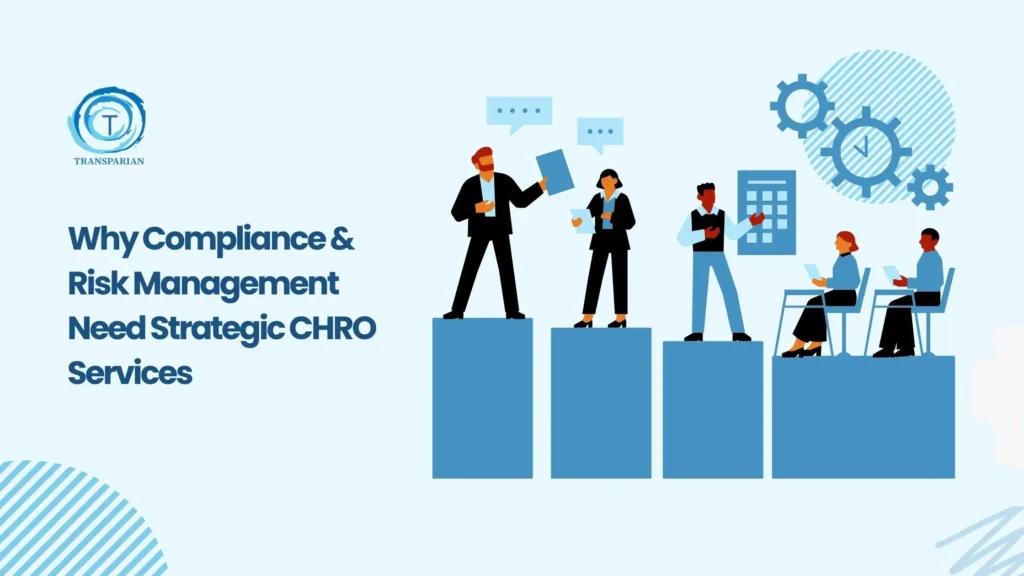
In today’s regulatory environment, compliance is no longer a checklist activity; it is a proactive, organization-wide discipline that protects the company from financial penalties, legal exposure, reputational damage, and employee-related risks. With evolving labour laws, increasing workplace complexities, hybrid teams, and rising digital vulnerabilities, organizations now rely on strategic HR leadership to manage compliance with precision and foresight.
It is this change that has seen the modern CHRO services not only change its orientation but also become the center of compliance and risk governance, unlike earlier times. An integrated approach, which ties people, policies, culture, and systems, can be found in whether they involve full-time leadership, HR leadership consulting, Outsourced CHRO services, Fractional CHRO, or Virtual HR.
The New Reality: Compliance is a People, Process & Culture Challenge
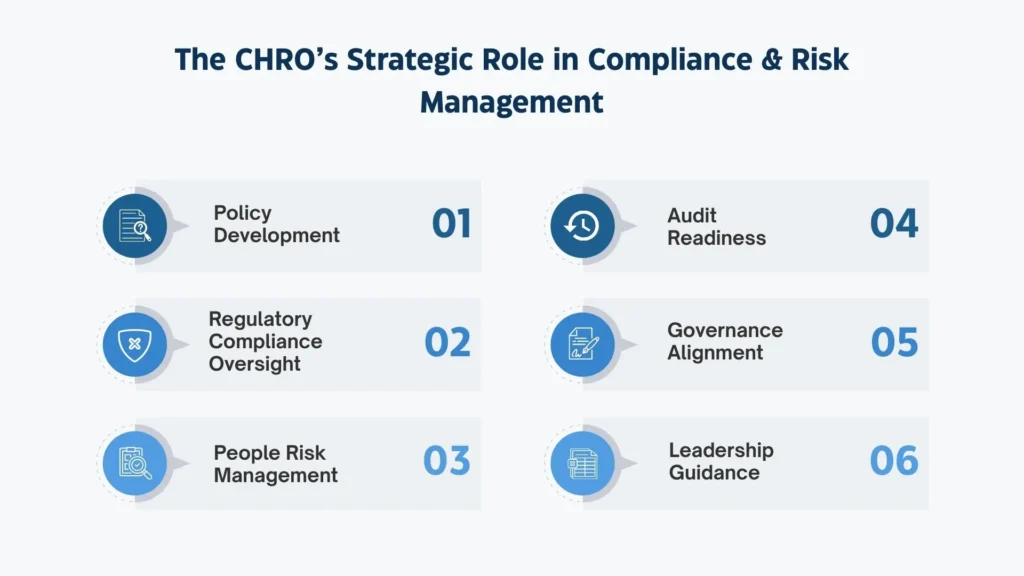
Most compliance failures are rooted not in documentation gaps, but in people-driven risks: poor training, unclear policies, misaligned behaviors, weak reporting culture, or inadequate oversight. This is why companies are increasingly turning to strategic CHRO leadership to build a strong, scalable, organization-wide CHRO compliance strategy.
A strategic CHRO embeds compliance into core workflows such as hiring, onboarding, performance management, remote-work governance, workplace behavior standards, data-security practices, and leadership decision-making. CHRO-led governance frameworks ensure that HR compliance, people risk management, and regulatory compliance in HR become everyday habits rather than once-a-year exercises.
Why CHRO Leadership Is Now Essential for Compliance & Risk Management
1. Navigating Multi-Jurisdiction Complexities
Organizations with remote teams or multi-location operations face different state and industry-specific rules. A CHRO develops systems to ensure that statutory compliance in HR, documentation, payroll rules, working hours, Shops & Establishments requirements, and safety standards are followed consistently across locations.
This includes building location-specific compliance calendars, automated reminders, digital audit checklists, and workflows that minimize manual errors. Strategic CHRO oversight prevents the common pitfalls companies face when compliance responsibilities are scattered among HR generalists without a unified framework.
2. Managing Employment Law Updates with Agility
Legal changes today move fast labour laws, wage codes, harassment policies, privacy rules, contract employment norms, leave reforms, and remote-work regulations are constantly evolving.
A seasoned CHRO ensures timely employment law updates, translates legal language into simple internal policies, and builds training that employees can actually understand. The ability to interpret regulations strategically, not just execute them helps companies avoid legal consequences while strengthening organizational governance.
3. Building Comprehensive HR Compliance Architecture
Many organizations still rely on outdated, reactive approaches. CHROs build a modern, end-to-end compliance architecture that includes:
- policy drafting and version control
- compliance tracking matrices
- digital document management
- evidence-ready audit trails
- risk registers
- automated compliance alerts
- investigation protocols
This structured system ensures reliable workplace policy compliance across departments, shifts, and locations.
Incident-Response Preparedness: A Critical Area Often Overlooked
Although the majority of organizations are concerned with filings and documentation, incident management is one of the most significant aspects of compliance. Misconduct, harassment claims, fraud alerts, safety accidents, regulatory alerts, or employee complaints need to be addressed in structured and time-linked responses.
A CHRO-led compliance risk assessment helps identify high-risk areas long before incidents arise. In addition, HR leaders design incident-response playbooks that define:
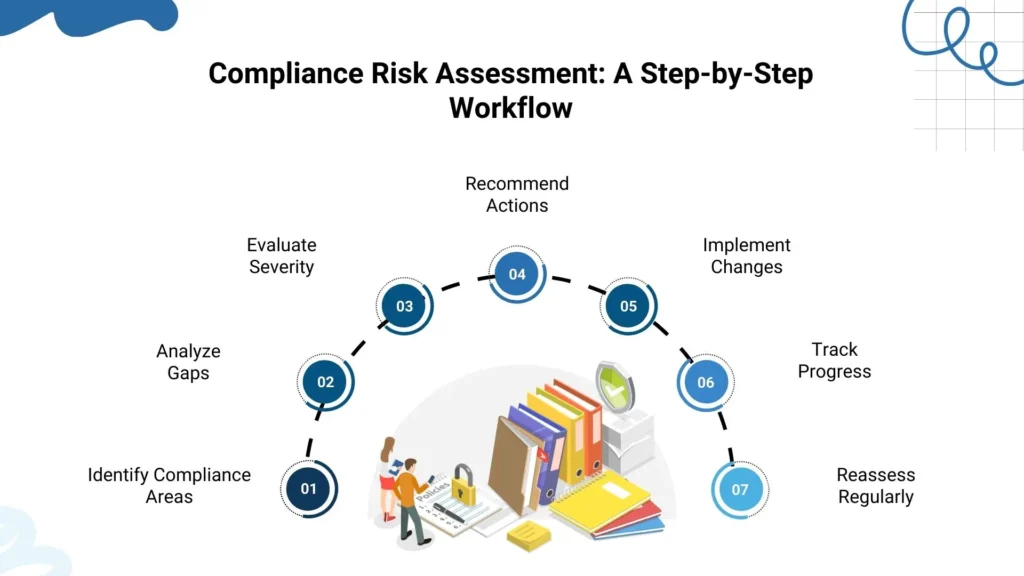
- the response sequence
- roles and responsibilities
- timelines for actions
- documentation steps
- evidence protocols
- communication guidelines
- remediation procedures
CHRO leadership can make the process of incident response more consistent, transparent, and defensible in legal courts by operationalizing it.
Digital Transformation: The Rise of Virtual & Tech-Enabled Compliance
As workplaces become hybrid and distributed, organizations increasingly adopt Virtual HR and Virtual HR solutions to streamline compliance processes. These digital systems ensure accurate data flow, stronger governance, and automated oversight especially when supported by a Fractional CHRO or outsourced HR leadership model.
Key digital capabilities include:
- cloud-based HRIS for compliance auditing
- e-learning platforms for mandatory training
- automated reminders for statutory filings
- digital onboarding with policy acknowledgement tracking
- centralized document repositories
- workflow automation for compliance approvals
- AI-enabled analytics to detect people-risk patterns
Technology reduces manual errors and enhances visibility, enabling CHROs to monitor compliance performance in real time.
Cyber, Data Protection & AI Governance Are Now HR Responsibilities
Another significant compliance change in the modern world is the convergence of HR, cybersecurity, and data governance. As data on the employees is digitized and HR systems are interconnected across the departments, there are chances of a data leak, unauthorized access, or even insider threat events at any one point in time.
Strategic CHRO leadership collaborates with IT and Security teams to manage:
- employee data protection protocols
- role-based access control
- data retention and purging guidelines
- digital behavior monitoring policies
- cybersecurity awareness training
- breach reporting timelines
- third-party contractor governance
As organizations adopt AI tools for hiring, performance reviews, and workforce analytics, CHROs also play a decisive role in ensuring fairness, transparency, and bias-prevention in automated decision-making.
Industry-Specific Compliance Needs Tailored CHRO Leadership
Each industry possesses a compliance environment. One size fits all will leave holes that may leave the organization vulnerable to fines or operational risk. Strategic CHRO services tailor compliance systems for industries such as:
- Finance – data privacy, whistleblower nos, background verification
- Manufacturing – safety standards, shift compliance, labour inspections
- Healthcare – patient data confidentiality, workplace safety
- IT/ITES – global compliance, cybersecurity readiness, remote-worker governance
- Startups & SMEs – lean compliance frameworks, early-stage policy development
Customizing HR governance to industry needs ensures not only legal alignment but also operational efficiency.
Driving Compliance Culture Through Behavior Change
Effective compliance is built on culture, not just checklists. This is where CHRO services play a transformational role. Instead of depending only on policy manuals or annual training, they focus on building long-term behavioral adoption across the workforce.
One of the strongest ways they achieve this is through microlearning-based compliance training. Short, simple modules help employees retain information better and avoid training fatigue. Gamified learning adds an element of engagement that encourages participation instead of treating compliance as a mandatory task.
Leader-led communication further strengthens the culture. When senior managers actively reinforce compliance expectations, employees perceive it as a shared priority, not just an HR responsibility. Consistent team-level compliance rituals such as brief weekly discussions or check-ins help integrate good practices into daily work.
Measuring Compliance Performance Through Metrics
A modern compliance framework requires quantifiable metrics. CHROs design dashboards that track:
- audit-readiness levels
- training completion rates
- policy acknowledgement accuracy
- grievance turnaround timelines
- incident severity classifications
- compliance lapses and recurrence
- documentation accuracy
These metrics enable leadership to identify trends early and improve decision-making related to compliance investments, workforce governance, and risk prioritization.
Why Organizations Choose Flexible CHRO Leadership Models
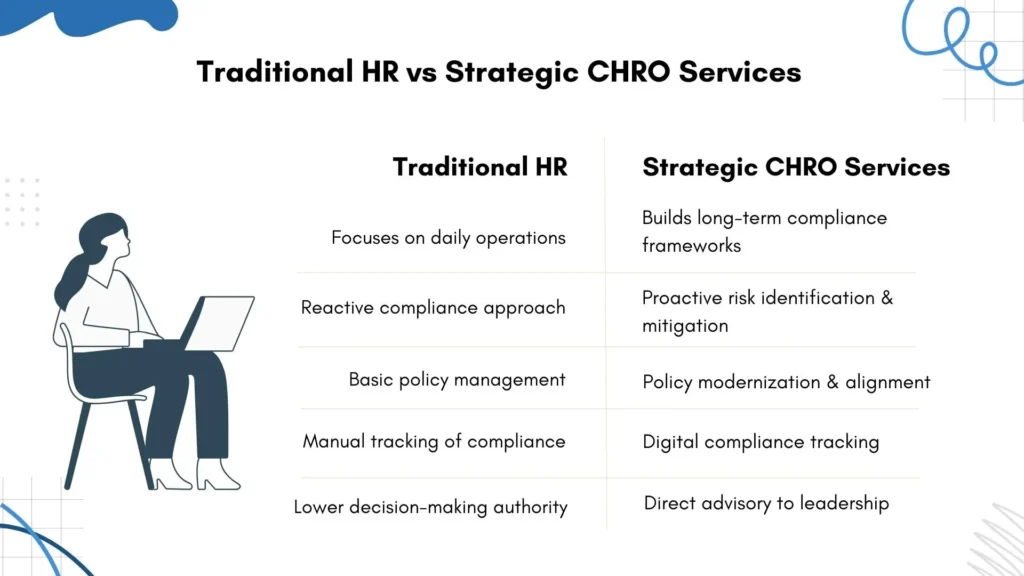
Not every business can invest in a full-time chief officer, but nearly every business needs strong compliance and risk governance. Models such as Outsourced CHRO services, HR leadership consulting, Fractional CHRO, and Virtual HR provide access to senior HR strategy without the cost of a permanent C-suite hire.
These models bring:
- faster compliance diagnosis
- improved policy design
- tech-enabled workflows
- unified governance structures
- risk mitigation frameworks
- scalable support for growth-ready businesses
Such flexible leadership solutions help organizations strengthen compliance maturity while remaining cost-efficient.
FAQ’s
Strategic CHRO Services help organizations build policies, monitor adherence, manage statutory requirements, and ensure employees follow ethical and legal standards across all locations.
CHROs identify people-related risks, implement governance frameworks, strengthen workplace policies, and create processes that reduce legal, operational, and reputational risks.
Rapid regulatory changes, hybrid work models, and increasing employee risks require expert oversight. CHROs ensure compliance systems stay updated, consistent, and audit-ready.
Outsourced CHRO services provide expert leadership without full-time cost. They guide employment law updates, multi-state compliance, HR audits, and governance improvements.
A CHRO compliance strategy covers policy development, regulatory tracking, employee training, documentation, audits, risk assessments, and behavior-level compliance reinforcement.
Yes. CHROs integrate compliance into everyday behavior through training, communication, leadership alignment, and cultural initiatives that make compliance a shared responsibility.