
The role of HR has shifted dramatically over the last few years, but 2026 marks a defining point. The support role that was viewed as part of it has now become a growth, compliance, and culture driver. The term virtual HR is no longer associated with remote HR support in isolation and is a complete scale development of how organizations strategically guide people, address risk, and construct performance-oriented teams without geographic boundaries.
Expanding companies, particularly startups and medium-sized enterprises, are finding virtual HR solutions to get access to leadership-level capability, up-to-date systems, governance systems without the baggage of an old-fashioned HR framework. The forces being used to cause this transformation are that of digital maturity, distributed workforces, and the increase in expectations with regard to compliance, experience, and agility.
Why Virtual HR Is Becoming the Default HR Model in 2026
Organizations are currently working in a complex environment with hybrid teams, international recruitment, shifting labor legislations, and more people scrutiny. Conventional HR arrangements find it difficult to keep up.
Virtual HR offers a flexible operating model where strategic HR leadership, systems, and processes are delivered digitally, often through a blend of technology and senior HR professionals. This approach allows businesses to scale HR capabilities in line with growth, rather than ahead of it.
Key drivers behind adoption include:
- Expansion of distributed workforce management
- Accelerated digital HR transformation
- Demand for leadership-level guidance without permanent roles
- Heightened focus on HR compliance management
- Shift toward measurable people outcomes
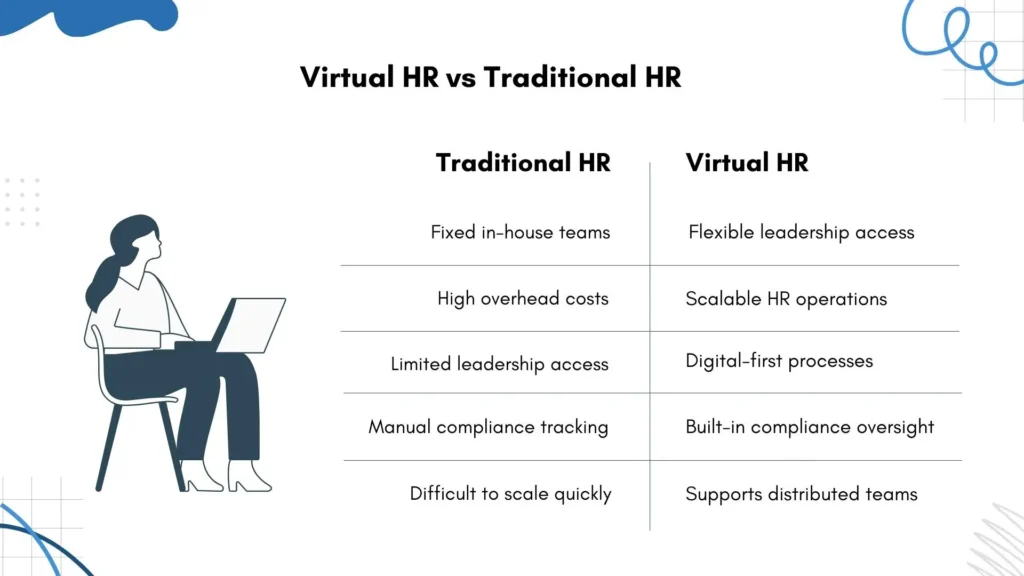
Digital HR Leadership: The Real Shift Behind Virtual HR
What separates Virtual HR from basic HR outsourcing is leadership. In 2026, Virtual HR is closely tied to access to senior decision-makers especially through CHRO services and Fractional CHRO models.
Digital HR leadership focuses on:
- Designing scalable HR operating models
- Translating business goals into people strategy
- Embedding governance into everyday HR processes
- Balancing automation with human judgment
Rather than reacting to issues, Virtual HR leaders proactively manage risk, performance, and culture using data and digital workflows to guide decisions.
The Rise of Fractional CHROs in Virtual HR Models
One of the most impactful shifts in 2026 is the normalization of Fractional CHRO engagement. Expanding companies can have a stage when HR decisions have a direct impact on valuation, compliance risk, and effectiveness of the leadership but a full-time CHRO can be untimely or prohibitively expensive.
Fractional CHROs operating within Virtual HR solutions help organizations:
- Build HR compliance leadership frameworks
- Establish clear people governance
- Align talent strategy with growth plans
- Support founders and leadership teams with senior counsel
This model provides strategic depth while maintaining financial agility, an advantage especially relevant for scaling businesses.
HR Automation as the Backbone of Virtual HR
Technology enables Virtual HR to function at scale. In 2026, HR automation is no longer limited to payroll or attendance, it spans the entire employee lifecycle.
Automation supports:
- Digital onboarding and documentation
- Policy management and acknowledgments
- Performance tracking and goal alignment
- Compliance alerts and audit readiness
- Employee self-service and workflows
However, automation alone is not leadership. The real value emerges when automated systems are guided by strong governance, decision frameworks, and oversight ensuring efficiency does not come at the cost of fairness or compliance.
HR Compliance Leadership in a Distributed Workforce Era
The further the teams are geographically spread, the higher are the compliance risks. Various places come with varied employment regulations, cultural demands, and regulation of paperwork. Herein lies the role of the HR compliance leadership in the achievement of Virtual HR.
Effective Virtual HR models embed:
- Centralized HR compliance management
- Ongoing compliance risk management
- Clear ownership of policies and controls
- Regular compliance reviews aligned with growth stages
Instead of using compliance as an annual audit process, Virtual HR incorporates compliance in the daily HR routine to minimize surprises, fines, and reputation risks.
Managing Compliance Risk Without Slowing Growth
Many growing businesses fear that stronger compliance processes will slow them down. Virtual HR in 2026 disproves this assumption.
With the right structure:
- Risks are identified early
- Controls are built into workflows
- Leadership visibility improves
- Decision-making becomes faster, not slower
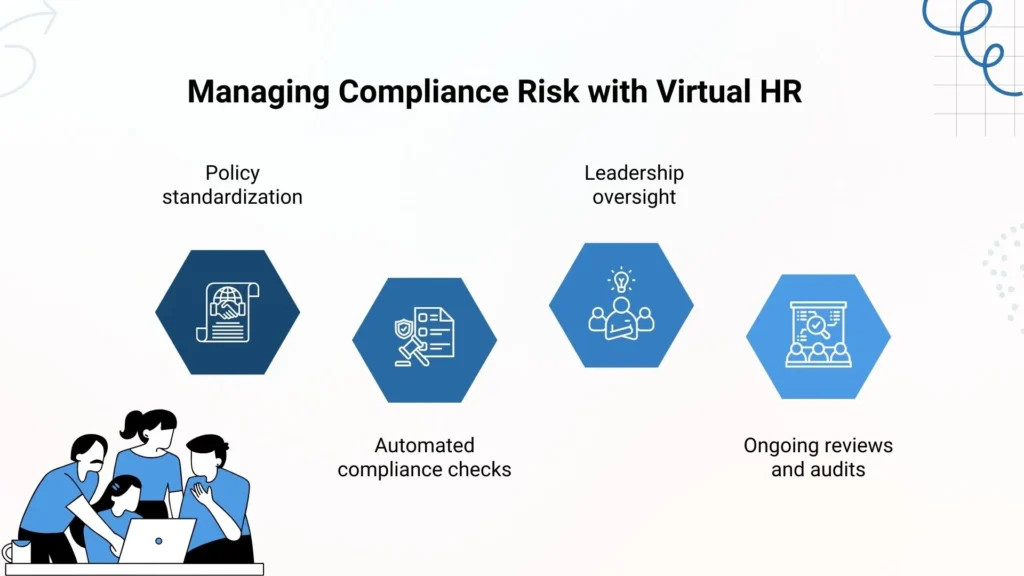
Virtual HR assures compliance risk management, and speed and safety go hand in hand. This balance is particularly severe in the cases of companies that are growing in terms of location or those that are recruiting at an extremely fast rate.
Distributed Workforce Management Beyond Remote Policies
Working remotely is no longer a new experience, and the challenge is to organize work performance, engagement, and accountability across the locations. The concept of distributed workforce management in 2026 extends much further than the guidance of remote work.
Virtual HR addresses this by:
- Standardizing role clarity and expectations
- Aligning performance goals across teams
- Training managers to lead without physical presence
- Creating consistent employee experiences regardless of location
This structured approach ensures that distributed teams operate as a unified organization rather than disconnected units.
Employee Experience Strategy as a Growth Lever
The expectation of the employees has changed. Employees have become very critical of the organizations on how clear, fair, developmental, and accessible the leadership is rather than on remuneration.
A strong employee experience strategy within Virtual HR focuses on:
- Predictable and transparent processes
- Continuous feedback mechanisms
- Digital-first employee touchpoints
- Leadership visibility and communication
Virtual HR also enables businesses to become thoughtful in designing experience, as opposed to allowing individual managers or haphazard practices to do so.
Continuous Performance Management Replaces Annual Reviews
One of the most visible changes in Virtual HR models is the shift to continuous performance management. Annual appraisals no longer align with fast-moving business environments.
In 2026, performance management under Virtual HR emphasizes:
- Ongoing goal alignment
- Regular check-ins and feedback
- Data-supported performance insights
- Clear links between outcomes and growth opportunities
This approach benefits both employees and leadership by keeping performance discussions relevant, fair, and actionable.
What Gets Missed in Virtual HR Strategies and Why It’s Critical
1. Governance Frameworks for Digital HR
Clear decision rights, escalation paths, and accountability models are essential but rarely documented or explained.
2. Human Oversight in Automated HR Systems
Automation must be paired with leadership judgment to prevent bias, misinterpretation, or compliance blind spots.
3. Leadership Enablement for Virtual Managers
Managing people virtually requires new skills. Virtual HR must actively develop leaders, not just deploy tools.
4. Measurable HR Outcomes
Virtual HR solutions work best when tied to business metrics retention, productivity, compliance health, not just activity completion.
Virtual HR as a Strategic Advantage, Not a Cost Center
In 2026, organizations that treat Virtual HR as a strategic function gain a measurable edge. They respond faster to change, scale more responsibly, and create environments where people perform with clarity and confidence.
By combining digital HR transformation, senior leadership access, compliance rigor, and employee-centric design, Virtual HR reshapes how growing businesses compete for talent and manage risk, without adding unnecessary complexity.
As Virtual HR models mature, the focus continues to shift from tools to leadership, from administration to outcomes, and from reactive HR to intentional people strategy powered by technology, guided by expertise, and aligned with business growth.
FAQ’s
Virtual HR focuses on leadership, strategy, and compliance not just task execution. It includes decision-making support, performance frameworks, and long-term people planning, not only administrative services.
Growing companies use Virtual HR to access senior HR expertise, manage compliance risk, support distributed teams, and scale operations without building large in-house HR departments.
Virtual HR centralizes policies, documentation, and reporting while embedding compliance checks into daily HR workflows. This ensures consistency and audit readiness across locations.
Yes. Virtual HR supports distributed workforce management by standardizing processes, clarifying roles, enabling remote performance tracking, and ensuring fair treatment across teams.
Yes. Virtual HR provides scalable systems, leadership oversight, and compliance control, making it a sustainable model for businesses planning long-term expansion.