Every founder remembers the day the spreadsheet stopped working.
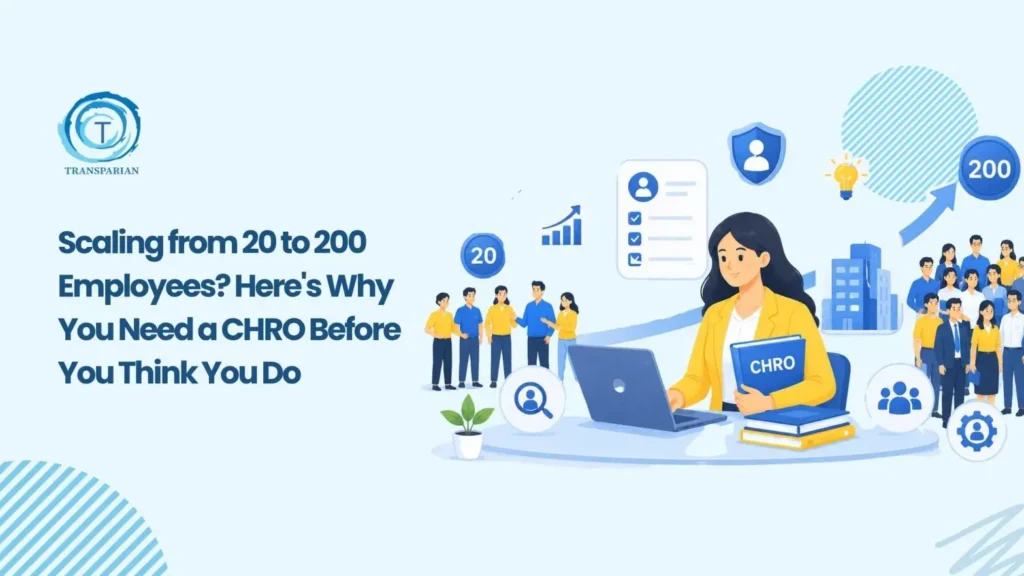
At 20 employees, HR is a shared responsibility. The founder writes offer letters, someone in finance runs payroll, and someone in operations handles the odd leave request. It works because everyone still fits in one room. But somewhere between 50 and 150 employees, that informal system quietly breaks and most leadership teams don’t notice until the damage is already done.
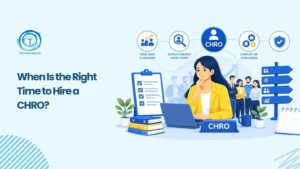
Here’s the part nobody tells founders early enough: growing headcount and growing HR leadership are not the same curve. Companies that treat them as one usually end up hiring a fractional CHRO six to twelve months after they actually needed one after the attrition spike, after the compliance notice, after the culture has already started to fray at the edges.
The 20-to-200 Employee Trap
There’s a predictable pattern founders fall into. At 20 people, hiring feels personal, the founder knows every candidate, culture spreads by proximity, and compliance obligations are minimal. By 80 or 100, the company has crossed into a different regulatory and organizational category entirely, whether anyone officially decided that or not. By 200, there are usually layers of management that were never designed, they simply happened, because someone had to own a growing team.
The trap is that none of these shifts feel urgent at the moment. Each one looks like a small, manageable problem:
- A missed compliance filing here
- An inconsistent policy there
- A manager who gives feedback completely differently from the manager one desk over
Individually, they’re noise. Together, they turn into the kind of organizational debt that a CHRO exists specifically to catch before it compounds.
Why “We’ll Hire HR When We Need It” Is the Wrong Framing
Most founders don’t resist HR leadership out of neglect. They resist it because HR at the operational level payroll, leave, onboarding paperwork genuinely can wait a while. What can’t wait is strategic HR leadership: someone responsible for organizational design, leadership development, pay structure, and workforce planning tied directly to where the business is actually headed.
By the time a company feels the need for a CHRO, it’s usually already showing symptoms unexplained attrition among the people you can least afford to lose, inconsistent people decisions across departments, a founder still personally fielding escalations that should never have reached them, or a board asking pointed questions about org structure that nobody can answer with confidence. These are lagging indicators. The real value of a CHRO is in acting on the leading ones, long before they show up on an attrition report.
What Actually Breaks Between 20 and 200 Employees
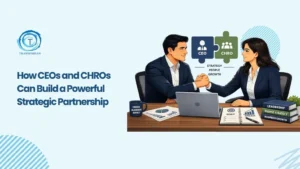
Organizational structure. At 20 people, reporting lines are obvious. At 200, without deliberate design, companies end up with a flat structure pretending to be a hierarchy, or a middle layer that slows every decision down. This is usually where CEO and CHRO alignment starts to matter most. Someone needs to be building this structure ahead of growth, not patching it after confusion sets in.
Compensation consistency. Early hires are often paid based on negotiation leverage rather than any real framework. By 100 employees, the pay gaps that were invisible at 20 become visible, resented, and occasionally the subject of a very uncomfortable meeting. Building a defensible pay structure before the company scales is far cheaper than untangling one afterward.
Compliance exposure. This is where risk builds up the fastest and the quietest. As headcount grows, so do statutory obligations, labour law registrations, PoSH compliance and annual reporting, PF/ESIC thresholds, state-specific labour codes, board-level disclosures most founders have never had reason to track. A CHRO doesn’t just manage people; they own the compliance backbone that keeps a scaling company off a regulator’s radar.
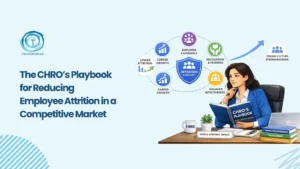
Manager capability. Somewhere around 50 to 80 employees, individual contributors get promoted into their first management role often with zero training in giving feedback, managing performance, or handling conflict. Left unaddressed, this becomes one of the biggest drivers of employee attrition in scaling companies, and it rarely shows up until exit interviews start telling the same story.
Culture that isn’t accidental. At 20 people, culture is whoever happens to be in the room. At 200, culture has to be designed and reinforced through actual systems onboarding, recognition, communication rhythms. Left alone, culture doesn’t stay the same as a company scales. It dilutes, unless someone owns keeping it intact.
Deal readiness. Even if a founder isn’t thinking about a merger, acquisition, or fundraise right now, buyers and investors look hard at HR maturity. Messy org charts, undocumented policies, and compliance gaps are exactly the kind of thing that shows up during due diligence and slows a deal down. This is one reason fractional CHRO support during M&A has become common, the groundwork pays off long before any deal conversation starts.
The Cost of Waiting
The instinct to delay HR leadership usually comes from a reasonable place, budget discipline, a sense that a full-time CHRO is premature at this size, or simply not knowing what the role would actually do day to day. But waiting isn’t free. It shows up as:
- Regretted attrition among people you can’t easily replace
- Compliance penalties that basic foresight would have avoided
- A founder still doing HR’s job eighteen months after they should have handed it off
- Reports and dashboards that describe problems instead of fixing them
This last point matters more than it sounds. Plenty of companies bring in HR support that measures everything and changes nothing. The difference between that and a genuinely action-oriented CHRO is what actually moves the needle during a scaling phase.
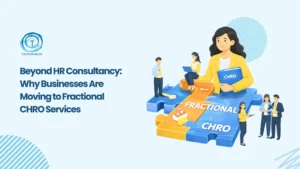
This is exactly why the fractional CHRO model has become the practical middle ground for growing companies. It skips the cost and long-term commitment of a full-time executive hire, while putting experienced leadership in place at the exact point where the informal systems of a 20-person company stop being enough. Whether that support looks like an on-demand or virtual CHRO or a more hands-on virtual HR model, the goal is the same; build the org design, pay framework, and compliance foundation in parallel with growth, not after it.
What to Look for Before You Hit 100 Employees
The right time to bring in CHRO-level thinking isn’t a fixed headcount, it’s a set of signals. Worth checking:
- Is the founder still personally involved in every hiring decision past employee 40?
- Are managers handling performance conversations with no shared framework at all?
- Has the company ever run a PoSH audit or does it have a documented Internal Committee?
- Are compensation decisions being made ad hoc, without any structure tied to role, level, or market?
If more than one of these sounds familiar, that’s not a coincidence, it’s a pattern. The founders who scale smoothly from 20 to 200 aren’t the ones who happened to avoid these problems. They’re the ones who brought in strategic HR leadership before the problems became visible, while there was still room to design things deliberately instead of repairing them under pressure.
Let Transparian Simplify Your Journey to Strategic HR Leadership
From building the right organizational structure to putting compliance, compensation, and manager capability in place before growth outpaces them, Transparian provides expert Fractional CHRO Services for founders and business owners scaling their teams. Through experienced HR leadership and practical, action-oriented advisory, Transparian helps growing businesses build people systems that scale smoothly, retain top talent, and stay ahead of the problems that usually only show up once it’s too late.
FAQ’s
A growing company should consider a Fractional CHRO when employee growth starts creating challenges in hiring, compliance, performance management, or organizational structure. Many businesses benefit from strategic HR leadership between 30 and 100 employees, before these issues become costly.
A Fractional CHRO provides executive-level HR leadership without the cost of a full-time hire. They help with workforce planning, organizational design, leadership development, compensation strategies, compliance, employee engagement, and long-term HR planning.
An HR manager handles day-to-day HR operations such as recruitment, onboarding, payroll coordination, and employee relations. A Fractional CHRO focuses on business strategy, people planning, culture, organizational growth, compliance, and leadership alignment.
A Fractional CHRO creates scalable HR systems, standardizes hiring processes, develops leadership capabilities, establishes compensation frameworks, ensures statutory compliance, and builds an organizational structure that supports rapid business growth.
A Fractional CHRO improves retention by implementing structured performance management, career development plans, fair compensation practices, manager coaching, employee engagement initiatives, and a positive workplace culture that supports long-term growth.
CHRO services align people strategy with business goals by improving workforce planning, strengthening leadership, building scalable HR processes, ensuring compliance, developing company culture, and helping businesses attract and retain top talent as they grow.