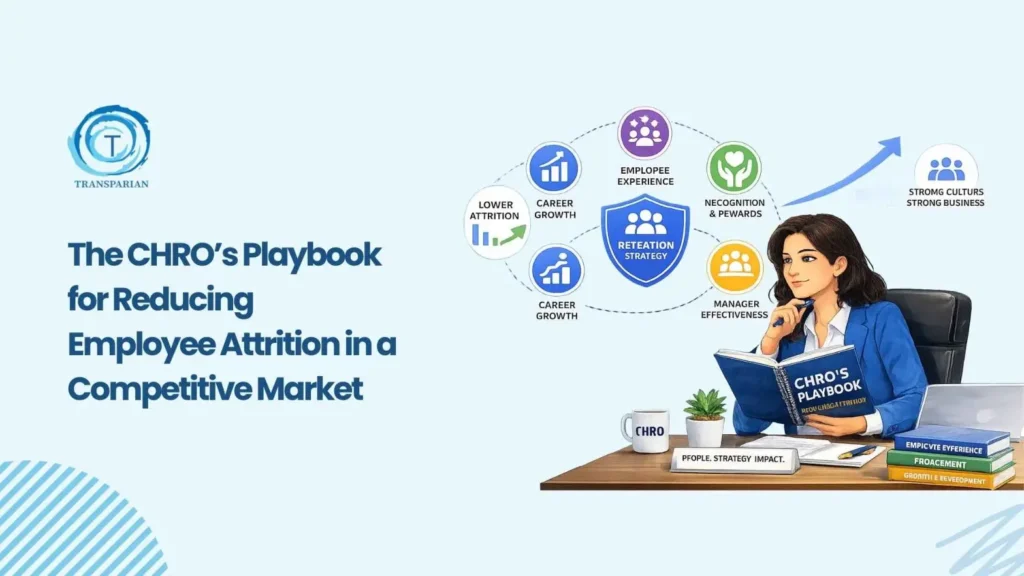
Every growing company hits a point where attrition stops being a statistic and starts showing up in missed deadlines, stretched teams, and leadership conversations that go in circles. You lose a couple of key people, everyone pitches in, and then a couple more – and suddenly you are spending more on recruitment than training.
This is not just a talent market problem. India is a country where voluntary turnover has remained at 18-25 per cent for decades. Organisations are rebuilding their workforce each year, without understanding why. The organisations getting this right are not spending more on perks. They are investing in the right talent – CHRO Services or a Fractional CHRO – to develop a retention playbook that gets to the root of the problem. This playbook looks like this.
1. Stop Relying on Exit Interviews
Exit interviews are a post-mortem. By the time someone is explaining why they are leaving, the decision was made weeks ago and they probably will not tell you the whole truth anyway. If your attrition strategy starts here, you are already too late.
A CHRO builds a listening infrastructure that catches the signal before it becomes a resignation. The tools that matter:
- Pulse surveys run monthly or quarterly to track team-level engagement trends
- Stay interviews with high-performers asking: what would make you leave?
- Structured one-on-ones between managers and direct reports to surface concerns early
- Manager feedback loops that flag disengagement before it shows up in headcount numbers
When organisations bring in CHRO Services, this diagnostic layer is usually the first thing built. It moves attrition from reactive crisis management to something that can actually be measured and addressed.
2. Your EVP on Paper Is Not Your EVP in Practice
Most companies have a decent Employee Value Proposition if you read the careers page — competitive salary, flexible work, great culture. The problem is what employees actually experience on a Tuesday afternoon is often very different. A Fractional CHRO audits that gap. It is almost always where the retention problem lives.
The EVP components that retain employees in today’s market:
- Genuine flexibility, not a policy that exists but a culture that actually supports it
- Career progression that is visible and achievable, not just promised at appraisal time
- Learning investment tied to individual goals, not just mandatory compliance training
- Recognition that happens in the moment, not once a year at an awards ceremony
- Leaders who actually live the values the company claims to stand for
This is not complicated. But it does require someone at the senior leadership level to own it, which is exactly the role a Fractional CHRO plays.
3. The Biggest Retention Lever Most Companies Ignore: Manager Quality
People do not leave companies. They leave managers. Gallup’s research consistently shows that managers account for at least 70 percent of the variance in employee engagement. Yet most organisations invest far more in employer branding than in the quality of the managers employees report to every day.
CHRO Services focused on manager quality typically cover:
- Attrition analytics broken down by team and manager, the problem is almost never evenly distributed
- Coaching programmes for first-time managers promoted for technical skills but never trained to lead people
- 360-degree feedback tools that surface blind spots before they damage team morale
- Accountability frameworks that tie a manager’s performance review to their team’s retention and engagement
A Fractional CHRO has the seniority to surface these conversations at the leadership table without it becoming political. That is not something an HR generalist can typically pull off and it is one of the most practical reasons the Fractional CHRO model works so well for mid-sized organisations.
4. Retention Starts Before the Offer Letter
Companies that consistently outperform on retention hire differently. They are clear about who thrives in their environment, honest about what the role actually involves, and they treat the first 90 days as a retention programme rather than an orientation checklist. The most dangerous attrition window is the first six months and it almost always traces back to mismatched expectations set during hiring.
What a retention-first hiring approach looks like in practice:
- Job descriptions that reflect the real day-to-day of the role, not just a wishlist of qualifications
- Interview processes that assess cultural alignment alongside skills
- Honest conversations with candidates about pace, culture, and what success actually looks like
- 90-day onboarding with clear milestones, manager check-ins, and early wins built in
When CHRO Services are engaged for talent acquisition redesign, the impact on early-tenure attrition is usually one of the first measurable outcomes, often visible within two to three quarters.
5. Predict Who Is About to Leave, Not Just Count Who Already Has
Most HR teams can tell you last quarter’s attrition rate. Very few can tell you which employees are likely to resign in the next 60 days. That gap between measuring and predicting is where a data-informed CHRO makes a real difference. Certain behaviours consistently precede a resignation and if you are tracking the right signals, you can act before the decision is made.
Early warning signs a CHRO tracks to get ahead of attrition:
- Declining engagement scores across two or more consecutive pulse surveys
- Reduced participation in L&D programmes or internal initiatives
- Stagnant performance ratings with no documented career development conversation
- Increase in unplanned absenteeism taken in short, irregular bursts
- Withdrawal from team communication fewer messages, skipped meetings, reduced visibility
A Fractional CHRO with cross-industry experience can also benchmark these metrics against sector norms, helping leadership understand what is within their control versus what is simply the market.
Upgrade Your HR Leadership
Combine strategy and execution with experienced CHRO-level guidance.
6. Mid-Tenure Employees Leave When They Cannot See a Future
The most expensive attrition to manage is the quiet kind. Mid-tenure employees, those in the two to five year range, start looking outside not because they are unhappy today, but because they cannot see where they are going. The role is decent. The company is fine. But there is no clear next step, no visible promotion criteria, and nobody is having that conversation with them.
Building career architecture that retains this cohort involves:
- Role frameworks that define what each level means in terms of scope, accountability, and decision authority
- Promotion criteria employees can self-assess against, removing the ambiguity that drives them to look outside
- Lateral mobility pathways for high-performers who are ready to grow but do not have a vacancy above them
- Regular career conversations at the manager level, structured and supported by tools, not left to chance
This requires CHRO-level authority and cross-functional buy-in. Companies that engage CHRO Services for people strategy consistently see better mid-tenure retention as a direct result.
7. Make Retention a Business Problem, Not an HR Problem
The most important shift a CHRO drives is this: retention is not an HR metric. It is a business metric. And until the leadership team treats it that way, nothing else on this list will move the needle.
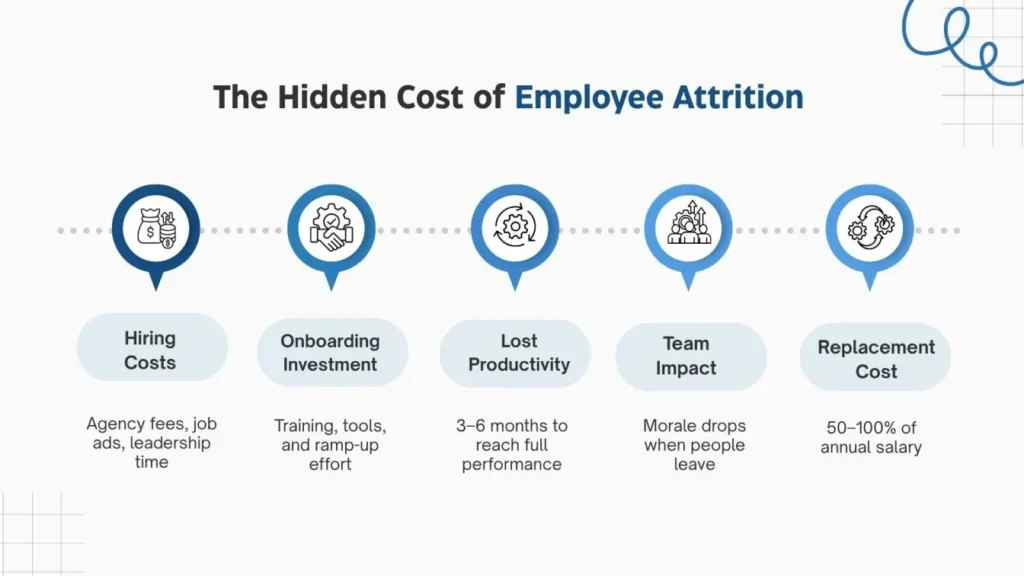
The true cost of losing one employee that leaders need to see clearly:
- Recruitment costs — agency fees, job board spend, and senior leader interview time
- Three to six months before a replacement hire is fully productive
- Lost productivity and client impact during the vacancy and ramp-up period
- Team morale impact — when good people leave, others start asking themselves the same question
Replacing a mid-level employee typically costs 50 to 100 percent of their annual salary. For a company running at 25 percent attrition on a 200-person team, that number compounds quickly. A Fractional CHRO translates people metrics into P&L language that founders, CEOs, and CFOs actually respond to. That shift in ownership is what moves the dial.
The CHRO Retention Playbook: At a Glance
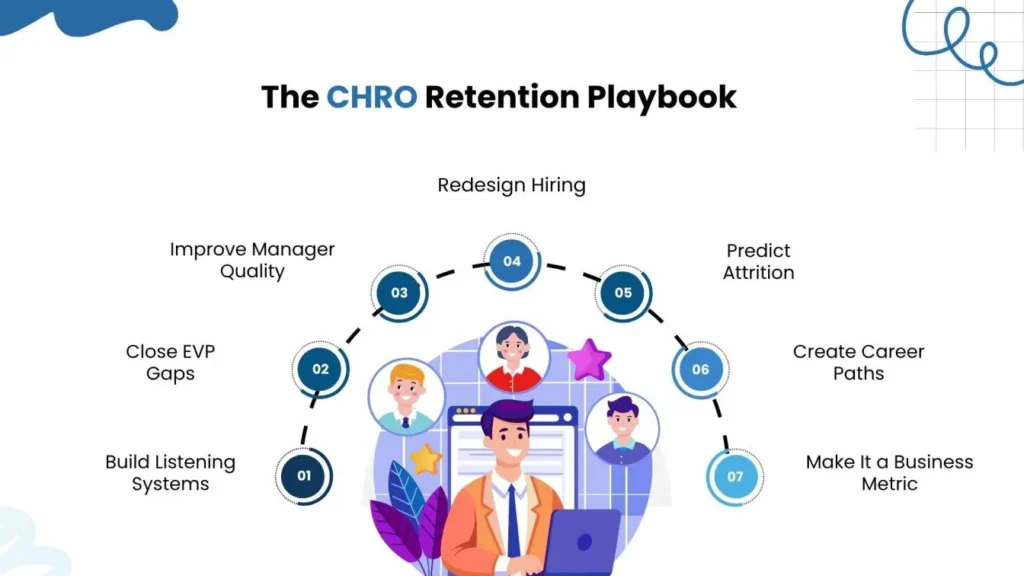
- Build continuous listening systems — exit interviews are already too late
- Close the gap between your stated EVP and what employees actually experience
- Fix manager quality — it drives more attrition than any other single factor
- Redesign hiring to set the right expectations from day one
- Use workforce analytics to predict attrition before it happens
- Build visible career architecture for mid-tenure employees
- Make retention a P&L conversation, not just an HR one
Work with Transparian on Your Retention Strategy
Transparian provides CHRO Services and Fractional CHRO engagements for growing organisations across India and the APAC region. If attrition is a problem your business is dealing with right now, we can help you diagnose it, build a strategy around it, and execute on it, with senior HR leadership that works as part of your team, not as an outside consultant.
FAQ’s
Employee attrition refers to the reduction of workforce due to resignations, retirements, or other voluntary exits. High attrition impacts productivity, increases hiring costs, and disrupts team stability, making it a critical business concern.
The most common causes include poor manager relationships, lack of career growth, low engagement, mismatched job expectations, and inadequate compensation or recognition.
CHRO Services help organizations identify root causes of attrition, build retention strategies, improve manager effectiveness, and align people practices with business goals.
An Employee Value Proposition (EVP) is the overall experience and benefits employees receive. A strong and consistently delivered EVP improves satisfaction and reduces attrition.
Organizations can predict attrition using workforce analytics such as engagement scores, absenteeism patterns, performance trends, and participation in learning programs.
Key strategies include improving manager quality, creating clear career paths, strengthening onboarding, using data to predict risks, and aligning retention efforts with business goals.