Most companies assume that hiring is the fastest way to fill skill gaps. But in today’s rapidly changing business environment marked by talent shortages, rising salary expectations, and longer hiring timelines many organizations are discovering that the smarter first move is building capability inside their current workforce. Before reaching out to recruitment agencies, staffing services, job recruitment agencies, Hiring Agencies, or Tech Recruitment Agencies, strengthening your internal talent bench often delivers faster, more sustainable, and more cost-efficient results.
Upskilling and training your existing team is no longer just a development initiative, it’s a strategic workforce planning tool. It helps companies reduce dependency on external hiring, improve productivity, boost retention, and build a future-ready workforce with the right competencies to support growth.
Below is a deep-dive into all the covered topics in the market and the missed topics most blogs don’t address, giving you a comprehensive view of why investing in employee upskilling is a game-changing move before you begin recruiting externally.
The Rising Skill Gap and Why Internal Development Matters
Organizations of all industries are experiencing growing skill gaps particularly those that require technology, customer experience, compliance, analytics, and digital implementation. The changing nature of markets requires more specialized and updated skills in the job position. Outsourcing can seem like the best quick solution, yet it is frequently constrained by supply, lacks specialized skills, and is having to compete with the best talent.
This is where talent shortage solutions rooted in internal development become essential. When you assess your current workforce, conduct a capability audit, and identify learning paths that align with business goals, you unlock a reliable talent pipeline that is faster, more predictable, and more cost-effective than external hiring.
Firms developing internal learning channels, embedding a culture of learning, and investing in skill development achieve less dependency on outsourcing firms and prevent the cycle of skyrocketing costs of recruiting and replacing employees.
Training Helps Close Skill Gaps Faster Than Hiring
Hiring is not faster than training, which is one of the biggest myths. Reality has it that recruitment cycles, particularly of the skilled job, may take 30 to 90 days. Including onboarding, ramp-up, cultural adaptation and workflow orienting, it can take months before a new employee can work in full capacity.
Up-skilling of an already existing employee, on the other hand, takes advantage of his or her institutional knowledge, established relationships, and ecosystem knowledge. When supported by modern skills development programs, micro-learning modules, and hands-on project assignments, employees can learn needed competencies more quickly than bringing in someone from the outside.
This is more so in digital roles that were impacted due to tech upskilling trends where learning is skill-based, has modularity and is rapidly deployable.
Cost Savings and Better ROI from Internal Development
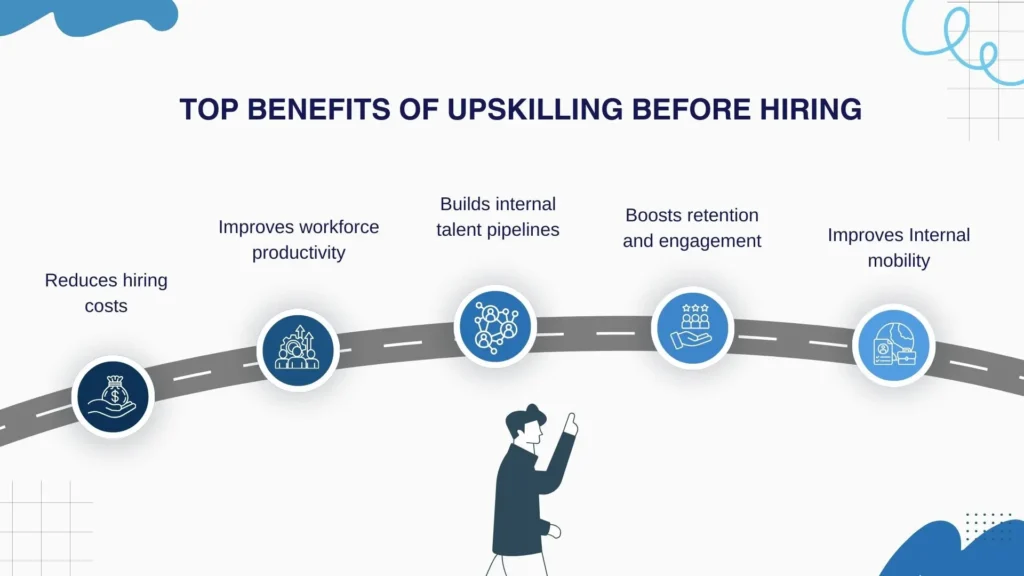
Internal recruitment has latent expenses in terms of advertising the job, recruitment agency, onboarding, investing in interviews, overheads, and mis-hiring. These costs are minimized by training your current employees.
Upskilling delivers a measurable return on investment because:
- Employees already understand your systems and processes.
- Time-to-productivity is shorter compared to external hires.
- Training boosts long-term organizational capability rather than filling gaps one role at a time.
- You avoid competing for talent in inflated markets.
- A culture of growth improves retention and reduces turnover costs.
When companies invest in internal development, they unlock talent optimization maximizing the potential of people already on the payroll.
Improved Productivity and Performance Across Teams
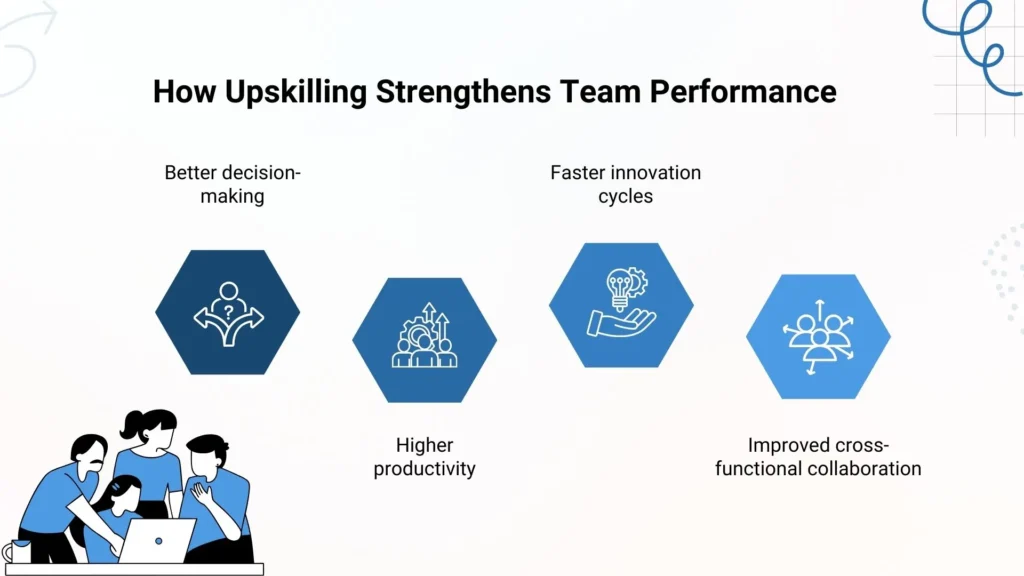
Employees with systematic training are better in performance, more productive, and productive in achieving the goals of the organization. An organization with a competency-enhancing workforce is more flexible, more involved, and better positioned to effectively cope with the changing roles and obligations.
Upskilling boosts team skill improvement, especially when learning is applied directly to business projects. Whether it’s digital literacy, industry-specific tools, management skills, or soft skills like communication and critical thinking, training becomes an accelerator for performance.
The future-ready workforce is also stronger, which means that organizations can react to market opportunities, customer demands, and technological changes much faster.
Internal Mobility Becomes Easier and More Efficient
One rarely discussed benefit is how training strengthens internal mobility. Instead of hiring externally for every role, employees can move vertically to leadership roles or horizontally into new specializations.
A robust employee learning strategy creates a talent ecosystem in which employees can:
- Transition from manual roles to tech-enabled ones
- Move from operations to customer-facing roles
- Take on leadership or mentorship positions
- Grow into highly skilled technical or analytical roles
Internal mobility reduces hiring dependency and makes succession planning more seamless, efficient, and predictable.
Boosting Employee Engagement and Retention
Staff tend to remain in a firm that invests in their development. Training programs are a clear indication that the company appreciates their input and has long-term prospects in their progression. This enhances motivation, loyalty and sense of belonging.
When organizations cultivate a development-focused environment, employee engagement rises significantly. Engaged employees are more efficient, more collaborative, and more committed to business outcomes.
Firms that have excellent learning initiatives are always in a position to reduce their turnover, and this is beneficial in avoiding the vicious circle of hiring and retraining that is costly and disruptive.
Building a Future-Ready Workforce for Rapidly Changing Markets
Industries are evolving quickly, driven by automation, AI, digital transformation, and new customer expectations. Roles that exist today may change dramatically in the next 12–24 months. This means companies need proactive workforce planning, not reactive hiring.
Upskilling supports this shift by helping organizations develop:
- Multi-skilled employees who can adapt to multiple functions
- Cross-functional teams with broader expertise
- Workforce resilience in times of disruption
- Agile teams capable of absorbing new responsibilities
- Strong talent pipelines aligned with future business goals
Investing in training reduces risk, increases capability, and strengthens operational stability in the face of rapid market changes.
Faster Innovation and Stronger Problem-Solving Capabilities
Learning teams are always more innovative. Employee upskilling increases innovation, introduction to new tools, improved decision-making, and solving complex problems. The employees get up-to-date skills, technology, and business models that speed up the innovation processes.
It is particularly useful in those organizations which implement new technologies or enhance internal processes. The teams that are upskilled are also more comfortable with trying new ideas and implementing new strategies.
Better Collaboration and Cross-Functional Communication
Training employees to new skills enables them to know the bigger picture in the organization. The alignment is improved through cross-functional upskilling such as the sales teams on product features or customer support teams on analytics.
Better collaboration accelerates execution, reduces friction between teams, and enhances the overall organizational workflow. Training encourages employees to share knowledge, support each other’s growth, and build a stronger internal community further lowering the immediate need for job recruitment agencies or Hiring Agencies when internal talent can effectively take on evolving responsibilities.
Lower Hiring Risks and More Accurate Workforce Planning
Hiring comes with risks, cultural mismatch, skills mismatch, low performance, or quicker-than-expected turnover. Upskilling minimizes these risks because you already know the employee’s strengths, learning pace, and cultural alignment.
Training also supports more accurate workforce planning. By identifying internal talent who can take on emerging roles, organizations can reduce dependency on external hiring pipelines and focus resources on truly critical positions.
This is especially valuable for fast-growing businesses that want predictability in talent supply.
FAQ’s
Upskilling helps close skill gaps faster, reduces hiring costs, improves productivity, and builds a future-ready workforce. It ensures internal talent is prepared for evolving roles without immediately relying on external hiring.
Yes. Training reduces the need for constant external hiring, minimizes onboarding expenses, and maximizes the return on your current workforce. It also lowers dependency on recruitment partners and job boards.
Employees stay longer when they feel valued and supported. Offering learning and development opportunities increases loyalty, engagement, and motivation, helping companies avoid frequent rehiring cycles.
Upskilling enhances problem-solving, productivity, collaboration, and innovation. Teams become more confident, agile, and capable of handling new responsibilities with minimal external support.
Microlearning, on-the-job training, digital courses, mentorship, and project-based learning are the fastest and most effective ways to build new capabilities within existing teams.
The biggest advantage is creating a sustainable talent engine strengthening internal capabilities, reducing hiring pressure, and building a workforce ready for future challenges.