
Small and mid-sized enterprises reach a critical point where people’s decisions begin to impact revenue, compliance, culture, and long-term scalability. Hiring, retention, leadership gaps, compliance risks, and inconsistent HR processes start surfacing simultaneously. At this stage, founders often ask one core question: should we invest in a full-time CHRO or explore a Fractional CHRO model?
For most SMEs, the answer increasingly leans toward flexibility, expertise, and impact rather than hierarchy or headcount. Understanding why this shift is happening requires looking beyond job titles and into outcomes.
The Real HR Challenge SMEs Face
SMEs rarely struggle because they lack HR intent. They struggle because they lack structured hr leadership that balances strategy with execution. Early-stage HR teams focus on operations payroll, attendance, hiring paperwork while leadership-level decisions such as workforce planning, talent management, and long-term people management are either reactive or ignored.
As organizations grow, these gaps create:
- High attrition due to unclear career paths
- Inconsistent performance expectations
- Compliance vulnerabilities
- Leadership burnout
This is where CHRO-level thinking becomes essential but not necessarily a full-time hire.
What a Fractional CHRO Actually Does (Beyond the Title)
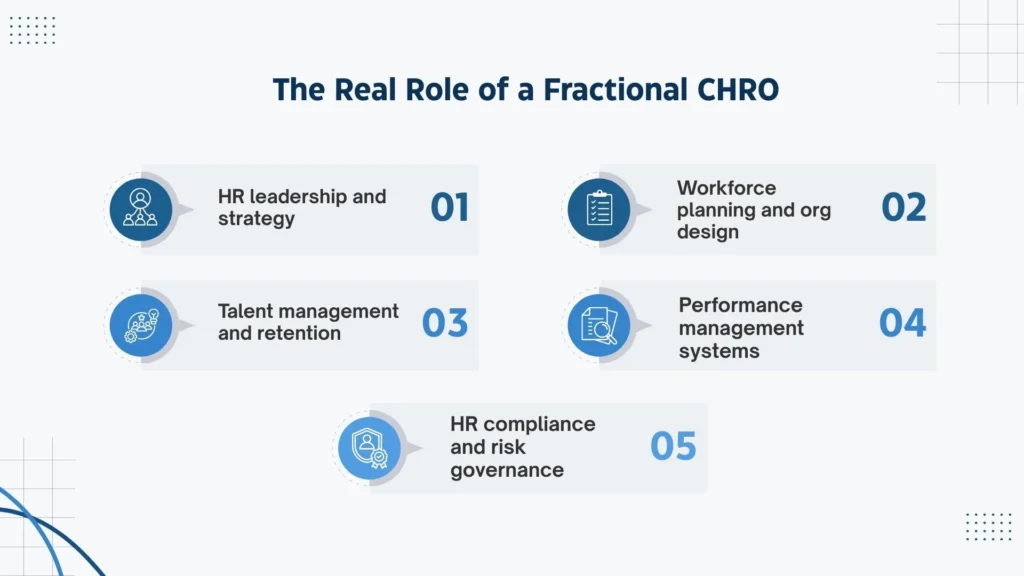
A Fractional CHRO provides senior HR leadership on a part-time or engagement-based model. Unlike operational HR managers, this role focuses on designing systems, aligning people strategy with business goals, and creating scalable HR frameworks.
Key responsibilities typically include:
- Building people strategy aligned with business objectives
- Designing performance management systems
- Structuring employee retention strategy
- Leading hr compliance and governance
- Strengthening leadership capability across teams
For SMEs, this level of expertise is needed but not always 40 hours a week.
Cost Efficiency Without Capability Compromise
Employing a full-time CHRO is associated with huge fixed costs, salary, benefits, long-term obligations, sometimes before the organization is even quite clear about what kind of HR leadership it requires. A Fractional CHRO is a way of accessing the same strategic capability at a fraction of the price, and has the flexibility to adopt a larger or smaller role.
This cost efficiency allows SMEs to:
- Allocate budgets toward growth and hiring
- Avoid premature executive overhead
- Access seasoned leadership without long-term risk
Fractional leaders unlike those hired by the junior HR have the pattern recognition of many organizations which allows them to make faster and more informed decisions.
Strategic Depth vs Administrative Load
The fact is that many SMEs wrongly engage full-time HR leaders who get absorbed with the administrative tasks. Virtual HR solutions enable a Fractional CHRO to split up strategy and execution.
While internal HR teams handle day-to-day tasks, the fractional leader focuses on:
- Organizational design
- Leadership coaching
- Policy architecture
- hr risk management
This ensures that HR evolves from a support function into a growth driver.
Why SMEs Need Workforce Planning Before Headcount Expansion
Disciplined workforce planning is among the least noticed benefits of a Fractional CHRO. SMEs enjoy role clarity, capability mapping, and future-fit org structures, in lieu of reactive hiring.
Effective planning answers questions like:
- Which roles drive revenue versus support growth?
- When should leadership layers be introduced?
- How do we prevent role redundancy?
A full-time hire may be too embedded to challenge assumptions, while a fractional leader brings objectivity and strategic distance.
Talent Management Without Bureaucracy
In most cases of SMEs, the structured talent management is usually postponed with the assumption that talent management is a concern in large organizations. As a matter of fact, there is an early investment in performance structures and career advancement, which decreases attrition and increases productivity.
A Fractional CHRO designs:
- Clear performance expectations
- Growth paths aligned with business needs
- Feedback systems tied to outcomes
These systems are practical, lean, and tailored avoiding the bureaucracy that often accompanies full-scale HR departments.
Employee Retention Is a Leadership Issue, Not an HR One
Compensation alone is hardly a problem with attrition in SMEs. It is also motivated by lack of clarity over leadership, inconsistency in management practices and distrust. A Fractional CHRO works closely with founders and managers to build a sustainable employee retention strategy.
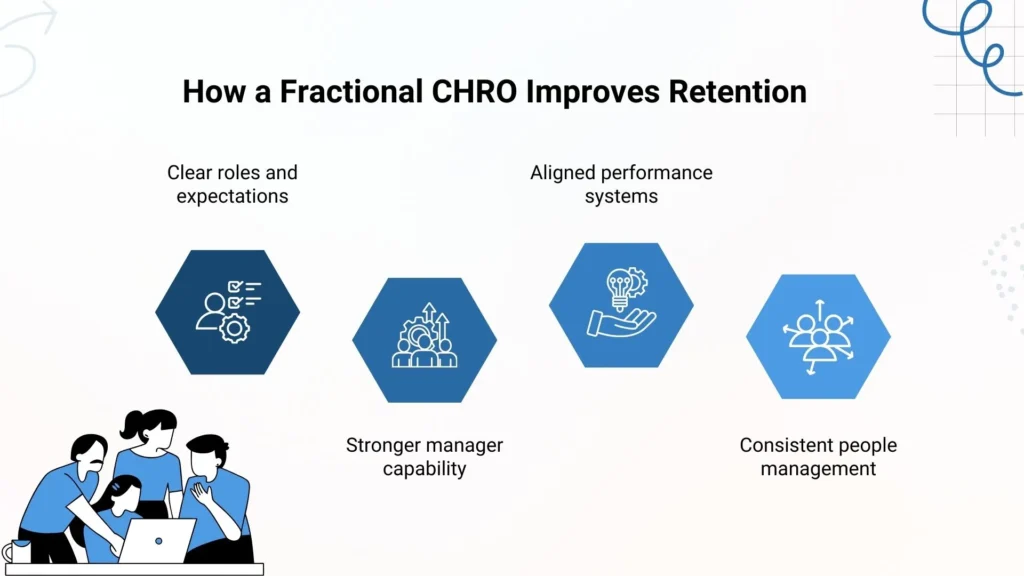
This includes:
- Manager capability building
- Culture alignment
- Transparent communication frameworks
- Leadership accountability
Consistency, equitability, and development are the areas that the strategic HR leadership is most important in enhancing retention.
Compliance and Risk: Where SMEs Are Most Vulnerable
As teams grow, regulatory exposure increases. Many SMEs operate with partial awareness of statutory compliance in hr, relying on outdated policies or external vendors without internal ownership.
A Fractional CHRO strengthens:
- Compliance governance
- Policy audits
- Risk assessments
- Alignment with labor laws
This proactive approach to hr compliance and hr risk management protects the organization from penalties, disputes, and reputational damage.
Fractional CHRO vs Full-Time Hire: Execution Reality
Even a full-time CHRO can take months to get familiar with the business before he or she makes a difference. A Fractional CHRO is hired with a specific purpose to address some problems and get some results.
For SMEs, this means:
- Faster decision-making
- Outcome-based engagement
- Reduced dependency on hierarchy
This execution-first mindset is particularly valuable during phases of rapid growth or transition.
Why Fractional CHROs Are Ideal for Startups and Scaling SMEs
In start-ups and early and growth-stage companies, particularly in fractional chro, the fact that one can gain access to the senior HR leadership without committing to a fixed structure is a strategic advantage.
Startups benefit from:
- Scalable HR architecture
- Founder-level advisory support
- Culture design during growth
- Integration of people management with business strategy
This flexibility supports experimentation without long-term risk.
Performance Systems That Drive Accountability
Many SMEs operate without formal performance management systems, leading to subjective evaluations and unclear accountability. A Fractional CHRO introduces systems that are simple, measurable, and aligned with business outcomes.
These systems focus on:
- Role clarity
- Goal alignment
- Continuous feedback
- Leadership responsibility
The result is improved productivity and reduced conflict.
Virtual HR Solutions as an Extension of Leadership
The use of fractions can be supplemented by modern Virtual HR solutions to enable consistency in executing it. HR processes with technology enable support documentation, analytics, and communication, leaving leadership to think about strategy.
A Fractional CHRO makes sure that these tools are applied to serve a purpose and not simply out of convenience.
When Full-Time CHROs Make Sense and When They Don’t
Full-time CHROs are valuable when organizations reach scale, complexity, and maturity. However, hiring one too early often leads to misalignment, underutilization, or cultural mismatch.
For SMEs still evolving:
- Needs change rapidly
- Strategy is iterative
- Flexibility matters more than permanence
This is where CHRO services delivered fractionally provide maximum ROI.
Building HR Leadership Without Overbuilding the Org Chart
SMEs don’t fail because they lack people. They fail because they lack clarity. HR leadership consulting through a fractional model focuses on clarity roles, expectations, culture, compliance without inflating structure.
By embedding senior thinking without structural rigidity, organizations build resilience rather than dependency.
FAQ’s
A Fractional CHRO is a senior HR leader who works with an organization on a part-time or engagement basis, providing strategic HR leadership without being a full-time employee.
A full-time CHRO is permanently on payroll, while a Fractional CHRO offers the same strategic expertise but with flexible engagement, lower cost, and outcome-focused involvement.
SMEs need strategic HR leadership without heavy executive overhead. A Fractional CHRO provides scalable expertise, flexibility, and faster impact aligned with business growth stages.
Yes, a fractional chro for startups helps founders build HR systems, culture, compliance, and performance frameworks early, without committing to a full-time executive hire.
A Fractional CHRO addresses workforce planning, talent management, employee retention strategy, performance management systems, HR compliance, and leadership capability gaps.
By strengthening leadership practices, clarifying roles, aligning performance systems, and building a consistent people management approach that improves trust and engagement.