
As organizations expand across cities, states, and regions in India, ensuring a safe, respectful, and compliant workplace becomes more complex. With employees spread across corporate offices, branch locations, client sites, factories, and remote setups, delivering uniform and effective posh training for employees is no longer just a compliance exercise, it is a strategic HR responsibility.
While most organizations understand the legal mandate of the PoSH Act, 2013, the real challenge lies in implementing PoSH training consistently across diverse locations, cultures, languages, and work environments. This is where many organizations struggle and where structured, scalable approaches to PoSH compliance become critical.
Why PoSH Training Becomes More Complex in Multi-Location Organizations
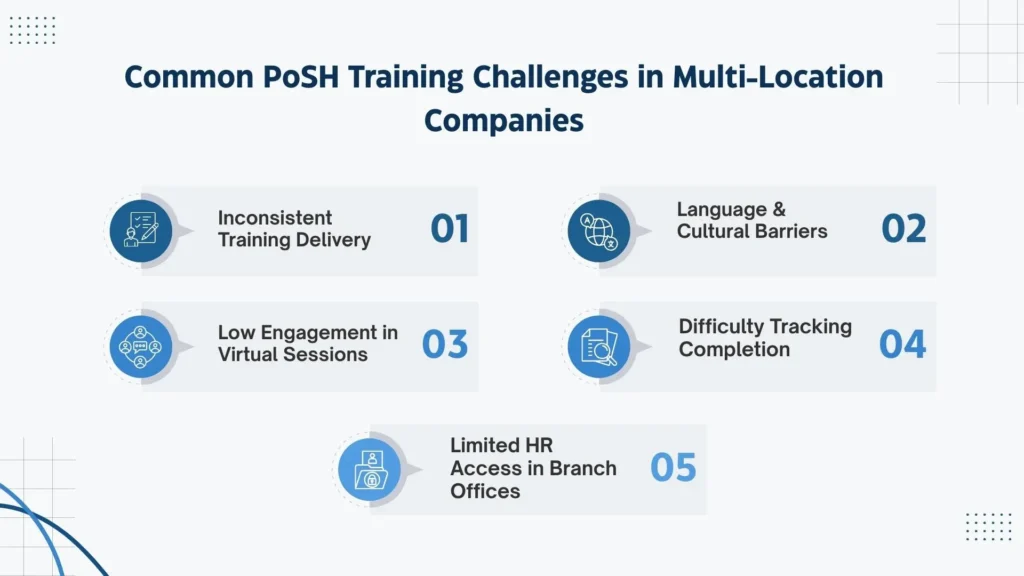
Multi-location organizations face challenges that single-office setups do not. The employees can be under various supervisors, practice various local traditions, or be able to work in environments with unequal access to HR support. Without a standardized approach to posh awareness training, organizations risk inconsistent understanding of acceptable behavior, reporting mechanisms, and accountability.
Common pain points include:
- Variations in the meaning of PoSH guidelines in different locations.
- Uneven quality of training delivery
- Limited awareness among remote or field employees
- Nightmare following a training of difficulty monitoring across regions.
- Gaps in escalation and complaint handling across offices
This complexity makes posh training for multi location organizations a specialized requirement rather than a one-size-fits-all activity.
Legal Foundation: What the PoSH Act Requires Across Locations
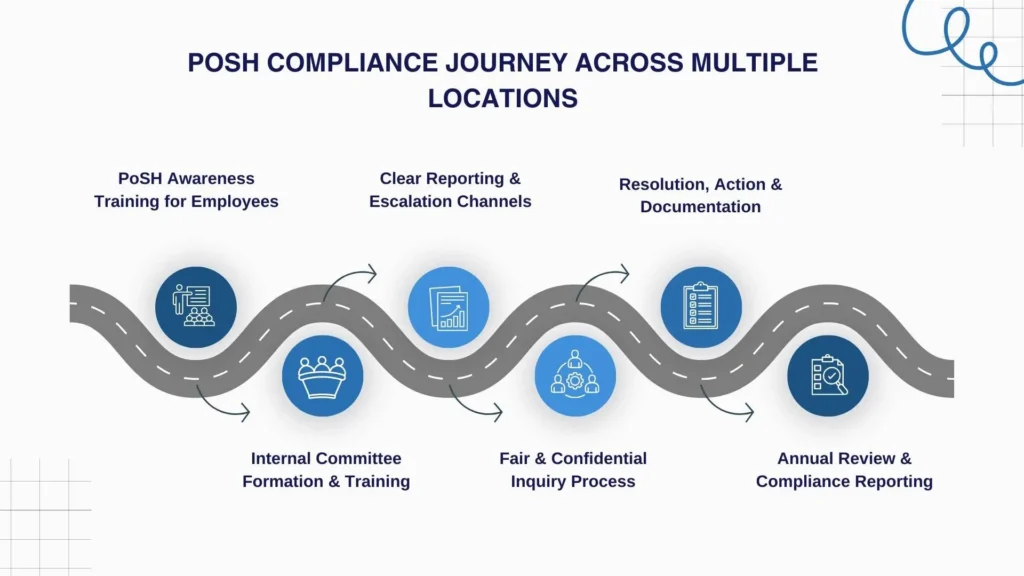
The PoSH Act applies uniformly across India, regardless of where employees are located. Any organization having 10 or above employees should:
- Carry out frequent posh compliance training.
- Ensure awareness of rights and responsibilities
- Form and train an Internal Committee
- Enable safe and confidential complaint redressal
Nevertheless, the compliance is not restricted to the headquarters. The law covers the branch offices, project sites, warehouses, regional sales teams and even workers working outside the office, at home. This makes posh compliance management a continuous and organization-wide effort.
Core Elements of Effective PoSH Training for Employees
Most organizations correctly focus on the basics of PoSH training. These foundational elements remain essential:
Understanding Sexual Harassment
Employees must clearly understand:
- What constitutes sexual harassment
- Verbal, non-verbal, physical, and digital misconduct
- Hostile work environment vs quid pro quo harassment
Employee Rights and Responsibilities
posh training for employees must explain:
- The right to a safe workplace
- The duty to maintain professional conduct
- The importance of respectful communication
Complaint Redressal Process
Training should clearly outline:
- How to file a complaint
- Timelines under the PoSH Act
- Confidentiality expectations
- Protection against retaliation
While these topics are widely covered, they alone are not enough for organizations operating across multiple locations.
What Most Organizations Miss: The Multi-Location Execution Gap
The largest loopholes in PoSH training are not legal, but operational ones.
Ensuring Consistency Across Offices
There are various organizations that have different forms of conducting training in different places. This results in:
- Uneven interpretation of policy
- Confusion about escalation paths
- Varying levels of confidence among employees
Standardized training models would make sure that the employees in Mumbai, Bengaluru, Guwahati or a village in the far east will get the same core message and understanding.
Addressing Language and Cultural Diversity
There is linguistic and cultural diversity of the workforce in India. The English only education tends to narrow the understanding. Effective interactive training incorporates:
- Regional language delivery
- Contextual examples relevant to local environments
- Inclusive communication styles
This significantly improves retention and engagement.
PoSH Training for Remote and Field Employees
With hybrid and remote work now permanent, posh training for remote employees is a critical yet often overlooked area. The same PoSH applicability is equally applicable to employees operating at home, at the location of the client and in the field, as they Remote-focused training should cover:
- Harassment in virtual meetings
- Inappropriate messages or emails
- Digital boundaries and online conduct
- Reporting concerns without physical HR access
Those organizations not including remote workers in their PoSH strategy are putting themselves at risk of severe compliance.
Internal Committee Training: The Backbone of Compliance
Although employee awareness is relevant, the effective PoSH implementation is held up by internal committee training. Internal Committees have not been well equipped in many organizations.
Advanced internal committee training should include:
- Legal interpretation of the PoSH Act
- Conducting impartial inquiries
- Interview and documentation techniques
- Handling complaints across locations
- Managing conflicts of interest
- Maintaining confidentiality in small offices
Action by well trained committees brings uniformity in work of complaint handling irrespective of the source of the complaint.
The Role of a PoSH Consultant in Multi-Location Rollouts
PoSH compliance may need the intervention of experts in India. An experienced posh consultant brings structure, neutrality, and scalability to training programs.
A qualified consultant helps organizations:
- Design standardized training frameworks
- Customize training for different employee groups
- Deliver engaging posh workshops across locations
- Support Internal Committees with advanced training
- Conduct compliance audits and gap assessments
In companies that are fast growing or have dispersed workforces, consultant-based programs can provide consistency without overwhelming internal HR departments.
Interactive Training: Moving Beyond Tick-Box Compliance
Interactive training is one of the most overlooked opportunities of PoSH implementation. Slide delivery or recorded presentations can serve documentation, but do not produce behavior change.
High-impact training includes:
- Scenario-based discussions
- Realistic case studies
- Role-based examples for managers
- Anonymous Q&A sessions
- Polls and quizzes for engagement
The interactive formats enhance participation, recall and persuade the employees to speak out, particularly in the small branches.
Building a PoSH Compliance Checklist for Large Organizations
A centrally located luxurious compliance checklist assists HR leaders to monitor preparedness at the location. An effective checklist typically includes:
- Training completion status by location
- Internal Committee formation and tenure
- Availability of policies in regional languages
- Display of PoSH notices at all offices
- Documentation of complaints and resolutions
- Annual reporting compliance
This checklist serves as a governance and an audit protection mechanism.
Measuring Effectiveness: Beyond Attendance Numbers
True posh compliance management goes beyond training attendance. Organizations should assess:
- Employee understanding through assessments
- Quality of questions raised during sessions
- Confidence in reporting mechanisms
- Trends in complaints and resolutions
- Feedback from different locations
These insights help HR leaders refine training strategies and address location-specific gaps.
The Future of PoSH Training in India’s Distributed Workforce
With the growing trends of organizations spreading geographically and adopting flexible work arrangements, there is a need to transform posh training in multi location organizations. Doing delivery with the help of technology, tracing data, and facilitation with the help of experts are becoming the expectation, not the option.
Organizations that invest in structured, inclusive, and scalable posh awareness training are better positioned to protect employees, strengthen trust, and demonstrate genuine commitment to workplace dignity across every location they operate in.
FAQ’s
Yes. Under the PoSH Act, PoSH training is mandatory for all employees, regardless of location. Organizations must ensure consistent training across head offices, branches, and remote teams.
Yes. PoSH training applies to remote and hybrid employees, as harassment can occur through digital communication, virtual meetings, and work-related interactions outside physical offices.
Consistency can be achieved through standardized training frameworks, centralized content, expert-led sessions, and tracking mechanisms that monitor training completion across locations.
HR is responsible for coordinating PoSH training, maintaining documentation, supporting the Internal Committee, and ensuring compliance across all offices and employee groups.
Yes. Online PoSH training is permitted and widely used for multi-location organizations, provided it is interactive, well-documented, and covers all mandatory topics.
A PoSH consultant helps design structured training programs, deliver consistent sessions across locations, support Internal Committees, and ensure audit-ready compliance.