Growth today is not the same as it was just a few years ago. Companies now scale with smaller teams, hybrid workforces, faster hiring, and more regulatory oversight. In this setting, HR is no longer just a support function. It now directly affects how quickly a business can grow while avoiding operational or compliance risks.
This change raises an important question: Does a traditional in-house HR team still help companies grow quickly, or does a Virtual HR model offer a better advantage for today’s businesses?
To answer this, it’s important to examine how each model performs under real, unpredictable, and continuous growth pressure.
Understanding the Two HR Models in a Growth Context
What Is Virtual HR?
Virtual HR is a model where HR services are delivered remotely using a combination of digital systems, standardized processes, and specialized HR professionals. Instead of maintaining a full internal department, organizations access HR capabilities on demand.
Typical Virtual HR coverage includes:
- HR operations and administration
- Payroll and statutory processes
- HR compliance management
- Policy drafting and documentation
- Performance frameworks
- Workforce planning and reporting
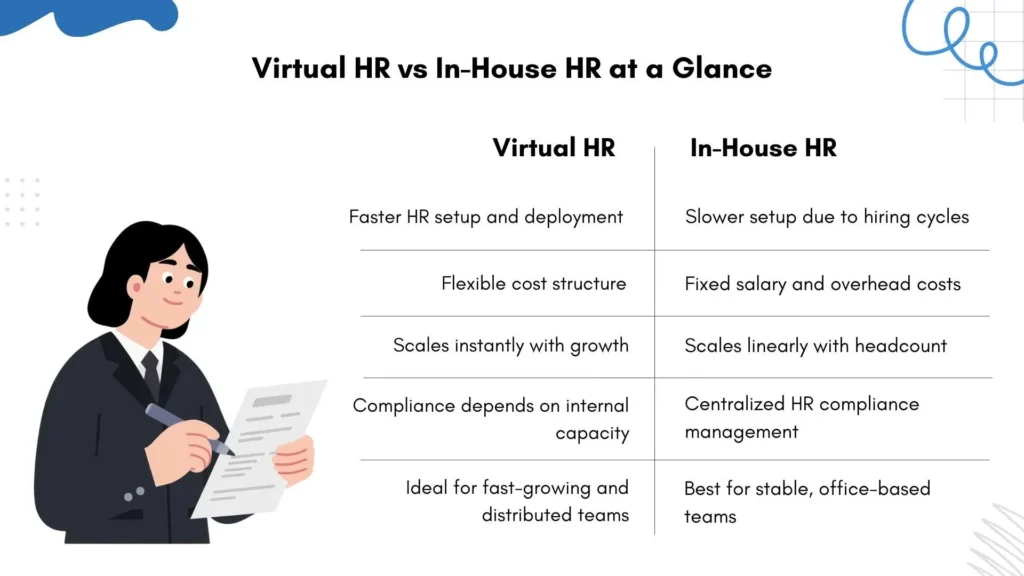
This model is strong because it offers flexibility, scalability, and quick access to expertise, without the delays that come from hiring and training internal teams.
What Is In-House HR?
In-House HR means having a permanent internal team that manages employee relations, hiring, compliance, and company culture. This approach focuses on being close to employees and interacting with them in real time.
In-house HR teams often handle:
- Employee engagement initiatives
- Internal communication
- Hiring coordination
- Grievance handling
- Day-to-day HR administration
This setup works well when things are stable, but it can struggle when a company starts to grow quickly.
Growth Speed: Agility vs Stability
Why Virtual HR Often Enables Faster Growth
Most companies don’t grow in a straight line. Sudden hiring, restructuring, opening new locations, and changing compliance needs are common. Virtual HR is built to handle these changes without slowing things down.
Growth-enabling advantages include:
- Immediate access to HR expertise
- Faster rollout of HR policies and systems
- Scalable support during expansion phases
- Reduced dependency on individual internal hires
Since Virtual HR uses standard systems, companies don’t have to rebuild their HR setup every time their team size changes.
When In-House HR Slows Expansion
In-house HR teams need time to hire, train, and get new staff up to speed. When a company is growing fast, this can cause slowdowns onboarding and documentation
- Inconsistent policy application
- Reactive compliance tracking
- Increased leadership involvement in HR issues
As a result, growth becomes constrained by internal capacity rather than business opportunity.
Compliance as a Growth Enabler, Not a Constraint
HR Compliance Management in Virtual HR
Compliance is key to growing in a sustainable way. As companies expand, they face more regulations, especially when hiring remotely or working in multiple locations.
Virtual HR models often embed HR compliance management into their core delivery, supported by strong HR compliance leadership. This ensures:
- Consistent statutory adherence
- Up-to-date employment policies
- Audit-ready documentation
- Reduced legal and financial risk
This proactive approach helps leaders grow their companies with confidence, without worrying about missing compliance issues.
Compliance Challenges in In-House HR Teams
In-house HR teams typically balance compliance alongside daily operational tasks. As complexity grows:
- Regulatory updates may be missed
- Documentation becomes fragmented
- Compliance becomes reactive rather than preventive
Without dedicated focus on HR compliance management, organizations risk penalties, disputes, and operational slowdowns.
Cost Considerations Beyond Headcount
Growth-related HR costs extend far beyond salaries. They include:
- Time lost to inefficient processes
- Cost of compliance errors and corrections
- Delayed hiring decisions
- Leadership distraction from core business activities
Virtual HR spreads these costs across efficient systems and shared expertise. In-house HR takes on these costs directly, often without a clear view of how they affect growth speed.
Employee Experience: Structure Matters More Than Location
Employee Experience with Virtual HR
When thoughtfully designed, Virtual HR delivers consistency and accessibility. Key elements include:
- Structured digital onboarding journeys
- Clear HR access through defined channels
- Self-service systems for routine requests
- Transparent and standardized policies
For hybrid and remote teams, this brings clarity and fairness that informal processes often can’t offer.
Employee Experience with In-House HR
In-house HR teams offer advantages in environments where:
- Teams operate primarily onsite
- Immediate physical interaction is critical
- Culture is deeply location-driven
But if strong systems aren’t in place, in-house HR can have trouble staying consistent as teams become more spread out.
Leadership Bandwidth and Strategic Focus
How Virtual HR Frees Leadership Capacity
A leader’s time is one of the most valuable resources in a growing company. Virtual HR helps lighten this load by:
- Managing compliance and documentation
- Standardizing HR workflows
- Delivering structured reporting and insights
- Minimizing HR-related firefighting
This allows executives to focus on growth, innovation, and market expansion.
Leadership Dependency in In-House HR
In-house HR teams often depend heavily on leadership input, especially during early or rapid growth stages. This can result in:
- Slower decision-making
- Policy inconsistencies
- Over-reliance on individual HR staff
As companies grow, this reliance can quietly slow them down and make them less flexible.
Scalability and Long-Term Flexibility
Scaling with Virtual HR
Virtual HR models are inherently scalable. They allow organizations to:
- Expand HR capacity without additional hires
- Adjust service scope as business needs evolve
- Enter new regions with minimal setup
- Maintain consistent HR standards across locations
This flexibility helps companies keep growing without having to make big changes to their structure.
Scaling Challenges with In-House HR
In-house HR scales linearly with headcount. Expansion often requires:
- Additional HR hires
- Process redesign
- Increased management oversight
These changes take time and can slow things down when fast growth is most important.
Hybrid HR Models: Balancing Speed and Control
Many modern organizations adopt a hybrid structure that blends:
- A lean internal HR presence for coordination and culture
- Virtual HR for systems, scalability, and compliance
- Centralized HR compliance management frameworks
- Strong hr compliance leadership through specialized expertise
This approach balances working well internally with being efficient externally, so companies can grow faster without using too many resources too soon.
HR as Growth Infrastructure
The real difference between Virtual HR and In-House HR isn’t where the team is located. It’s about how HR is set up to support speed, compliance, and clear leadership.
Organizations that grow faster tend to:
- Treat HR as infrastructure rather than administration
- Prioritize compliance early in the growth cycle
- Build scalable systems before headcount accelerates
- Reduce dependency on single points of failure
By aligning Virtual HR, hr compliance leadership, and disciplined HR compliance management, modern companies position HR as a driver of growth rather than a constraint.
FAQ’s
Virtual HR operates remotely and scales on demand, while in-house HR relies on permanent internal staff. The difference lies in flexibility, speed, cost structure, and compliance execution.
Virtual HR often supports faster growth by enabling quicker hiring, scalable systems, and proactive HR compliance management, especially during expansion or restructuring phases.
No. Virtual HR is increasingly used by mid-sized and growing companies that need flexibility, compliance support, and scalable HR operations without adding fixed overhead.
Yes. Strong hr compliance leadership within Virtual HR models ensures consistent adherence to statutory requirements, documentation, and audit readiness.
Virtual HR is often more cost-effective during growth stages as it avoids long-term salary commitments and reduces inefficiencies linked to manual processes and compliance errors.
Companies often consider Virtual HR when growth accelerates, compliance complexity increases, leadership bandwidth is limited, or teams become distributed across locations.