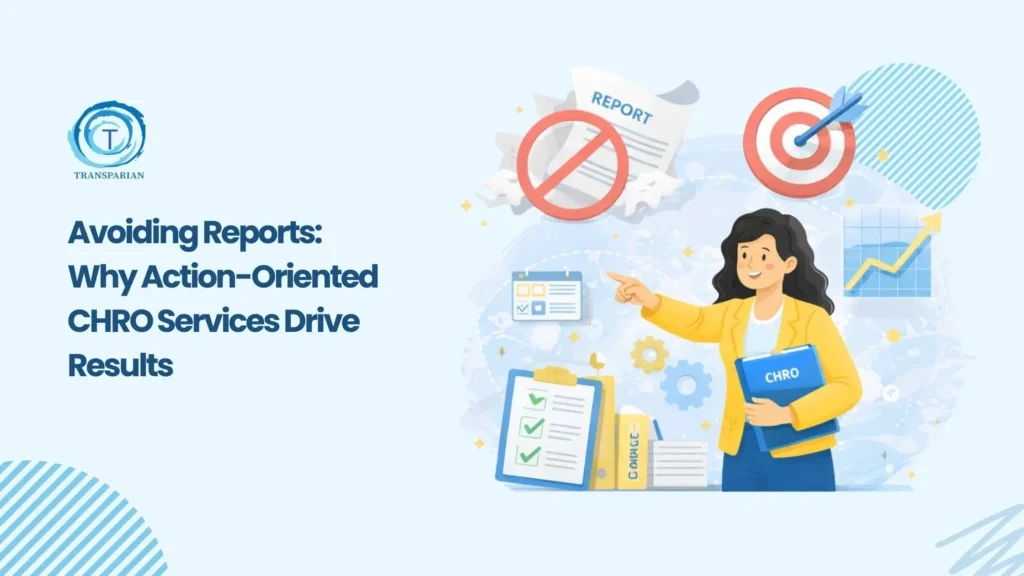
HR leadership faces a growing challenge. Despite an abundance of dashboards, presentations, and data, meaningful change remains slow. The issue is not a lack of information, but a culture that prioritizes reporting over action.
Today’s Chief Human Resources Officer is expected to drive change, not simply report on workforce trends. The difference between a reporting-focused and an action-oriented HR leader determines whether business value is created or lost.
What Does It Mean to Be an Action-Oriented CHRO?
An action-oriented CHRO doesn’t just track employee engagement scores; they intervene when those scores signal early-stage disengagement, before turnover happens. They don’t wait for a quarterly talent review to act on a succession planning gap. They identify it, resource it, and move.
This is more than a mindset shift; it is a fundamental change in how CHRO Services are designed and delivered. Traditional HR leadership is often reactive, focusing on requests, documentation, and reporting. In contrast, action-oriented CHRO Services prioritize decisions, pilot programs, and measurable interventions.
Organizations should shift their focus from asking, “What did HR report this quarter?” to “What did HR change this quarter?”
The Report Trap: Why So Many CHROs Get Stuck
Most CHROs do not intentionally fall into the report trap; they inherit it. New CHROs often encounter HR functions centered on documentation, such as compliance records, headcount tracking, and policy updates. While these are important, if they consume 70–80% of HR’s capacity, the function cannot drive meaningful change.
The trap typically looks like this:
- Spending hours building decks that summarize workforce data, the C-suite already has access to
- Attending meetings as an observer rather than as a decision-maker with recommendations ready
- Waiting for annual cycles – performance reviews, engagement surveys – before taking any talent action
- Measuring HR success by activity – training sessions run, policies updated – rather than by business outcomes.
The issue worsens when CHROs are evaluated mainly on operational stability instead of strategic workforce outcomes. Over time, the role shifts from driving transformation to serving as an administrative function, regardless of initial expectations.
This shift explains why the discussion around HR compliance leadership has evolved. Compliance is now considered the baseline, not the ultimate goal. CHROs are expected to maintain compliance while also driving enterprise performance, without compromising either responsibility.
What Action-Oriented CHRO Services Actually Look Like
The primary gap in HR discussions is not about what needs to happen, but how to achieve it. Action-oriented CHRO Services address this through practical approaches such as:
1. The 30-60-90 Day Intervention Model
Instead of waiting for annual reviews to identify issues, action-oriented CHROs implement rapid HR interventions with clear timelines:
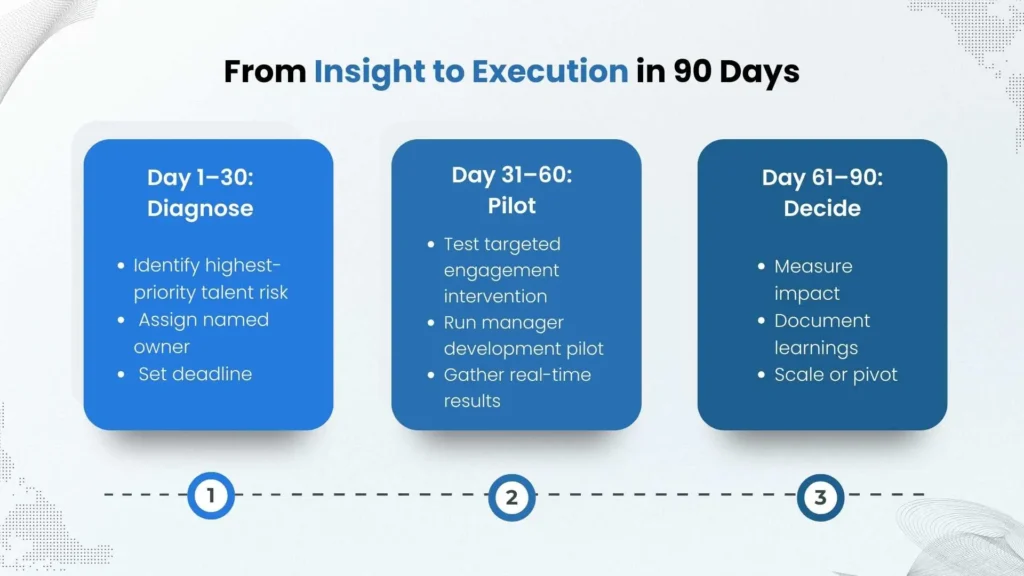
- Day 1–30: Diagnose the highest-priority talent retention risk in a critical business unit and assign a named owner with a resolution deadline
- Day 31–60: Run a targeted engagement pilot, test a new manager development framework with one regional team before committing enterprise-wide
- Day 61–90: Measure results, document learning, and make a clear scale-or-pivot decision
Reports identify problems in aggregate, while interventions address them in context. This distinction is significant.
2. A Deliberate Operating Cadence
Action-oriented CHROs establish a weekly rhythm of decisions, not updates. This includes:
- Structured check-ins with CFO and COO counterparts where HR arrives with recommendations, not just metrics
- Pre-agreed trigger thresholds that automatically activate talent responses (e.g., if attrition rate in a key function crosses 15%, a specific action plan activates, not a discussion about whether one should)
- Monthly reviews of HR KPIs tied directly to business outcomes, not internal HR operational targets alone
This approach differs fundamentally from a reporting cadence, where HR presents data and awaits direction.
3. Piloting Before Scaling
One of the most underused tools in CHRO Services is the structured pilot. While many HR leaders discuss innovation, action-oriented CHROs conduct real experiments:
- A new onboarding model was tested in one department before a full rollout
- A skills-based hiring framework was piloted with one talent stream to prove its viability
- A revised performance management process was trialed with one leadership cohort for 90 days.
Pilots provide evidence, which builds organizational trust and enables enterprise-wide change. This process elevates CHROs from support roles to recognized transformation leaders.
The CHRO-CFO Relationship: Where Action Gets Funded
The partnership between the CHRO and CFO is both critical and often overlooked. Action-oriented CHROs recognize that the CFO is not only responsible for budgets but can also co-sponsor workforce transformation.
When a CHRO can translate people analytics into financial language, the conversation shifts entirely. For example:
- A 5% reduction in employee turnover in a high-cost-to-replace engineering team = measurable savings in recruitment, onboarding, and productivity ramp
- A targeted leadership development investment in 10 high-potential managers = projected performance uplift across their combined team span
- A workforce restructuring plan built with culture preservation in mind = lower post-restructure attrition and a faster recovery curve
This type of CHRO-CFO collaboration secures funding for talent programs during cost-optimization cycles. It also ensures HR compliance leadership is financially sustainable by framing it in terms relevant to the CFO, not just regulatory requirements.
Digital HR Transformation: Action, Not Implementation
Digital HR transformation is widely discussed but often poorly executed. This is largely because organizations approach it as a technology project instead of a behavior change initiative.
An action-oriented CHRO understands this distinction. When leading digital HR transformation, the initial questions should focus on people and decision-making, not platforms:
- What decisions do we need HR technology to support?
- Are our managers equipped to act on the data these tools surface?
- How will we measure behavior change – not just system adoption rates?
Deploying a new HRIS system without changing the behaviors around it produces better-looking reports. Deploying it with behavioral enablement, manager coaching, and embedded usage metrics produces better outcomes. The technology is the vehicle. The CHRO’s job is to make sure people know how to drive it and where they’re going.
From Boardroom Presence to Boardroom Impact
CHROs are now more present in boardrooms, but many organizations have yet to translate this presence into real impact. Action-oriented CHRO Services address this by changing the substance of board discussions.
Rather than providing retrospective workforce updates, an action-oriented CHRO presents a board narrative that is:
- Forward-looking – addressing talent risks 12–18 months ahead, not summarizing past data
- Decision-forcing – presenting two or three clear options with explicit tradeoffs, not just information
- Business-risk framed – connecting leadership pipeline gaps to revenue continuity and competitive positioning.
In the boardroom, an action-oriented CHRO addresses questions such as: Where are our leadership gaps and what actions are underway to address them? What is our current retention risk in key business units? How does our talent acquisition strategy adapt to changing market conditions? These are action-focused questions, and CHROs who answer them effectively secure lasting influence.
Navigating Cost Reduction Without Destroying Culture
A key test for action-oriented CHROs is managing workforce restructuring while preserving the organization’s core values. Many CHROs revert to reporting mode during these times, documenting decisions made by others rather than leading the process.
The most effective CHROs lead restructuring proactively and differently:
- They enter the process with a culture preservation framework already built – not assembled in the aftermath of difficult decisions.
- They sequence communication intentionally, so that employee experience during difficult moments still signals organizational respect and transparency.
- They protect the talent segments most critical to post-restructure recovery, rather than applying across-the-board cuts that eliminate future capability.
- They design a re-engagement plan for the workforce that remains, because survivor disengagement is one of the most underestimated risks that follows any restructure
This work is strategically significant and requires proactive action at every stage, rather than documentation after decisions are finalized.
The Measurement Shift: From Activity to Outcome
Ultimately, the key difference between action-oriented and reporting-oriented CHRO Services is what is measured. The distinction is clear:
| Reporting-Oriented CHRO Measures | Action-Oriented CHRO Measures |
| Training hours completed | Time-to-productivity for new hires |
| Policies updated | Policy compliance rate + behavior change |
| Headcount processed | Retention rate in high-risk, high-value roles |
| Engagement survey distributed | Engagement score movement quarter-over-quarter |
| Succession plans documented | Leadership bench strength ready to deploy now |
This is not a superficial adjustment to the HR dashboard; it is a fundamental shift in HR accountability. Organizations that adopt outcome-based standards for CHROs consistently achieve greater value, faster results, and clearer business impact.
Digital HR transformation, HR compliance leadership, and broader CHRO Services can deliver exceptional, measurable results, but only when they are structured around action rather than reporting.
FAQ’s
A traditional CHRO often operates reactively through reports and documentation. An action-oriented CHRO sets intervention timelines, runs pilots, and ties every HR move to a business outcome.
HR compliance leadership sets the baseline. Action-oriented CHROs build compliance into their operating model so it runs in the background while strategic initiatives move forward.
It is a structured approach where a CHRO diagnoses a talent risk in the first 30 days, pilots a solution in the next 60, and makes a scale-or-pivot decision by day 90.
Digital HR transformation only delivers results when it changes how people make decisions, not just which platform they use. Action-oriented CHROs lead adoption through behavior change, not just implementation.
By translating people analytics into financial language – showing how talent decisions directly impact cost, revenue, and business continuity rather than presenting HR metrics in isolation.
Success is measured through outcome-based HR KPIs such as retention rates in high-value roles, leadership bench strength, time-to-productivity for new hires, and engagement score movement over time.