Sexual harassment investigation at the workplace is one of the sensitive, high stakes processes any organisation will ever go through. They involve real people, raw emotions, career implications, and legal obligations, all colliding in real time.However, the most neglected area of POSH Compliance is not the policy, training sessions, but the precise moment when a complaint is filed and an inquiry begins.
That is when the advisory role of a PoSH Consultant will not only come in handy, but it will be necessary.
Most discussions around PoSH advisory services focus on policy drafting, Internal Complaints Committee (ICC) constitution, or annual awareness workshops. These are important, no doubt. But they leave a significant gap in understanding, what does a consultant actually do when a sensitive investigation is live and unfolding?
This blog answers exactly that.
Why the Investigation Phase Demands Specialised Advisory Support
The Prevention of Sexual Harassment (PoSH) Act, 2013, provides the general format of the inquiry – the timeline, steps of the process, confidentiality, and the report. The Act was, however, not intended to be an operating manual. Once a complaint is received, organisations are confronted at once with questions which can not be answered by the policy alone:
- Who communicates with the complainant first, and how?
- Should the ICC chairperson be informed before HR or after?
- What if the accused is a senior leader and ICC members feel intimidated?
- How do we handle a complainant who is visibly distressed and has asked for anonymity?
- What if key witnesses are reluctant to participate?
These are not administrative questions. They involve judgmental calls where there is a need to have Procedural Guidance grounded in legal knowledge, workplace psychology, and organisational sensitivity. It is precisely this advisory support that a good PoSH Consultant can offer.
Setting the Stage: Pre-Inquiry Advisory
Before the first formal inquiry meeting takes place, a consultant’s advisory role begins quietly but critically.
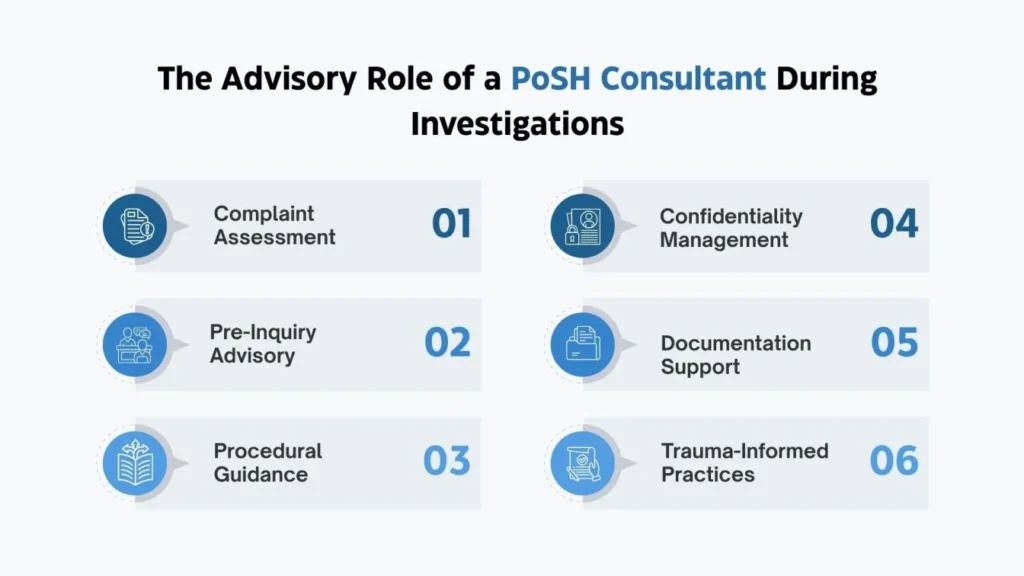
The initial step that fails to be handled well by most organisations is complaint assessment. Not all written complaints are immediately triable under PoSH and not all verbal complaints can be overlooked. A PoSH Consultant will assist the ICC to know what the complaint is all about and whether it qualifies in the threshold under the Act as well as whether interim relief to the complainant is required under Section 12.
This stage also involves:
- Reviewing whether the ICC is validly constituted with a quorum and an external member present
- Ensuring that the complaint redressal mechanism has been triggered correctly within the prescribed timeline
- Advising on recusal if any ICC member has a conflict of interest
- Helping the organisation understand its duty of care without prejudging the outcome
Most organisations are flying blind during the pre-inquiry advisory phase and it is one of the most important areas, where a consultant can avoid expensive procedural mistakes before they occur.
Guiding the ICC Without Influencing the Outcome
One of the most delicate parts of the job of a PoSH Consultant in an ongoing investigation is to find the balance between advisory support and undue influence. The ICC is the fact finding body. The consultant does not determine who is telling the truth, nor does he influence the outcome of the inquiry.
What the consultant can and should do is provide Procedural Guidance at every stage:
- Structuring the inquiry meetings — assisting the ICC in knowing the order of statements, documents submission and cross-examination processes.
- Framing questions — giving the advice on questions that are relevant, non-leading and trauma-informed so that the inquiry itself does not re-traumatise the complainant.
- Managing documentation — making sure that minutes, statements and evidence are typed correctly and remain confidential.
- Handling procedural objections — when one of the sides complains of unfairness or bias, the consultant can guide the ICC through it without disrupting the flow.
The ICC often includes members who are committed but not legally trained. A consultant bridges this gap, ensuring that the due process rights of both the complainant and the respondent are respected without requiring the ICC to become legal experts overnight.
Managing Confidentiality: The Most Common Failure Point
Confidentiality breaches are the most frequent failure in procedure in sensitive investigations – and it is not deliberate in most cases. A manager whispers something to a colleague. An HR email is copied to someone outside the inquiry loop. One of the witnesses accidentally discloses that he was summoned to the interrogation.
A PoSH Consultant provides active advisory support on:
- Who needs to know what, and at what stage
- How to communicate interim decisions (such as seat changes or work-from-home arrangements) without revealing the reason
- Drafting confidentiality reminders to ICC members, witnesses, and support staff
- Advising on what can and cannot be shared with senior management during a live inquiry
Confidentiality breaches are not only ethical lapses, but they may lead to the investigation being questioned in court and may do great emotional damage to both parties. The work of the consultant is to assist the organisation to secure the process during its occurrence.
Supporting Trauma-Informed Inquiry Practices
Complainants in workplace harassment investigations are often in a state of acute stress. They might have been skipping their workplace, having a sleeping problem, or having fear of professional repercussions. They are not simply giving out information when ICC calls them to be questioned, but they are re-experiencing.
A PoSH Consultant with understanding of trauma-informed practices advises the ICC on:
- Creating a physically and psychologically safe environment for hearings
- Providing the alternative of handing in written answers instead of verbal cross-examination where necessary.
- Being aware of the signs of distress in testimony and understanding when to take a break.
- Avoiding language that implies blame or minimises the complainant’s experience
This does not mean the inquiry becomes one-sided. The right of the respondent to be heard, evidence presentation, and responding to the allegations are also safeguarded. Trauma-informed does not mean biased, it means procedurally humane.
Looking for a Trusted PoSH Consultant?
Get expert guidance on policies, ICC setup, and compliance requirements.
Strategic Decision-Making at Critical Junctures
During an inquiry there are times that the organisation is confronted with decisions that have serious repercussions in either direction that is taken. These are the times where an organisation approaches sensitive issues with integrity or fall into legal and image risk.
Strategic Decision-Making is a core part of a consultant’s advisory value during these inflection points:
- When a complaint is withdrawn — advising the ICC on whether the inquiry must continue ex-officio and on what grounds
- When new evidence surfaces mid-inquiry — guiding the process of admitting or rejecting evidence fairly and documenting the rationale
- When the accused is a high-ranking individual — advising on how to protect the ICC’s independence and ensure management does not apply pressure, directly or indirectly
- When the timeline cannot be met — navigating the permissible extension under the Act and communicating appropriately with the parties involved
- When the inquiry report is challenged — advising on the correct appeals pathway under the Act and supporting the organisation’s legal response if escalated
Such decisions do not have to be postponed to a quarterly review meeting. They need a consultant who is accessible, professional and with a profound understanding of the organisational culture and facts of the case.
What Most Organisations Get Wrong About the Consultant’s Role
A common misconception is that a PoSH Consultant is primarily a training vendor or a compliance checkbox. This misunderstands the depth of the role, particularly during active inquiries.
Organisations that engage consultants only for annual training sessions and then attempt to navigate investigations independently often encounter:
- ICC members stepping back due to lack of confidence
- Findings being challenged on procedural grounds
- Respondents or complainants filing complaints with the Local Complaints Committee (LCC) or labour courts due to perceived unfairness
- Significant reputational damage that could have been mitigated with better process management
The advisory role during sensitive investigations is not supplementary to POSH Compliance, it is compliance in its most operational and consequential form.
Let Transparian Support Your PoSH Advisory Needs
Navigating a workplace harassment investigation is not something your ICC should figure out alone. Transparian works alongside organisations as a trusted PoSH Consultant, offering the kind of calm, experienced Procedural Guidance that makes a real difference when it matters most. If your organisation needs support building stronger POSH Compliance practices or handling a sensitive inquiry with confidence, Transparian is ready to help.
FAQ’s
A PoSH consultant provides procedural guidance, confidentiality support, and compliance advisory during sensitive workplace investigations under the Prevention of Sexual Harassment Act 2013. They help the ICC conduct fair, structured, and legally compliant inquiries.
Organizations should involve a PoSH consultant immediately after a complaint is filed to avoid procedural errors, ensure proper documentation, and maintain confidentiality from the start.
Yes, a PoSH consultant can advise the ICC during inquiry meetings, but they do not influence decisions or determine the outcome. Their role is strictly advisory and procedural.
A PoSH consultant advises on communication protocols, document handling, and access control to prevent confidentiality breaches during sensitive workplace harassment inquiries.
A PoSH consultant supports the ICC by structuring inquiry meetings, guiding questioning, reviewing documentation, and managing procedural challenges.
Organizations often struggle due to lack of procedural knowledge, confidentiality breaches, and poor documentation areas where PoSH consultants provide critical guidance.