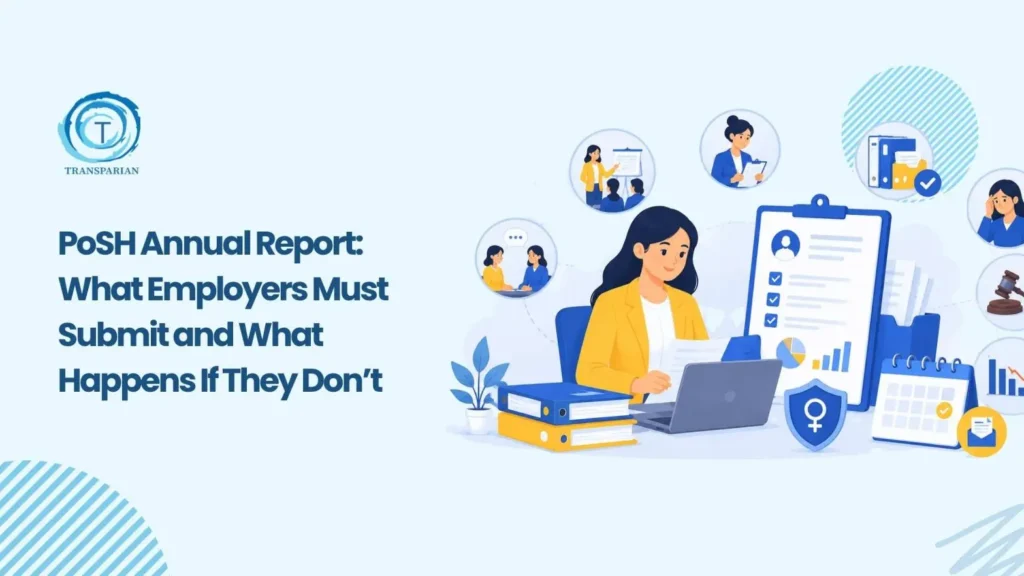
Every employer covered under the PoSH Act has one compliance deadline that quietly trips up more companies than any other requirement in the law: the annual report. It doesn’t get the attention that policy drafting or training sessions get, but it’s the one document regulators actually ask to see when they come knocking. And unlike a missed training session, a missing annual report carries a direct, traceable penalty.
Most HR teams know they need an Internal Committee. Fewer know that the IC’s job doesn’t end with handling complaints, it also has to produce a report every year, and that report has to go somewhere specific. Here’s what the law actually requires, what the report needs to contain, and what happens to companies that skip it.
Getting this right is a smaller part of a much larger picture. PoSH compliance isn’t a single document or a once-a-year filing, it’s an ongoing obligation that touches IC constitution, training cycles, policy upkeep, and recordkeeping, with the annual report sitting at the end of that chain as the proof point for everything that came before it. Employers who treat the report as a standalone task often discover, too late, that the report itself was never the real problem, the gaps in the underlying process were.
What Is the PoSH Annual Report?
Under Section 21 of the Sexual Harassment of Women at Workplace (Prevention, Prohibition and Redressal) Act, 2013, every Internal Committee is required to prepare an annual report and submit it to the employer. The employer, in turn, has to include this information in the report sent to the District Officer.
This isn’t routine paperwork. It’s how the government tracks how workplace harassment complaints are being handled across the country and it’s also the document that proves, on record, that an organization has a functioning ICC rather than just a policy sitting in an HR folder somewhere.
The report has to be submitted annually, and the obligation sits with the employer, not just the ICC chairperson. If the ICC fails to prepare it, or the employer fails to forward it, the liability sits with the organization either way. Many employers assume that having an active ICC automatically satisfies this requirement, but constitution and reporting are two distinct obligations under the law. An organization can have a fully formed, functioning committee and still fall foul of Section 21 simply because nobody followed through on the paperwork at year-end.
What the Report Must Contain
The law specifies a fairly narrow set of disclosures. It’s not meant to be a narrative document — it’s closer to a structured disclosure with a handful of data points:
- Number of complaints received during the year
- Number of complaints resolved, withdrawn, or found false
- Number of cases pending beyond 90 days, with reasons for the delay
- Number of PoSH training sessions or awareness programs conducted
- Action taken by the employer based on ICC recommendations
That’s the core structure most organizations follow, though some State Rules ask for a bit more detail. The important part is that this isn’t something to write loosely, every number needs to tie back to actual case records, training attendance logs, and ICC meeting minutes. A report that’s filed but doesn’t match the underlying documentation is arguably worse than no report at all, because it puts the employer on record with figures that can’t be backed up if anyone asks questions later.
Who the Report Goes To
This is where a lot of employers get confused, because the chain of submission has two separate legs.
The Internal Committee compiles its findings and submits the annual report to the employer (or the relevant HR/management head) at the end of each calendar year. The employer then includes this in its own annual report and submits it to the District Officer notified for that jurisdiction. In most States, this routes through the Labour Department or the office designated under the State’s PoSH Rules.
A few States have started accepting submissions through online portals as part of broader statutory compliance reporting, so it’s worth checking whether your State has digitized the process rather than assuming a physical filing is still required.
For organizations with branches across multiple States, this also means multiple District Officer filings, not one consolidated submission. A single ICC at the head office covering complaints from a branch elsewhere doesn’t exempt the employer from that State’s own filing requirement, a point covered in more depth in our piece on keeping PoSH compliance consistent across multi-location organizations.
Why This Report Gets Overlooked
In our experience working with HR teams across sectors, the annual report rarely gets missed out of negligence. It gets missed because of how PoSH work tends to be structured internally. Training gets calendared, the policy gets reviewed once a year, and the ICC handles complaints as they come in but nobody really owns the year-end reporting cycle the way someone owns, say, quarterly TDS filings.
There’s also a sequencing problem. The annual report depends on the ICC having clean records throughout the year complaint logs, disposal timelines, training attendance. If those records aren’t maintained consistently, the report turns into a scramble assembled from memory and scattered emails rather than from a clean trail. That’s usually when numbers get fudged, not out of intent to mislead, but because nobody can actually locate the figures by deadline.
This is also why many organizations end up working backwards from the PoSH compliance checklist before March 31 every year. Treating the annual report as a once-a-year scramble guarantees errors. Treating it as a quarterly reconciliation makes the year-end filing close to automatic.
What Happens If Employers Don’t Submit It
This is the part employers tend to underestimate. The law doesn’t leave the consequences vague.
- Monetary penalty: Failure to constitute an IC, act on its recommendations, or comply with reporting requirements can attract a fine of up to ₹50,000 under Section 26.
- Escalated penalties on repeat default: A second violation can lead to a higher penalty, cancellation or non-renewal of business licenses, and in some cases double the original fine.
- Regulatory and reputational exposure: Non-filing creates a documented compliance gap that surfaces during labour audits, investor due diligence, vendor compliance checks, and ESG reporting. A missing annual report is now a common reason for disqualification at the vendor-screening stage for larger corporate clients and government tenders.
- Real consequences beyond the fine itself: as we’ve covered in what actually happens when a company fails a PoSH audit, the fallout often shows up in places employers don’t expect client contracts, funding rounds, and leadership credibility.
None of this requires an actual harassment case to have occurred. The penalty applies to the failure to report, regardless of whether the workplace had zero complaints or several. A company with no complaints all year still has to file a report stating exactly that, silence isn’t compliance.
Building a Reliable Reporting Process
The organizations that handle this well tend to do three things consistently:
- Maintain a live complaint register through the year instead of reconstructing it at filing time
- Tie ICC meeting minutes directly to the annual report template, so the report is a summary of existing records, not a new document built from scratch in December
- Assign clear ownership for both legs of the submission ICC to employer, employer to District Officer with reminders well ahead of the deadline rather than at it
It also helps to build in a mid-year check-in, separate from the year-end push. A quick review around September or October, looking at how many complaints have come in, whether disposal timelines are on track, and whether training records are current, makes the eventual filing far less stressful and catches gaps while there’s still time to fix them.
None of this is complicated. It’s mostly a documentation discipline problem, not a legal complexity one. But it’s a discipline with real financial and reputational teeth if it slips.
Let Transparian Simplify Your PoSH Compliance
From constituting and training the Internal Committee to preparing audit-ready annual reports and District Officer filings, Transparian provides expert PoSH compliance support for HR teams and business owners. Through hands-on ICC training, policy reviews, and experienced compliance consultants, Transparian helps growing businesses stay audit-ready, penalty-free, and fully aligned with every PoSH requirement.
FAQ’s
A PoSH Annual Report is a mandatory report prepared by the Internal Committee (IC) under the PoSH Act, 2013. It summarizes the number of sexual harassment complaints received, resolved, pending cases, awareness programs conducted, and actions taken by the employer during the reporting period.
Yes. Every organization covered under the PoSH Act and required to constitute an Internal Committee must prepare and submit a PoSH Annual Report, even if no complaints were received during the year.
The Internal Committee is responsible for preparing the PoSH Annual Report. The employer must then ensure the relevant information is included in the report submitted to the designated District Officer.
Failure to comply with PoSH reporting requirements can attract a penalty of up to ₹50,000 under Section 26 of the PoSH Act. Repeated non-compliance may result in higher penalties and regulatory action.
Employers should maintain complaint registers, IC meeting minutes, investigation records, training attendance logs, and action-taken reports throughout the year to ensure accurate annual reporting.
Organizations can streamline compliance by maintaining updated records, conducting regular Internal Committee reviews, scheduling periodic compliance checks, and seeking support from experienced PoSH compliance consultants when needed.