

July 31 is eight days away. For most individual taxpayers in India, that date is the ITR filing deadline for FY 2025-26 and missing it is not a neutral event. A late fee kicks in, the option to carry forward certain losses disappears, and a refund claim can get complicated. None of that is worth the delay.
This post covers who is required to file by July 31, which categories get a later deadline, what happens if you file after the due date, and how the process actually works so you are not scrambling at the last minute.
The July 31 Deadline — What It Covers
July 31, 2026 is the due date for filing the Income Tax Return for FY 2025-26 (Assessment Year 2026-27) for taxpayers not covered under tax audit.
That means: individuals, HUFs, and firms not subject to audit under the Income Tax Act or any other statute. In practice, this covers the vast majority of salaried employees, pensioners, freelancers, small business owners without audit applicability, and investors with capital gains or rental income.
If you fall into any of these categories, July 31 is your deadline.
Who Must File by July 31
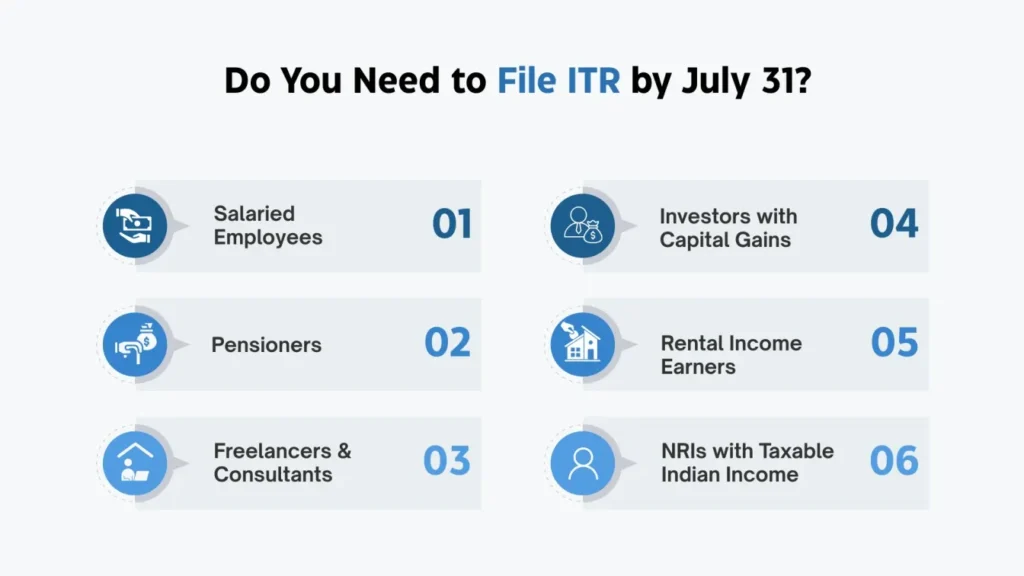
Salaried employees — all salaried individuals whose total income exceeds the basic exemption limit (₹3 lakh under the new regime for FY 2025-26, ₹2.5 lakh under the old regime) are required to file. Even if your employer has deducted TDS in full, the obligation to file still exists if income crosses the threshold.
Individuals with other income — interest income, rental income, dividend income, capital gains from shares or property, or freelance/consulting income all require a return if total income exceeds the exemption limit.
Individuals below the exemption limit who must still file — this is where people often get caught out. Even if your income is below the taxable threshold, you are required to file if:
- You have paid electricity bills exceeding ₹1 lakh in the year
- You have incurred foreign travel expenditure above ₹2 lakh
- You have deposited more than ₹1 crore in one or more current accounts
- You want to claim a refund on excess TDS deducted
- You have carried forward losses from a previous year
HUFs (Hindu Undivided Families) — required to file if HUF income exceeds the basic exemption limit.
Partners in firms — individual partners in non-audited firms file their personal returns by July 31.
NRIs with income taxable in India — rental income from property in India, capital gains on sale of Indian assets, or interest from NRO accounts are taxable in India. NRIs with such income file under the same July 31 deadline unless specific extensions apply.
If you are unsure about your filing obligation, the post on what ITR is and when it applies covers the basics in detail.
Who Gets a Later Deadline
Not everyone files by July 31. Extended deadlines apply to certain categories:
Taxpayers subject to tax audit (Section 44AB) — businesses with turnover exceeding ₹1 crore (or ₹10 crore for digital transactions), professionals with gross receipts exceeding ₹50 lakh, and other cases requiring audit under Section 44AB have a deadline of October 31, 2026.
Transfer pricing cases — taxpayers with international transactions or specified domestic transactions requiring a transfer pricing report under Section 92E have a deadline of November 30, 2026.
Partners in audited firms — if you are a partner in a firm that requires a tax audit, your personal return deadline follows the firm’s audit deadline — October 31, 2026.
For a full breakdown of form-specific applicability and how to know which category applies to you, the guide on which ITR form to file is worth going through before you proceed.
What Missing July 31 Actually Costs You
Filing after the deadline is not illegal — you can still file a belated return under Section 139(4) up to December 31, 2026. But there are concrete costs attached to missing July 31.
Late filing fee under Section 234F — ₹5,000 for taxpayers with income above ₹5 lakh, ₹1,000 for those with income below ₹5 lakh. This is payable even if no tax is due.
Loss of ability to carry forward losses — if you have made losses under the head capital gains, business income, or speculation that you want to set off in future years, you must file by the due date. A belated return cannot be used to carry forward most losses. For someone with short-term or long-term capital losses from equity or mutual fund redemptions, this is a significant consequence.
Interest on tax due — if there is any outstanding tax liability, interest under Section 234A accrues at 1% per month from July 31 until the date of filing. If advance tax was also short-paid, Sections 234B and 234C apply additionally.
Delayed refund — if you have excess TDS and are due a refund, filing late pushes the refund processing timeline back. It also affects interest on refund — interest under Section 244A runs from April 1 of the assessment year, but for belated returns it runs from the date of filing.
No revision possible until filed — once the July 31 deadline passes without a return, you cannot file a revised return for any clerical errors or omissions. You can only file the belated return and then revise it.
Understanding the full picture of what a late filing involves is covered in more depth in this post on common ITR filing mistakes to avoid.
The Right ITR Form — Getting It Correct Before You File
One of the most avoidable errors in the July rush is selecting the wrong form. The form determines what schedules you fill, what income you can declare, and what the return covers. A return filed in the wrong form is treated as defective.
The forms that apply to the July 31 category:
ITR-1 (Sahaj) — salaried individuals with income up to ₹50 lakh from salary, one house property, and interest. Does not cover capital gains or more than one house property.
ITR-2 — individuals and HUFs with income from salary, capital gains, multiple house properties, foreign assets, or more than ₹50 lakh total income. No business income.
ITR-3 — individuals and HUFs with income from business or profession (non-audited), along with other income.
ITR-4 (Sugam) — individuals, HUFs, and firms (other than LLP) opting for presumptive taxation under Sections 44AD, 44ADA, or 44AE, with income up to ₹50 lakh.
The distinction between ITR-1 and ITR-2 catches most people specifically around capital gains. If you have sold any mutual funds, shares, or property in FY 2025-26, you cannot use ITR-1 even if your total income is under ₹50 lakh. Use ITR-2.
The New Tax Regime — Default and Opt-Out
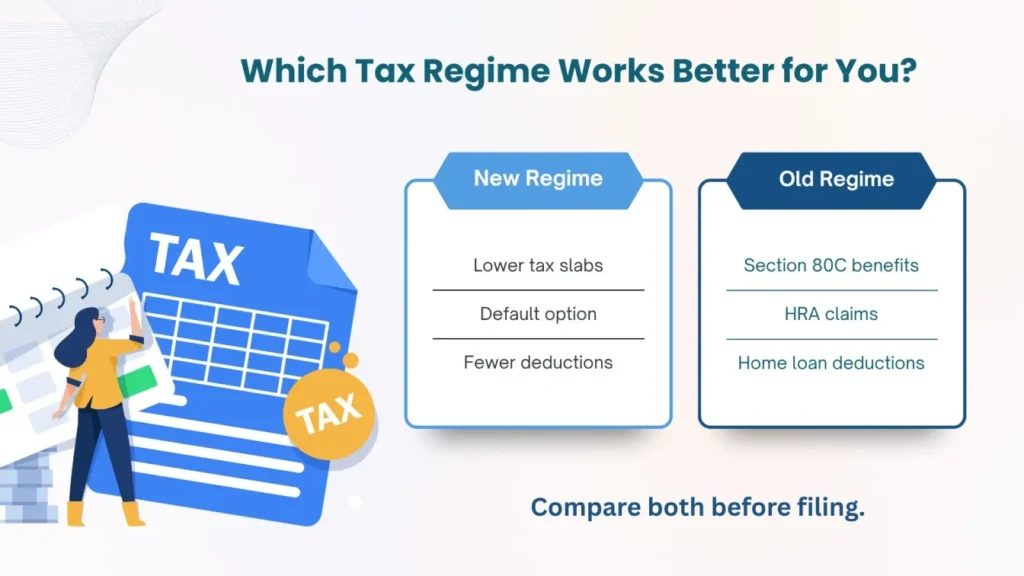
For FY 2025-26, the new tax regime continues as the default. If you want to file under the old regime and claim deductions like Section 80C, HRA, or home loan interest, you must explicitly opt out of the new regime while filing.
This is a decision that affects your tax outgo, not just your form selection. If you have significant Section 80C deductions, health insurance premiums, or home loan interest, the old regime may work out better. If your deductions are minimal, the new regime’s lower slab rates may result in lower tax. The comparison is straightforward; calculate under both and file under whichever results in lower tax.
The post on Section 80C deductions every taxpayer should know covers the full list of eligible investments and payments under the old regime.
Pre-Filing Steps That Cannot Be Skipped
With the July 31 deadline approaching, the temptation is to just log in and file quickly. That approach is where most post-filing notices originate. Before hitting submit:
Reconcile AIS and Form 26AS with your own records. The income tax department now automatically compares your declared income against the Annual Information Statement (AIS). Mismatches between what you declare and what AIS shows are the single most common trigger for assessment notices. If you have not done this step yet, the guide on AIS vs Form 26AS reconciliation explains exactly how to work through it category by category.
Verify your pre-filled data. The portal pre-fills returns from AIS and TIS data. Pre-filled does not mean correct duplicated entries, timing mismatches, and gross values where net income applies are common. Accept pre-filled figures only after verifying them against your own documents.
Check for outstanding demands or notices. Log into the portal and look under the “Pending Actions” tab before filing. Any outstanding demand from a prior year that has not been responded to can complicate the current year’s return.
Validate your bank account. A return is only complete once it is e-verified, and a refund (if any) goes to the pre-validated account. If your bank account is not validated on the portal, do it now, it takes a few minutes but must be done before filing. The pre-filing checklist in 6 things to check before submitting your ITR covers this and several other validation steps worth running through.
E-Verification — The Step Most People Forget
Filing a return is not the same as completing it. The return is valid only once it is verified. E-verification must be done within 30 days of filing.
Options for e-verification:
- Aadhaar OTP — fastest and most commonly used
- Net banking — available through most major banks
- Demat account — via NSDL or CDSL
- Bank account validation (EVC via pre-validated account)
- Physical ITR-V — for those who cannot use electronic methods, send the signed ITR-V to CPC Bengaluru by speed post within 30 days
An unverified return is treated as if it was never filed. This catches people who file on July 31 and assume they are done.
If Your Situation Is Complex, File Early
The July 31 deadline applies broadly, but some situations genuinely need more time to get right multiple income sources, capital gains from different asset classes, foreign income, stock option income, or significant discrepancies in AIS data.
In those cases, the answer is not to rush and file a return you need to revise, nor to file late and absorb the fee. The answer is to start the process now, get the reconciliation done, and file accurately. That is what a tax consultant in India does for you, particularly when the numbers across income heads, TDS certificates, and AIS do not align cleanly.
If you want to understand why professional assistance changes the filing outcome on complex returns, the post on why to choose a professional for ITR filing is a good reference.
Let Transparian File Your ITR Before July 31
From income reconciliation and tax regime selection to accurate form filing and e-verification, Transparian provides end-to-end ITR filing services and tax consultant in India support for salaried professionals, freelancers, business owners, and NRIs. File before the deadline accurately, without the last-minute pressure.
FAQ’s
For FY 2025-26 (AY 2026-27), the ITR filing deadline for most individuals, HUFs, and non-audit taxpayers is July 31, 2026. Filing after the due date may attract penalties, interest, and other consequences.
Salaried employees, pensioners, freelancers, investors, landlords, and other taxpayers whose income exceeds the applicable exemption limit must generally file their ITR by July 31 if they are not subject to a tax audit.
Yes. You may still need to file an ITR if you want to claim a tax refund, carry forward losses, have foreign travel expenditure above prescribed limits, or meet certain specified financial transaction criteria.
Missing the deadline can result in a late filing fee under Section 234F, interest on unpaid taxes, delayed refunds, and loss of the ability to carry forward certain losses such as capital losses and business losses.
Businesses and professionals subject to tax audit, taxpayers involved in transfer pricing cases, and partners in audited firms are eligible for later filing deadlines as specified under the Income Tax Act.
Before filing, review Form 16, AIS, Form 26AS, bank statements, capital gains statements, TDS certificates, investment proofs, and pre-filled return data to ensure accurate reporting.