
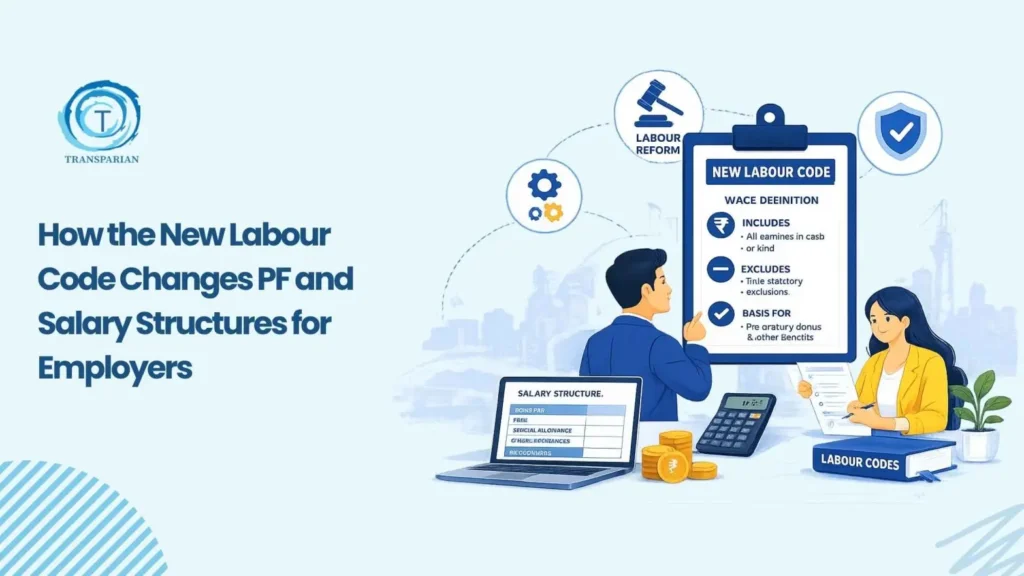
For most payroll teams in India, the salary structure has long doubled as a tool for managing PF liability. Keep basic pay low, load the rest into allowances; HRA, conveyance, medical, special allowance and the PF contribution base stays small. It’s been legal, it’s been standard, and for companies with large employee counts, the savings have been significant.
The Code on Wages, 2019 changes this. When the four labour codes come into force, the definition of “wages” will be revised in a way that limits how far companies can take that approach. For a large share of Indian employers particularly those that have aggressively structured salaries to minimise PF outgo, this means higher statutory contributions, revised salary structures, and a payroll overhaul that can’t be left until the notification deadline.
The Problem with How Wages Are Currently Defined
India’s existing labour laws define “wages” differently across different Acts. The EPF Act has one definition, the Payment of Gratuity Act another, and the Payment of Wages Act yet another. This fragmentation allowed salary structures to be built legally in ways that minimise liability under specific Acts.
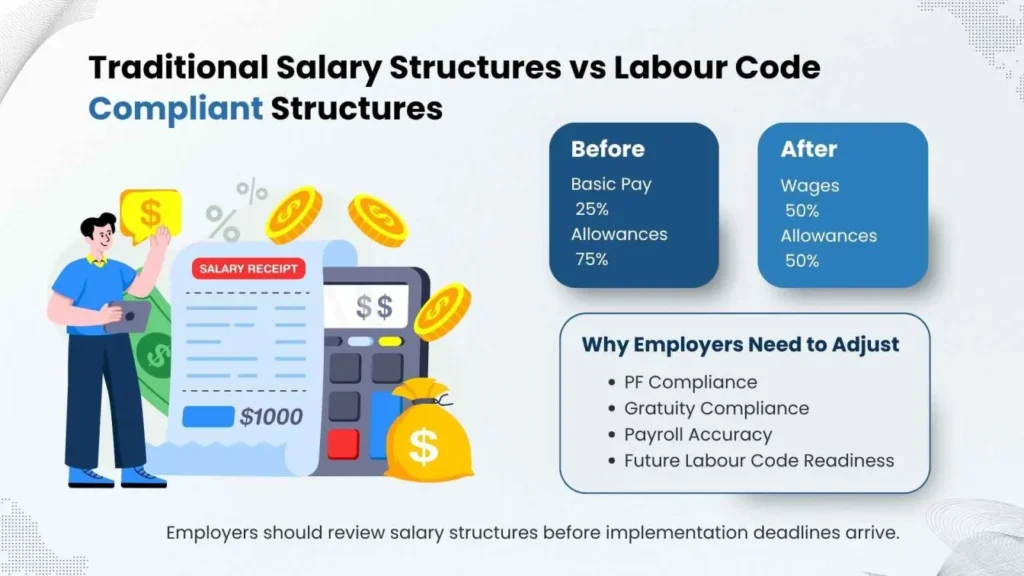
The most common version: keep Basic + DA at 20–30% of CTC, and push everything else into allowances. Since EPF is calculated on Basic + DA, a lower basic means lower PF deductions for both employer and employee. Take-home pay looks higher, and the employer’s contribution stays manageable.
Nothing about this was hidden. It became the default design for organised-sector salary structures across IT, manufacturing, retail, and financial services. Payroll software was built around it. Offer letters were written with it in mind.
What the Code on Wages Actually Says
The Code on Wages introduces a single, unified definition of wages that will apply across all four labour codes covering PF calculations, gratuity, bonus, and other statutory obligations.
The definition includes basic pay, dearness allowance, and retaining allowance. It excludes several components: HRA, overtime, statutory bonuses, conveyance, and certain others.
The critical addition is this: excluded components cannot in aggregate exceed 50% of total remuneration. If they do, the excess gets reclassified and counted as wages.
In plain terms — if your allowances collectively make up more than 50% of CTC, the portion above that threshold gets included in wages for the purpose of PF, gratuity, and related calculations.
This is the 50% rule, and it directly dismantles the low-basic salary structure that most organised-sector employers have been running for decades.
What This Means for PF: A Worked Example
Take an employee with a monthly CTC of ₹1,00,000.
Current structure (typical):
| Component | Amount |
|---|---|
| Basic + DA | ₹25,000 (25%) |
| HRA | ₹12,500 |
| Special Allowance | ₹55,000 |
| Other allowances | ₹7,500 |
| Total | ₹1,00,000 |
PF today: 12% of ₹25,000 = ₹3,000 (employee) + ₹3,000 (employer) = ₹6,000/month
Under the new wage definition:
Total excluded components (HRA + Special Allowance + Others) = ₹75,000 = 75% of CTC
Maximum permissible exclusion under the 50% rule = ₹50,000
Excess included in wages = ₹25,000
Revised wages = ₹25,000 + ₹25,000 = ₹50,000
PF under new code: 12% of ₹50,000 = ₹6,000 (employee) + ₹6,000 (employer) = ₹12,000/month
Monthly PF liability doubles. Across a workforce of 500 employees at comparable pay scales, the employer’s additional PF outgo runs into lakhs per month and this is before accounting for the gratuity impact.
The Knock-On Effect on Gratuity
Gratuity under the Payment of Gratuity Act is currently calculated on Basic + DA. Under the new Social Security Code, it will be calculated on wages as redefined under the Code on Wages.
For a long-tenured employee who has spent 10–15 years with a company, the difference between gratuity calculated on 25% of CTC versus 50% is material. For companies with large, stable workforces manufacturing, infrastructure, BFSI, this represents a meaningful increase in gratuity liability that needs to be modelled and provisioned for well in advance, not addressed at the time of separation.
What Happens to Take-Home Pay
This is the part payroll teams and HR often overlook when modelling impact. PF deductions are split — 12% from employees, 12% from employers. When the PF base increases, the employee’s deduction increases too.
For an employee working within a negotiated CTC, higher PF deductions mean lower take-home unless the package is restructured to absorb the change. That’s a communication and expectation-management challenge on top of the payroll recalculation itself.
Options employers typically weigh:
- Increase gross CTC to maintain net take-home adds to total cost
- Maintain CTC and accept reduced take-home for employees requires proactive communication
- Restructure salary components now to bring basic closer to 50%, ahead of enforcement
There’s no option that avoids the change. The only question is how it gets managed and whether it’s managed on your schedule or the regulator’s.
The Timing Question
The four labour codes are central legislation passed by Parliament, but they require states to issue their own notifications before taking effect in each state. Most states have not yet completed this process.
This means the new wage definition isn’t enforceable in most states today. But the direction is clear, the legislation is passed, and state notifications could follow with relatively short implementation windows.
Companies that wait for formal notification before modelling the impact will find themselves scrambling. Salary restructuring at scale takes time, offer letter revisions, payroll system updates, employee communication, and HRIS reconfiguration don’t happen in a week. The groundwork needs to be laid now.
What Employers Must Do Now
1. Audit current salary structures
Map the ratio of included to excluded components for every pay grade. Identify where excluded components exceed 50% of total remuneration, that’s your exposure under the new definition.
2. Model the PF and gratuity impact
Calculate revised contribution amounts at the 50% threshold for each affected employee band. The modelling should cover:
- Monthly EPF contribution (employer + employee) at revised wages
- Incremental gratuity liability for long-tenure employees
- ESIC recalculation where applicable (the definition change may affect eligibility at wage margins)
3. Decide on a restructuring approach
The decision needs to be deliberate, not defaulted:
- Restructure now to bring basic to ~50%, ahead of enforcement
- Model the cost under the new definition without restructuring and plan for it financially
- Offer new hires a revised structure while handling existing employees separately
4. Update payroll systems and HR documentation
Many payroll systems still calculate PF on Basic + DA. A system that doesn’t reflect the new wages definition will produce incorrect compliance outputs from day one of enforcement. Offer letter templates, HR policies, and employment contracts need to be reviewed in parallel.
5. Track state notification status
The Code on Wages may take effect in some states before others. Statutory compliance obligations will differ by jurisdiction until full national enforcement, so state-level tracking needs to go into the compliance calendar now.
A PF and ESIC compliance review and a labour law compliance checklist exercise should run together as part of any pre-enforcement readiness work.
The Broader Compliance Picture
The wage definition change doesn’t sit in isolation. It’s part of a wider overhaul of labour law compliance in India that touches fixed-term employment, social security portability, and occupational safety. Employers running lean compliance operations will feel the new codes more sharply than those who have kept their frameworks current.
The wage definition change is one of the more calculable pieces of this overhaul, the numbers are modelable today, the exposure is quantifiable, and early action directly reduces financial risk. Leaving it unaddressed is a choice with a known cost attached. The consequences of waiting on statutory compliance tend to arrive faster than most businesses expect.
Quick Readiness Checklist: New Wage Definition
- Salary structure audit completed — included vs excluded component ratios mapped by grade
- Employees where excluded components exceed 50% of CTC identified
- Revised PF contribution amounts modelled at the 50% threshold
- Incremental gratuity liability calculated for long-tenure employees
- ESIC eligibility reviewed at revised wage levels
- Restructuring approach decided and approved internally
- New hire offer letter templates updated
- Payroll system tested against new wage definition
- State notification status added to compliance calendar
- Employee communication plan prepared for take-home pay impact
Let Transparian Simplify Your PF and Payroll Compliance
From managing PF and ESIC filings to ensuring PoSH and state-specific statutory obligations are never missed, Transparian provides expert Labour Law Compliance support for HR teams and business owners. Through reliable compliance services and experienced statutory compliance consultants, Transparian helps growing businesses stay audit-ready, penalty-free, and fully aligned with every regulatory requirement.
FAQ’s
The Code on Wages introduces a uniform definition of wages and applies the 50% rule. If allowances exceed 50% of total remuneration, the excess amount is added to wages, increasing the salary base used for PF calculations.
The 50% wage rule states that excluded salary components such as HRA and special allowances cannot collectively exceed 50% of total remuneration. Any excess amount is treated as wages for statutory calculations, including PF and gratuity.
For many employees, yes. Companies that currently keep basic pay low and allocate a large portion of salary to allowances may see higher PF contributions because a larger portion of the salary will be classified as wages.
Employers may need to redesign salary structures by increasing the basic salary component and reducing allowances to align with the new wage definition and avoid compliance risks.
Components such as House Rent Allowance (HRA), overtime payments, statutory bonuses, conveyance allowances, and certain other allowances are generally excluded, subject to the 50% wage cap.
Businesses can stay compliant by conducting regular payroll audits, reviewing PF and ESIC calculations, updating salary structures where necessary, tracking state notifications, and seeking guidance from labour law compliance experts.