

July 31 has passed. If you did not file your Income Tax Return for FY 2025-26 by the due date, you are not alone and the situation is not as bad as it might feel right now. You can still file. There are penalties and some genuine losses, but they are manageable, and delaying further only makes things worse.
This post covers exactly what happens when you miss the deadline, what your options are, what it will cost you, and what to prioritise now.
First — What “Missing the Deadline” Actually Means
The July 31 deadline is the due date for filing under Section 139(1) of the Income Tax Act. Missing it does not mean you have broken the law in a way that triggers prosecution, that is a different threshold. What it means is that you have lost certain rights and will now face certain costs.
The distinction matters because a lot of people who miss July 31 assume the worst and put off filing even longer. That is the wrong response. The belated return window is open until December 31, 2026. Filing even in August is meaningfully better than filing in November.
What You Lost When July 31 Passed
Before getting to what you can still do, it is worth being clear about what cannot be recovered now that the deadline has passed.
The ability to carry forward most losses. This is the most significant permanent consequence. If you made losses under capital gains, business income, or speculation during FY 2025-26 and wanted to carry them forward to set off against future income, that option required a return filed by July 31. A belated return cannot carry forward losses under these heads.
The one exception: losses from house property. You can still carry forward house property losses even in a belated return up to ₹2 lakh per year, subject to the usual conditions.
If you had significant capital losses this year particularly from equity or mutual fund redemptions in a volatile market, this is a real cost. It is not recoverable after the deadline. For context on what capital gains reporting involves and how the Income Tax Department tracks it, the post on AIS vs Form 26AS reconciliation covers the mechanics in detail.
The option to revise before filing. You cannot file a revised return for something you have not yet filed. If you file a belated return and then spot an error, you can revise it, but that option starts only from the date of belated filing.
Interest-free status. Any tax that was due on July 31 is now accruing interest under Section 234A at 1% per month until you file and pay. This runs alongside any Sections 234B or 234C interest if advance tax was also short-paid during the year.
What You Can Still Do — The Belated Return
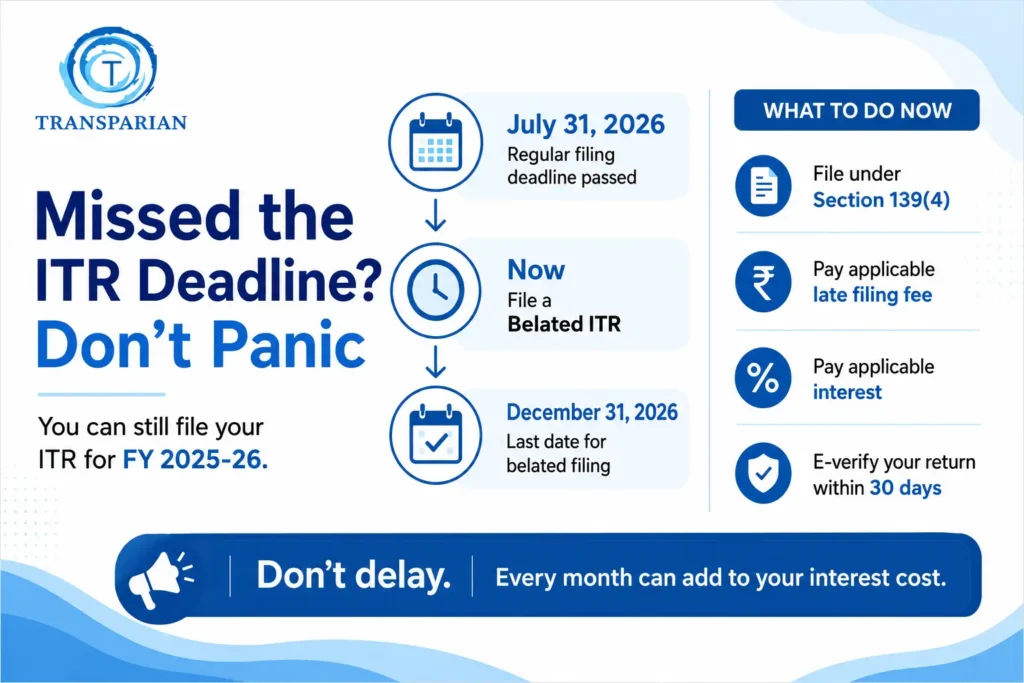
Under Section 139(4), you can file a belated return for FY 2025-26 until December 31, 2026. This is the primary option for everyone who missed July 31.
A belated return works exactly like a regular return in most respects. You use the same ITR form that would have applied to you; ITR-1, ITR-2, ITR-3, or ITR-4 depending on your income profile. If you are unsure which form applies, the guide on which ITR form to file lays it out by income type.
The belated return covers all income from FY 2025-26. It can be used to claim refunds, report income, and comply with the filing obligation. It cannot carry forward most losses, as noted above.
After you file, the return must be e-verified within 30 days. Until it is verified, it is not treated as filed. Use Aadhaar OTP, net banking, or demat account EVC whichever is quickest. Physical ITR-V sent to CPC Bengaluru by speed post is also an option if electronic verification is not possible.
The Cost of Filing Late — Section 234F
The late filing fee under Section 234F applies to belated returns:
- ₹5,000 if your total income for FY 2025-26 exceeds ₹5 lakh
- ₹1,000 if your total income is below ₹5 lakh
This fee is payable at the time of filing, you cannot file without paying it first. It is a flat amount, not calculated on the tax due, so it applies even if you have a refund coming or no additional tax liability.
This is a fixed cost. It does not grow the longer you wait within the belated return window. However, the interest under Section 234A does grow, 1% per month on the unpaid tax, calculated from August 1 until the date you file and pay. So while the Section 234F fee stays constant, the 234A interest is ticking.
The Interest Calculations — 234A, 234B, and 234C
These three sections apply in different scenarios and often together:
Section 234A — interest for late filing. Applies at 1% per month (or part of a month) on the tax due after TDS and advance tax credits, from August 1 until the actual filing date. If your tax due (after all credits) is zero, Section 234A interest is nil.
Section 234B — interest for short payment of advance tax. If less than 90% of your total tax liability was paid as advance tax by March 31, 2026, this applies at 1% per month from April 1 until the filing date.
Section 234C — interest for deferment of advance tax instalments. Applies if individual advance tax instalments (due June 15, September 15, December 15, March 15) were short-paid during the year.
All three can apply simultaneously. The combined interest on a significant tax liability, calculated over several months, can be material sometimes larger than the Section 234F penalty itself. The practical implication: file and pay as soon as you can. Every month of delay on Section 234A adds cost.
If You Have a Refund — File Immediately
Some people who miss the July 31 deadline assume that since they have a refund coming (excess TDS deducted), there is no urgency. That assumption is wrong on two counts.
First, you need to file to get the refund. The department does not process refunds on returns that have not been filed. Second, interest on refunds under Section 244A runs from April 1 of the assessment year but for belated returns, it runs only from the date of filing. Every month you delay is a month of refund interest you do not receive.
If your TDS was deducted correctly but you have additional deduction claims Section 80C investments, health insurance, home loan interest, those deductions reduce your tax liability and potentially increase your refund. They still apply in a belated return. Not filing means leaving that money unclaimed. For a full list of what you can still claim, the post on top Section 80C deductions every taxpayer should know is a useful reference before you proceed.
The Updated Return — An Additional Option
Beyond the belated return, there is a second option introduced in recent years that some taxpayers may find relevant: the Updated Return under Section 139(8A).
An Updated Return can be filed within two years from the end of the relevant assessment year. For FY 2025-26 (AY 2026-27), that window extends until March 31, 2029.
The Updated Return is designed for taxpayers who need to include income they missed or under-reported, not for claiming additional refunds. It cannot be used to increase a refund claim or reduce tax payable, it only works in one direction: adding income or correcting under-reporting.
The cost is higher than a standard belated return. An Updated Return filed in the first year after the assessment year (i.e., between April 2027 and March 2028) attracts an additional tax of 25% on the tax and interest due. Filed in the second year, it goes up to 50%.
This route is most relevant for taxpayers who genuinely missed reporting a source of income and want to regularise their position before the department identifies it through AIS or other data. It is not a substitute for the belated return if the belated return window is still open.
Can the Deadline Be Extended?
Each year, there is speculation about whether the government will extend the July 31 deadline. Sometimes extensions have been announced in prior years citing portal glitches or late availability of forms. For FY 2025-26, no official extension has been announced as of the date of this post.
It is worth checking the Income Tax Department’s official communications or following reliable updates. But waiting for a potential extension that may not come is a poor strategy. File the belated return now, at the actual cost, rather than waiting and potentially paying more in 234A interest.
What to Sort Out Before Filing the Belated Return
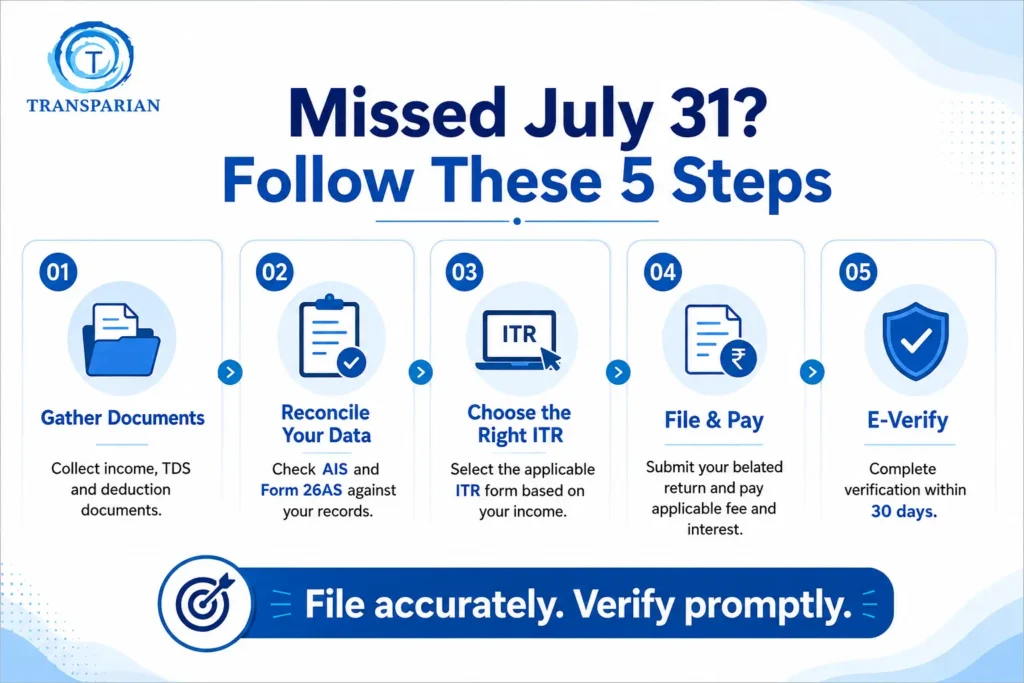
Rushing to file late is one thing. Filing accurately is another. The pre-filing checks that applied before July 31 still apply now arguably more so, because you cannot easily course-correct once a belated return is filed without going through the revision process.
Run through these before you file:
Reconcile your AIS and Form 26AS. The income tax portal now auto-compares declared income against AIS data. A mismatch between what you report and what AIS shows is the most common trigger for a notice. If you have capital gains entries, interest income from multiple banks, or dividend data in your AIS, cross-check everything before reporting figures. The detailed walkthrough on AIS vs Form 26AS reconciliation is exactly what you need here.
Verify all TDS credits. Check that TDS deducted by your employer, banks, and other payers appears correctly in Form 26AS. TDS credits you cannot see in Form 26AS cannot be claimed unless you follow up with the deductor.
Choose old vs new tax regime deliberately. For a belated return, you can still choose between the old and new regime — but if you had business or professional income, opting for the old regime with a belated return may not be permitted in all cases. Salaried taxpayers retain the choice. Do the calculation before you file.
Confirm your bank account is pre-validated. A refund goes to the account you nominate. If it is not pre-validated on the portal, validate it before filing.
Gather your deduction documents. Receipts for insurance premiums, PPF deposits, loan certificates, rent receipts, these still apply in the belated return and can reduce your liability or increase your refund.
The checklist in 6 things to check before submitting your ITR covers each of these steps in detail and is worth going through end-to-end before you file.
When Getting Help Makes Sense
If your return is straightforward one employer, salary income, standard deductions, no capital gains filing the belated return yourself through the income tax portal is manageable. The process is the same as a regular return; you just pay the Section 234F fee and any applicable interest at the time of payment.
If your situation is more complex, multiple income sources, capital gains from shares or property, foreign income, discrepancies in AIS data, prior-year demands on the portal working with a tax consultant in India at this stage is worth it. An error in a belated return is not a dead end, but revising it adds a step you can avoid with careful first-time filing.
The case for professional filing is laid out well in the post on why to choose a professional for ITR filing including the specific situations where self-filing carries the most risk.
The bottom line: missing July 31 is not ideal, but December 31 is still available. File your belated ITR, pay what is due, and close this out. Every week of delay costs more in interest and adds to the year-end rush when everyone else is filing too.
Let Transparian File Your Belated ITR Accurately
From interest calculations and form selection to income reconciliation and e-verification, Transparian provides reliable ITR filing services and tax consultant in India support for individuals who missed the July 31 deadline. File accurately, minimise penalties, and close the year cleanly.
FAQ’s
You can still file a belated return under Section 139(4) up to December 31, 2026. However, you lose the ability to carry forward most losses, and a late filing fee under Section 234F applies — ₹5,000 if your income exceeds ₹5 lakh, or ₹1,000 if it is below ₹5 lakh. Interest under Section 234A also accrues on any unpaid tax from August 1 until the date you file.
A belated return is an Income Tax Return filed after the July 31 due date under Section 139(4). It works like a regular return in most respects same forms, same income reporting, same deduction claims but it cannot be used to carry forward capital gains losses, business losses, or speculation losses to future years.
The last date to file a belated return for FY 2025-26 (Assessment Year 2026-27) is December 31, 2026. Filing after this date is not possible unless the Income Tax Department issues a specific extension or unless you opt for an Updated Return under Section 139(8A), which carries a much higher additional tax cost.
The late filing fee under Section 234F is ₹5,000 for taxpayers with total income above ₹5 lakh, and ₹1,000 for those with income below ₹5 lakh. This is a flat fee payable regardless of whether you owe additional tax or are due a refund. On top of this, Section 234A interest at 1% per month applies on any outstanding tax liability from August 1.
Yes, you can still claim your refund in a belated return. However, interest on refunds under Section 244A, which normally runs from April 1 of the assessment year, will run only from the date you actually file the belated return — not from April 1. The longer you delay, the more refund interest you forfeit.