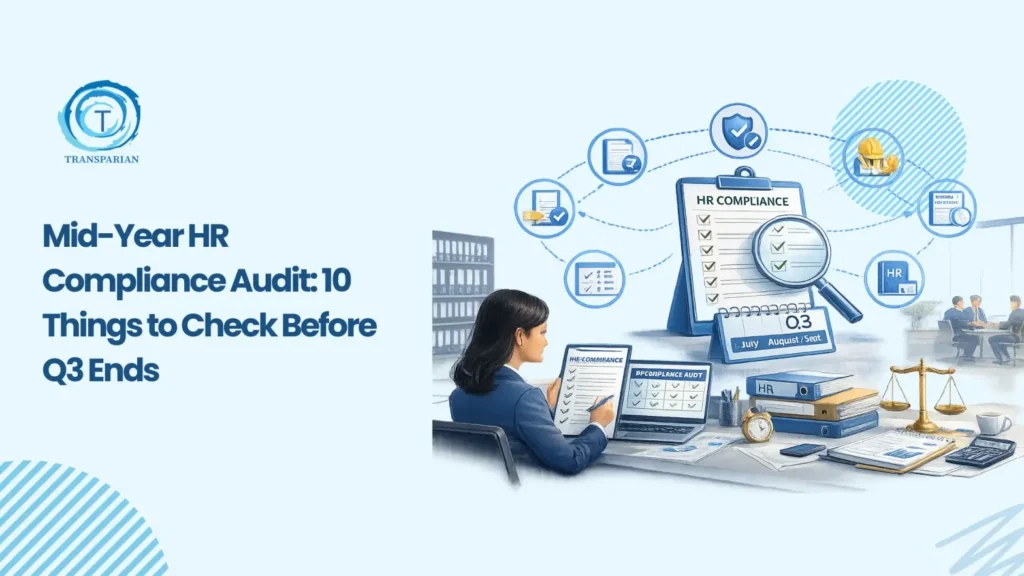
Q3 is when compliance gaps become compliance problems.
The H1 rush of onboarding, increment cycles, and financial year filings is done. Q4 deadlines are still months away. This is exactly the window where outstanding notices get ignored, contractor audits get deferred, and half-yearly filings slip past everyone.
A mid-year HR compliance audit does not need to be a formal exercise with a 40-page report. It needs to answer one question: what should have been done in the last six months that wasn’t? Here are ten areas worth going through before Q3 closes.
EPF and ESIC Filings for April Through September
Six ECR filings, six ESIC challan submissions. Pull the records and confirm every month is filed and paid. Sounds obvious, but a missed filing in a busy month gets buried fast, and EPF defaults attract interest at 12-18% per annum plus damages.
While you’re at it, check whether UAN generation is current for all employees who joined in Q1 and Q2. New joiners regularly fall through this gap. The same check applies to ESIC registration for employees who crossed the Rs. 21,000/month threshold during an increment cycle.
If there are any outstanding ECR demand notices or ESIC inspection letters from the previous financial year, this is the time to address them. They don’t age well.
PF and ESIC compliance obligations are the foundation of any HR compliance audit. Get this section right before moving to anything else.
2. Minimum Wage Revisions Coming in October
Most states revise minimum wages twice a year, in April and October. The April revision has already happened. October is six to eight weeks away.
Check the current minimum wage rates applicable in every state where you have employees or contractors deployed. Then verify that actual wages paid are at or above those rates across all categories and employment grades.
The October revision is the one to track now. When the notification comes out, payroll needs to be updated immediately, not in the following month’s cycle. Contractor wage structures need to be checked too. If a contractor is paying workers below revised minimum wages, the principal employer carries the liability.
3. Professional Tax Across All Operating States
Professional tax is state-specific, filed monthly or quarterly depending on the state, and has a habit of getting missed for states where only a handful of employees are based.
Run through every state where employees work. Confirm PT registration is in place, remittances are current, and returns have been filed on schedule. Karnataka, Maharashtra, and West Bengal are typically well-managed because of employee volumes. States like Andhra Pradesh, Telangana, and Gujarat need the same attention even for three employees.
For companies that opened new offices or added employees in a new state during H1, verify PT registration was completed before wages were disbursed there.
4. Labour Welfare Fund Contributions
Many states require Labour Welfare Fund contributions twice a year, on June 30 and December 31. The June deadline has passed. If contributions were not made on time, late payment attracts interest or penalties depending on the state.
Before Q3 ends, confirm June contributions are accounted for. Then set up the December submission now, not in late November when payroll is already managing year-end processes.
LWF rates and applicability differ by state. Maharashtra has different contribution slabs from Karnataka, which differs again from Gujarat. If you operate across multiple states, a state-wise LWF calendar is more useful than a generic reminder that lands on the wrong desk.
5. Contractor Compliance for H1
Principal employers are legally exposed when contractors default on statutory contributions. That exposure does not sit with the contractor.
For every active contractor covering April through September, verify EPF/ESIC remittance proof, CLRA license validity, and wage disbursement records. Good practice is to verify this monthly before releasing contractor invoices. If that was not happening, Q3 is the time to collect the proof and fill the gap.
Managing contract and temporary workers across these obligations requires a structured contractor compliance review, not an ad-hoc check before an inspection notice arrives. If contractor license renewals fall due in Q3 or Q4, track those now, not at expiry.
6. PoSH Compliance Review
The Internal Complaints Committee under the PoSH Act must be constituted and functional. For calendar-year companies, the annual report is due by January 31. Q3 is the right time to check whether the ICC is active, its composition is current (at least one external member is required), and whether any complaints received in H1 were handled correctly.
If no complaints were received, the ICC should still have met at least once, and that record should exist. PoSH compliance is not just about handling complaints. It includes annual awareness sessions for all employees, which many companies run once at launch and then quietly drop.
7. Salary Structure Audit for the New Wage Definition
The 50% wage rule under the Code on Wages is coming. For most Indian employers running low-basic salary structures, it will require restructuring.
Before Q3 ends, run a basic audit across pay grades: what percentage of CTC is basic for each band? Where is the special allowance doing most of the structural work? Which grades have excluded components above 50% of CTC?
This is preparation, not panic. The codes are not notified in most states yet. But companies that have mapped their exposure are in a materially different position from those who discover the gap the week after notification. While reviewing salary structures, also check that new hire offer letter templates from Q1 and Q2 reflect your current thinking on this.
The detailed impact on PF calculations is worth working through in parallel.
8. Factory Act or Shops and Establishments Compliance
For companies operating factories, check the Factory Act license validity date and confirm renewal applications have been filed or are in process.
For Shops and Establishment Act compliance, verify that registration certificates are current for all office locations. Some states require annual renewal; others are one-time. A new office opened in H1 needs to be registered before the next inspection cycle, not after.
The Factory Act compliance checklist for manufacturing units covers prescribed notice displays, safety audit records, and welfare facility requirements, not just the license itself. For factories approaching headcount thresholds that trigger new statutory obligations, tracking headcount monthly is more useful than discovering the threshold was crossed three months ago.
9. Four Labour Codes Readiness Check
State notifications for the four labour codes are still rolling out unevenly. Before Q3 closes, update your state-level notification tracker. Which states have notified which codes since April? Are there states where you operate that have issued new notifications in H1?
This is not just a watching brief. When a state notifies the Code on Wages, the new wage definition for PF and gratuity calculations applies in that state from the notification date. You need to know when that happens with enough lead time to update payroll configurations. Discovering a notification through an EPFO notice is not the right way to find out.
10. Outstanding Notices and Demands
EPF notices, ESIC inspection letters, professional tax demands, labour court summons. Some of these arrive, get logged somewhere, and get deferred during busy periods. Q3 is the time to pull the full list.
Outstanding notices accumulate interest. They also create disclosure requirements in some industries and show up during investor due diligence at the worst possible moment. An unresolved EPF demand from H1 sitting undisclosed is the kind of thing that closes deals on bad terms or delays exits.
The full picture of statutory compliance risk usually looks manageable until it’s actually examined. Pull the complete list, assign clear owners, and set resolution dates before Q3 ends.
Most compliance gaps are not discovered during audits. They surface during inspections, employee grievances, or due diligence. The audit is the mechanism that keeps those discoveries controlled and on your terms. Running one before Q3 ends does not guarantee a clean quarter. It significantly narrows what can catch you off guard.
For the full year-round framework, the labour law compliance checklist for HR teams covers the ongoing statutory calendar more completely.
Let Transparian Simplify Your HR Compliance Audit
From managing PF and ESIC filings to ensuring PoSH and state-specific statutory obligations are never missed, Transparian provides expert Labour Law Compliance support for HR teams and business owners. Through reliable compliance services and experienced statutory compliance consultants, Transparian helps growing businesses stay audit-ready, penalty-free, and fully aligned with every regulatory requirement.
FAQ’s
A mid-year HR compliance audit is a structured review of statutory obligations for the period April through September, run before Q3 ends. It covers EPF and ESIC filings, minimum wage compliance, contractor verification, Labour Welfare Fund contributions, PoSH status, and outstanding notices. The purpose is to catch gaps before they attract penalties or surface during an inspection.
The core checks are: all six ECR filings for April through September filed and paid; ESIC challans for the same period confirmed; UAN generation complete for Q1 and Q2 joiners; ESIC registration updated for employees who crossed the Rs. 21,000/month wage ceiling after increment; and no outstanding demand notices from the previous financial year left unresolved.
Most Indian states revise minimum wages twice a year, with revisions typically taking effect in April and October. The October revision is the relevant one to prepare for before Q3 ends. Once a state issues a revised minimum wage notification, employers must update payroll to reflect the new rates immediately.
LWF applies in states including Maharashtra, Karnataka, Andhra Pradesh, Telangana, Gujarat, West Bengal, Tamil Nadu, and several others. Contribution cycles vary by state. The most common deadlines are June 30 and December 31, covering the first and second half of the year respectively. Maharashtra requires monthly contributions; most other states follow the half-yearly cycle.
Maintain a state-by-state notification tracker covering all four codes: Code on Wages, Industrial Relations Code, Social Security Code, and Occupational Safety, Health and Working Conditions Code. Update it at the start of each quarter. The tracker should record notification date per state and code, and flag any payroll, wage definition, or contract labour changes that take effect in that state on the notification date.