
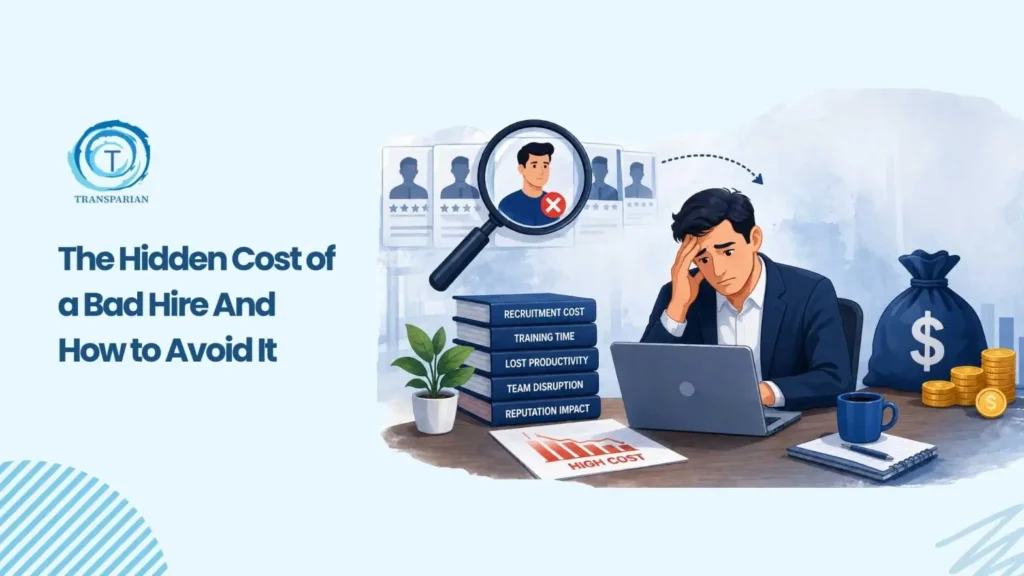
Every company has made a bad hire at some point. A candidate who looked great on paper, interviewed well, came with decent references and then, within weeks or months, it became clear something was off. The performance wasn’t there. The culture fit wasn’t right. The role simply wasn’t working. And by the time the decision was made to move on, the damage had already quietly piled up.
Most businesses only count what’s visible: the notice period, the time to repost the role, the cost of starting over. That number alone is painful. But the real cost of a bad hire runs much deeper than what shows up in a spreadsheet. Understanding it fully is what separates companies that keep making the same expensive mistake from those that build a hiring process that actually protects them.
What Does a Bad Hire Actually Cost?
The U.S. Department of Labor estimates that a bad hire can cost up to 30% of that employee’s first-year salary. For a mid-level role in India earning ₹8–12 lakhs annually, that’s ₹2.5 to 4 lakhs lost before you’ve even begun again. For senior roles; team leads, managers, or specialist hires, the number compounds quickly. Some estimates put the total cost as high as 150% of annual salary once you account for lost deals, disrupted projects, and the leadership time spent managing a situation that shouldn’t exist.
SHRM puts the average replacement cost at six to nine months of an employee’s salary when sourcing, onboarding, and ramp-up time are all factored in. For a growing company where every quarter counts, that’s not just expensive, it’s a serious disruption to momentum.
But those figures only capture the visible part of the problem. The costs that are harder to measure are often the ones that hurt the most.
The Hidden Costs Nobody Budgets For
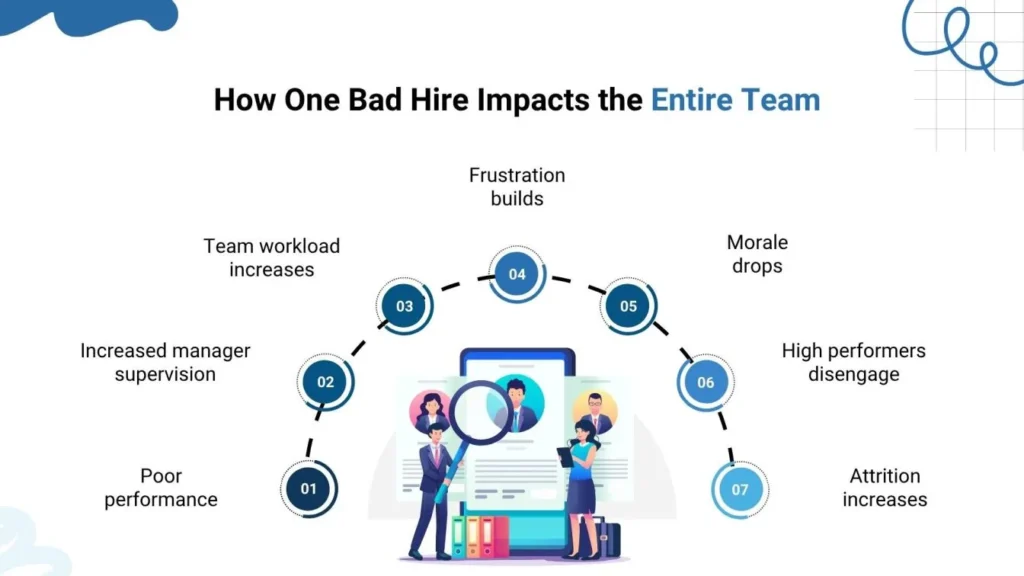
A poor hire rarely underperforms alone. The impact spreads across the team in ways that are easy to miss on any report:
- Lost productivity across the team. A struggling hire pulls manager attention, creates rework, breaks handoffs, and disrupts the rhythm of people around them often for months before any formal action is taken.
- Morale and retention damage. Strong performers notice a weak hire faster than management does. What they’re watching closely is how the organisation responds. If the wrong person stays on without accountability, high performers start quietly drawing their own conclusions and some of them start looking elsewhere. This is often where high attrition quietly begins, long before any resignation letter arrives.
- Management time that disappears. Performance conversations, documentation, coaching cycles, HR escalations; a struggling hire demands disproportionate bandwidth from managers who have their own deliverables to manage. That cost doesn’t show up anywhere, but it’s real.
- Employer brand erosion. Candidates talk. So do former employees. A bad hire who exits with a poor experience may leave a review, share the story with peers, or simply discourage other strong candidates from applying. In a market where job seekers research companies before they apply, a damaged employer brand costs far more than one recruitment cycle.
- Client-facing fallout. When a bad hire sits in a customer-facing role sales, account management, project delivery, internal disruption is only part of the problem. Strained client relationships, missed commitments, and lost trust are often far harder to recover from than the hire itself.
Why Do Bad Hires Happen?
The root causes tend to follow recognisable patterns. Most bad hires aren’t the result of one catastrophic failure, they’re the outcome of several small compromises that each seemed reasonable at the time:
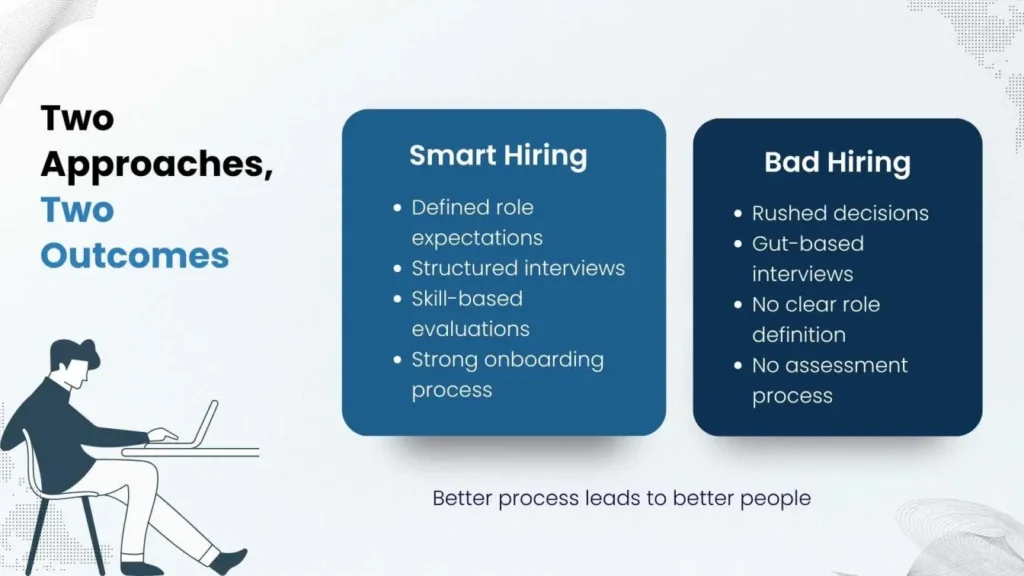
- Hiring under pressure. When a role has been open too long, the instinct is to close it. Interview benchmarks quietly drop. Red flags get rationalised. The first candidate who clears a reasonable bar gets the offer, not because they were the right fit, but because the team needed someone. The relief is short-lived.
- A poorly defined role. When hiring managers aren’t clear on what the role actually demands not just listed skills, but day-to-day responsibilities, working style, and what success genuinely looks like, they end up evaluating candidates against the wrong criteria. A solid recruitment strategy always starts with role clarity before anything else.
- Unstructured interviews. When every interviewer asks different questions with no consistent scoring criteria, you’re not really comparing candidates, you’re comparing the gut instincts of different people on different days. One strong conversation is not a reliable hiring signal.
- Reference checks as a formality. A five-minute call confirming job titles and dates is not a reference check. Asking specific, open questions about how someone performed under pressure, where they struggled, and how they worked with others will surface things no interview ever could.
- No practical assessment. For roles where execution is the job, there’s little substitute for seeing the candidate do some version of the actual work. Case studies, short tasks, or situational assessments remove a lot of the guesswork that interviews leave behind.
- A limited talent pool. Hiring only from whoever applied to a job posting means working with a fraction of available talent. The best candidates for most roles are passive, not actively browsing job boards, but open to the right opportunity. Without access to that audience, companies repeatedly choose from whoever showed up.
The Onboarding Factor
It’s worth saying clearly: even a good hire can become a bad one if the onboarding process is weak. Research consistently shows that how a new employee experiences their first thirty to ninety days has a direct impact on whether they stay, how quickly they contribute, and how engaged they become long-term.
In many organisations, onboarding is still treated as an administrative checklist: send the laptop, run through the policies, and do a few introductions. That approach sets people up to feel disconnected before they’ve even found their footing. A structured onboarding process sets clear expectations, builds the relationships a new hire needs to do their job well, and creates early wins that build confidence in the role.
Treating onboarding as an extension of the recruitment process not a separate administrative event is one of the simplest ways to protect a hire that took significant time and effort to make. The sourcing-to-onboarding process should be viewed as a single continuous effort, not two separate ones.
Building a Hiring Process That Actually Works
There’s no single fix. But companies that consistently hire well tend to do a few things differently:
- They define what success in the role looks like before the job is posted, not aspirationally, but practically. What will this person own in 90 days? What does a good week look like? What are the non-negotiables?
- They run structured interviews with consistent questions and agreed scoring criteria across every interviewer. It makes comparison meaningful rather than impressionistic.
- They include a practical assessment; a case study, a task, a short brief for roles where delivery is central to the job.
- They take references seriously and ask the questions that actually matter.
- They invest in onboarding with the same attention they give to sourcing. The hire isn’t complete at the offer stage.
- They resist the pressure to hire fast at the expense of hiring right. A short delay to find the correct person almost always costs less than months with the wrong one.
If in-house hiring keeps producing hires that don’t last, the issue is rarely the people making the decisions, it’s almost always the process behind those decisions. Fixing that is one of the highest-return changes a growing business can make, and it’s far cheaper than learning the same lesson twice.
Let Transparian Strengthen Your Hiring Process
From sourcing the right candidates to reducing mis-hires and managing end-to-end recruitment, Transparian’s Recruitment Services are built around finding talent that actually fits, not just filling positions. With over 20 years of HR experience, Transparian works with growing businesses to build hiring processes that are faster, sharper, and far less costly in the long run.
FAQ’s
A bad hire is an employee who fails to meet performance expectations, struggles with cultural fit, or cannot deliver the outcomes required for the role within a reasonable time frame.
A bad hire can cost anywhere between 30% to 150% of the employee’s annual salary, including recruitment costs, lost productivity, and replacement expenses.
Bad hiring decisions often result from rushed hiring, unclear job roles, unstructured interviews, poor reference checks, and limited access to quality talent pools.
A bad hire can disrupt workflows, create additional work for team members, and reduce overall productivity by requiring extra supervision and corrections.
Define clear role expectations, use structured interviews, include practical assessments, conduct thorough reference checks, and invest in a strong onboarding process.
Structured hiring ensures consistency, reduces bias, improves candidate evaluation, and significantly increases the chances of selecting the right candidate.