
Most growing companies hit a predictable wall. Their work is either too disorganized to be scaled or too costly to maintain. The first solution would be to hire a full-time Chief Human Resources Officer, but you look at the salary scales and realize that the cost is too high. Based on the compensation data of Glassdoor and PayScale India, an experienced CHRO in India will be anywhere between 40 lakh and 1.5 crore per year with top enterprise CHROs in the likes of Mumbai and Bangalore will be much higher at 1.8 crore plus, not to mention bonuses, ESOPs, gratuity, benefits, and the unseen cost of recruiting a C-suite employee. That is not a realistic price in the case of mid-sized business, startups in their early stages, and organizations in growth transition.
This is exactly where a Fractional CHRO enters the picture and why this model is rapidly becoming one of the most strategically sound decisions a cost-conscious, growth-focused company can make.
What a Fractional CHRO Actually Does
The common misconception is that a Fractional CHRO is simply a part-time HR manager with a fancier title. That framing misses the point entirely.
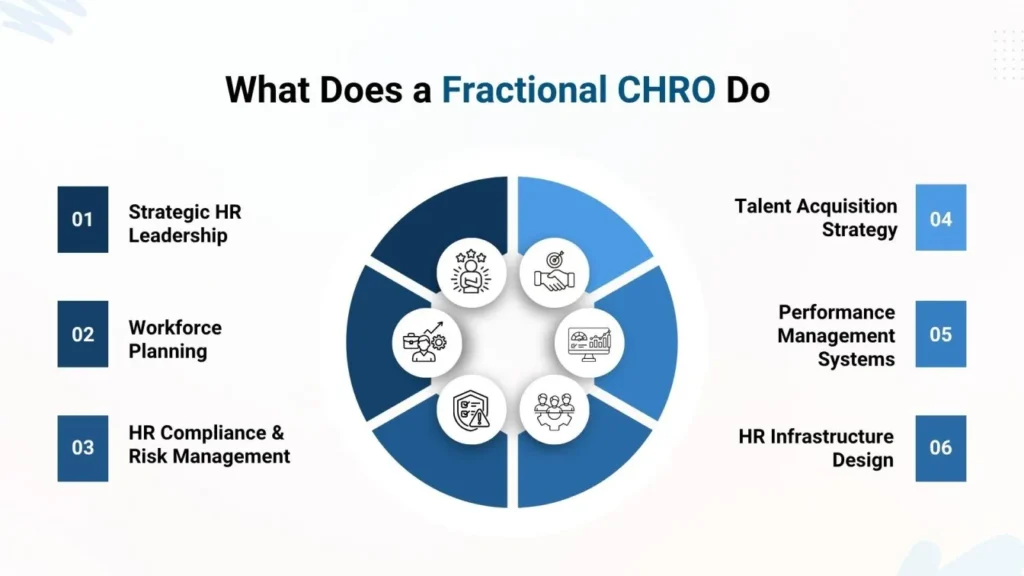
A Fractional CHRO brings executive-level strategic leadership to your people function, the same caliber of thinking and decision-making you would expect from a full-time CHRO but on a flexible engagement basis.They operate within a specified number of hours or days per month, integrated into your leadership team, leading HR strategy instead of merely administering HR administration.
Practically this means:
- They are at the executive table and make human capital decisions in line with business objectives.
- They audit, redesign and future-proof your HR Infrastructure.
- They identify legal and compliance exposures that create financial liability
- They build talent acquisition systems, compensation systems, and performance systems from the ground up.
- They reduce dependence on expensive HR agencies and reactive hiring
It is an executive level strategic workforce planning without the full-time cost burden.
The Real Cost Breakdown: Full-Time CHRO vs. Fractional CHRO
A full-time CHRO engagement in India typically includes:
- Base salary: ₹40 Lakh – ₹1.5 Crore/year for mid-market companies; ₹1.5–2 Crore+ for large enterprises and MNCs
- PF, gratuity, health insurance, ESOPs, and performance bonuses: 25–35% on top of base CTC
- Onboarding and ramp-up time: 3–6 months before full productivity
- Severance and notice period costs if the fit isn’t right, typically 1–3 months of salary
An average Fractional CHRO engagement in India is between ₹75,000-₹250,000 a month with the scope, size of company, industry, and time commitment. You achieve instant productivity on day one, no statutory overhead and have the full ability to increase or reduce the engagement as needed by the business.
For a company spending ₹80 Lakh annually on a full-time CHRO, a fractional model at ₹1,50,000/month (₹18 Lakh/year) delivers the same executive-level strategic leadership at roughly 22% of the cost, the savings multiply further when you account for PF contributions, gratuity accrual, and the real cost of a bad C-suite hire in a market where CHRO attrition is rising.
How a Fractional CHRO Rebuilds Your HR Infrastructure to Cut Costs Long-Term
One of the most underappreciated contributions of a Fractional CHRO is what they do to the underlying HR Infrastructure of an organization. The majority of businesses use fragmented HR systems, mismatched software, unequalized policies, undocumented procedures that cause inefficiency and wastage at all tiers.
Audit existing HR operations to identify where budget is being lost, overspending on HR tech licenses, redundant vendors, manual processes that could be automated through an HR technology stack overhaul.
Standardize people processes from onboarding to offboarding reducing the administrative time managers spend on HR tasks and lowering the HR cost per hire significantly.
Build scalable HR Infrastructure that grows with the company rather than requiring a full rebuild every 18 months. This includes org design, role clarity frameworks, compensation banding, and career pathing.
Introduce HR analytics measuring turnover rates, engagement scores, time-to-fill, and human capital management metrics that previously no one was tracking. Data-driven HR decisions consistently outperform gut-feel hiring and retention approaches.
The net present value of these infrastructure benefits can frequently produce cost savings that are more than the fractional engagement fee in the initial year.
Risk Management: The Hidden Financial Benefit Nobody Talks About
This is the topic most coverage on this subject glosses over entirely and it may be the most financially significant reason to bring in a Fractional CHRO.
HR Risk Management is not noble but the price of making a mistake is disastrous. Employment litigation, wrongful termination claims, misclassified contractors, non-compliance with the Industrial Disputes Act, violations under the Shops and Establishments Act, POSH (Prevention of Sexual Harassment) non-compliance, and failure to meet PF and ESI obligations, these are not hypothetical risks for Indian businesses. They are becoming more common and they can be largely avoided as long as you have the appropriate executive level strategic leadership that governs the role of your people.
A Fractional CHRO with strong HR compliance expertise will:
- Conduct a legal exposure audit across offer letters, appointment letters, policies, and contractor classification practices
- Update employee handbooks and standing orders to reflect current Indian labour law including the four Labour Codes
- Implement proper documentation practices that protect the company in the event of a dispute before a labour court or tribunal
- Train managers on legally defensible performance management and termination protocols under Indian employment law
- Ensure that organizational development decisions restructures, layoffs, role eliminations are executed in a way that minimizes legal liability under the Industrial Disputes Act
A single employment dispute in India, in terms of legal fees to tribunal to possible settlement may cost a company ₹10 Lakh to 75 Lakh or even more, on top of the reputational and leadership bandwidth cost. A Fractional CHRO who prevents even one significant legal exposure event more than pays for themselves across an entire year of engagement.
Strategic Talent Acquisition: Spending Less, Hiring Better
Reactive hiring is expensive hiring. When organizations fail to use a talent acquisition strategy, they turn to costly agency recruiters to fill each vacancy, make rushed decisions with little time pressure, and then deal with the downstream costs of poor fit, disengagement, underperformance, and employee retention challenges.
A Fractional CHRO installs a proactive talent framework instead:
- Employer branding that attracts candidates organically and reduces agency dependence
- Structured interview processes that improve hiring accuracy and reduce costly mis-hires
- Internal mobility programs that surface existing talent before going external
- Workforce planning that anticipates hiring needs 6–12 months ahead, avoiding panic hiring premiums
- Compensation benchmarking that keeps offers competitive without overpaying against market
The outcome is a measurable decrease in cost-to-hire, faster time-to-fill and retention, all of which directly impact the bottom line.
When Does a Fractional CHRO Make the Most Strategic Sense?
Not every organization needs a Fractional CHRO at the same moment, but there are specific inflection points where the ROI becomes immediately clear:
- Series A/B startups that have outgrown founder-led HR but cannot justify a full-time executive hire
- Mid-sized companies (50–500 employees) where HR is being managed by a generalist or operations leader who lacks the strategic depth to drive people strategy at scale
- Organizations in transition — M&A activity, rapid scaling, restructuring, or leadership change, where HR transformation is necessary but temporary
- Companies recovering from HR failures high turnover, culture problems, compliance issues, that need experienced leadership to reset the function
- PE-backed businesses looking to drive EBITDA improvement through HR cost optimization without sacrificing people capability
The Strategy Lift: Why “Cheaper” Does Not Mean “Lesser”
A persistent concern from leadership teams is whether a fractional model means settling for something less than a true strategic partner. The answer is a firm no and the reason comes down to the caliber of professional this model attracts.
Many of the best Fractional CHROs are former HR leaders from large Indian conglomerates, MNC India operations, or high-growth unicorn-stage startups seasoned professionals who have deliberately chosen the fractional model precisely because it allows them to do higher-impact work across multiple organizations. They bring cross-industry pattern recognition that a single full-time hire simply cannot match.
They are not running day to day HR administration. They are deciding on organizational development, workforce design, culture architecture, and talent philosophy, which are the very conversations that should be at the leadership table and have a direct impact on the business.
The model delivers on-demand HR leadership without the organizational drag of a full-time headcount. For companies that value agility, speed, and capital efficiency, that is not a compromise. It is a competitive advantage.
Measuring the ROI of a Fractional CHRO Engagement
Smart leadership teams do not take HR investment on faith. Here are the metrics that quantify the impact of a Fractional CHRO engagement:
- Reduction in HR spend as a percentage of total revenue
- Decrease in cost per hire year-over-year
- Voluntary turnover reduction — every percentage point of improvement saves significant replacement costs
- Time saved by managers on HR tasks that have been systematized
- Compliance audit results — reduction in legal exposure identified
- Employee engagement scores — a leading indicator of retention and productivity
- Time-to-fill for critical roles — faster hiring means less lost productivity
When these numbers are tracked from the start of a Fractional CHRO engagement, the ROI becomes visible within two to three quarters and compounds as HR Infrastructure improvements take root across the organization.
Let Transparian Support Your Fractional CHRO Needs
From reducing HR costs to building a future-ready people strategy, Transparian delivers expert Fractional CHRO support for growing organisations across India. Through hands-on HR Infrastructure design, Risk Management oversight, and executive-level strategic leadership, Transparian helps businesses scale their HR function with confidence, without the cost of a full-time C-suite hire.
FAQ’s
A Fractional CHRO reduces costs by optimizing hiring processes, minimizing agency dependency, improving retention, streamlining HR operations, and avoiding expensive compliance or legal risks.
Companies typically hire a Fractional CHRO during rapid growth, restructuring, scaling phases, mergers, or when HR becomes too complex for generalist HR teams.
A Fractional CHRO works as part of the leadership team and owns strategy, while HR consultants usually provide short-term advice without ongoing leadership involvement.
Yes, startups benefit significantly as Fractional CHROs help build HR infrastructure, hiring strategy, and culture without the high cost of full-time executive leadership.
Fractional CHROs typically provide workforce planning, organizational design, HR compliance, performance management, compensation planning, and talent acquisition strategy.
A Fractional CHRO builds structured hiring processes, workforce planning, employer branding, and interview frameworks to reduce mis-hires and recruitment costs.