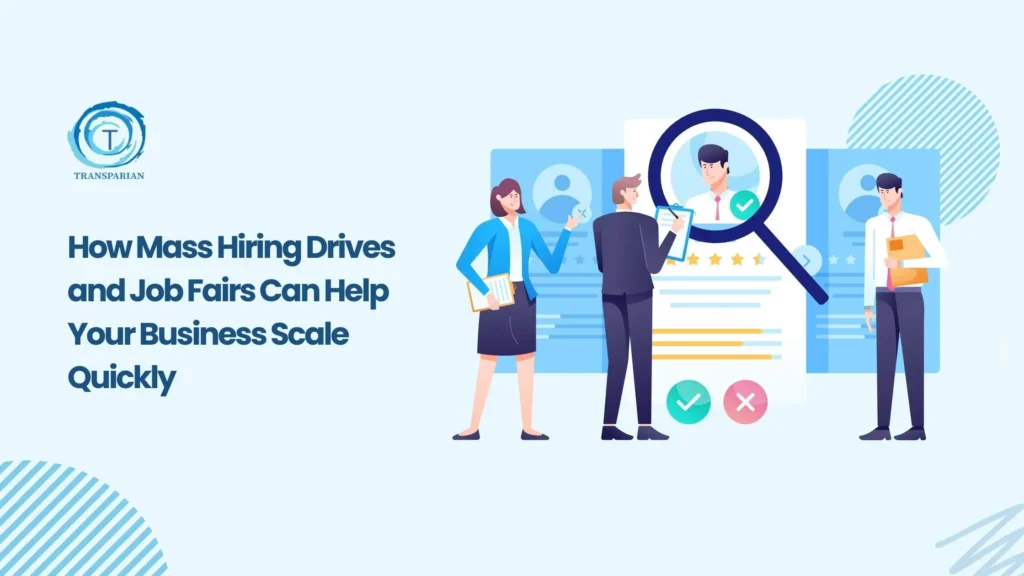
Scaling a business rapidly requires more than ambition and funding, it requires the right talent at the right speed. As companies expand into new markets, launch new products, or experience seasonal demand spikes, traditional hiring methods often fail to keep pace. This is where mass hiring drives and job fairs for recruitment emerge as powerful growth enablers, helping organizations hire at scale while maintaining speed, quality, and cost efficiency.
Modern businesses are no longer asking if mass hiring works, they are asking how it helps them scale faster, smarter, and more sustainably.
Why Businesses Struggle to Scale with Traditional Hiring Models
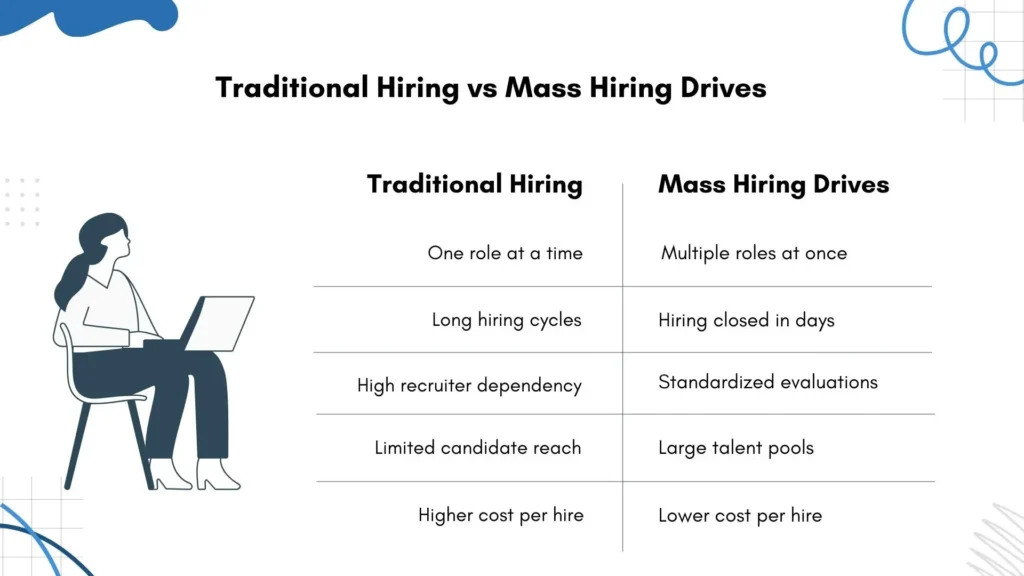
Before understanding the impact of mass hiring events, it’s important to recognize the limitations of conventional recruitment:
- Long hiring cycles slow down expansion
- High dependency on individual recruiters creates bottlenecks
- Limited candidate reach affects workforce quality
- Rising recruitment costs strain scaling budgets
Even experienced recruitment companies and job recruitment agencies acknowledge that one-role-at-a-time hiring does not support aggressive growth plans. Scaling requires a volume-driven yet quality-focused hiring approach, which mass hiring events are uniquely designed to deliver.
What Mass Hiring Drives and Job Fairs Actually Solve
Mass hiring drives and structured job fairs are not just large interviews, they are strategic workforce acceleration tools. When executed correctly, they compress months of hiring into weeks or even days.
Key problems they solve include:
- Rapid workforce onboarding
- Simultaneous hiring across roles and locations
- Standardization of the hiring process
- Reduced dependency on fragmented recruitment channels
This is why staffing services and Tech Recruitment Agencies increasingly recommend event-based hiring for fast-scaling organizations.
How Mass Hiring Drives Accelerate Workforce Scaling
High-Volume Talent Access in a Short Timeframe
Mass hiring events create a high-density talent environment, allowing employers to evaluate hundreds or thousands of candidates at once. This volume is nearly impossible to achieve through standard sourcing alone.
For businesses scaling operations, this directly supports:
- workforce scaling without operational delays
- Faster team deployment across projects
- Immediate talent availability for business-critical roles
Large recruitment agencies and IT recruiting companies in India use mass drives to meet aggressive client timelines, especially in IT, manufacturing, BPO, retail, and logistics sectors.
Faster Recruitment Funnel Movement
One of the most overlooked advantages is how mass hiring optimizes the recruitment funnel for mass hiring.
Instead of candidates moving slowly through stages over weeks, job fairs allow:
- Same-day screening
- On-the-spot assessments
- Immediate shortlisting
- Faster offer rollouts
This compressed funnel reduces candidate drop-off and keeps momentum high, making scaling predictable rather than reactive.
Cost-Effective Recruitment at Scale
Scaling businesses often ask whether mass hiring is economical. In reality, it is one of the most cost effective recruitment methods when measured per hire.
Benefits include:
- Lower cost per candidate interaction
- Reduced advertising and sourcing spend
- Better ROI compared to prolonged hiring cycles
- Efficient use of internal HR and staffing services
For startups and mid-sized enterprises, this cost efficiency directly impacts runway and profitability during growth phases.
Job Fairs as Employer Branding Powerhouses
Strengthening Employer Branding During Growth
Fast-growing businesses need more than hires, they need recognition. Job fairs act as live brand experiences that strengthen employer branding.
Candidates don’t just apply; they:
- Interact with leadership
- Experience company culture
- Understand growth opportunities
- Associate the brand with scale and stability
This branding effect benefits long-term hiring as well, helping recruitment companies and internal teams attract talent even beyond the event.
Attracting Passive and High-Intent Candidates
Unlike online job portals, job fairs attract:
- Passive job seekers exploring opportunities
- Career switchers
- Fresh graduates and early professionals
- Candidates actively ready to join
This mix enhances building talent pools that remain valuable long after the event ends, supporting a long term recruitment strategy rather than just immediate hiring needs.
Skills-Based Hiring at Scale
Moving Beyond Resumes to Real Skills
One area where most blogs fall short is explaining how mass hiring enables skills-based hiring.
Live assessments, group tasks, and role-specific evaluations allow employers to:
- Test real-world skills instantly
- Reduce resume bias
- Match candidates to actual job requirements
- Improve workforce productivity post-hire
This is especially valuable for Tech Recruitment Agencies and IT recruiting companies in India, where skill validation matters more than credentials alone.
Global Hiring Trends Driving Mass Recruitment Adoption
Alignment with Global Hiring Trends
Across industries, global hiring trends show a shift toward:
- Event-based recruitment
- Hybrid and virtual job fairs
- Centralized hiring operations
- Location-agnostic talent sourcing
Mass hiring drives both physical and virtual support companies expanding into new regions without setting up full recruitment infrastructure immediately. This makes them ideal for global expansion strategies led by recruitment agencies and staffing services.
Building Long-Term Talent Pipelines Through Mass Hiring
Turning Hiring Events into Talent Ecosystems
Most companies treat job fairs as one-time activities. Scalable businesses treat them as pipeline builders.
Mass hiring events help:
- Capture candidate data for future roles
- Segment talent by skills and experience
- Create ready-to-hire databases
- Support building talent pools for upcoming growth phases
This approach transforms hiring from reactive to proactive, strengthening the long term recruitment strategy.
Improving Hiring Speed Without Sacrificing Quality
Standardizing the Hiring Process Across Teams
As organizations scale, inconsistency becomes a major risk. Mass hiring introduces structured workflows that standardize the hiring process across departments and locations.
Benefits include:
- Fair and unbiased evaluations
- Consistent hiring criteria
- Faster onboarding readiness
- Reduced dependency on individual recruiters
This structure is why job recruitment agencies rely heavily on mass hiring frameworks for large mandates.
When Mass Hiring Drives Make the Most Sense
Mass hiring and job fairs for recruitment are especially effective when businesses need to:
- Launch new teams quickly
- Expand into new markets
- Support seasonal demand
- Replace high attrition roles
- Build bench strength for future growth
Industries like IT services, manufacturing, logistics, BFSI, retail, and startups working with Tech Recruitment Agencies benefit significantly from this approach.

Integrating Recruitment Partners for Scalable Results
Working with experienced recruitment agencies, staffing services, and recruitment companies ensures that mass hiring events are not chaotic but strategic.
These partners bring:
- Structured candidate flow management
- Technology-enabled assessments
- Compliance-ready documentation
- Data-driven hiring insights
Their involvement allows internal HR teams to focus on workforce integration rather than logistics.
Why Mass Hiring Is a Strategic Growth Lever, Not a Shortcut
The biggest misconception is that mass hiring sacrifices quality for speed. In reality, when aligned with skills-based hiring, standardized workflows, and strong employer branding, it becomes a powerful scaling engine.
Businesses that integrate mass hiring into their long term recruitment strategy don’t just grow faster, they grow more predictably, sustainably, and competitively.
FAQ’s
Job fairs allow companies to meet hundreds of candidates at once, speed up screening and selection, and reduce hiring timelines from months to days.
Industries such as IT services, BPO, manufacturing, retail, logistics, BFSI, and fast-growing startups benefit the most from mass hiring initiatives.
Yes, mass hiring drives significantly reduce cost per hire by minimizing advertising spend, recruiter dependency, and prolonged hiring cycles.
No. When combined with skills-based assessments and standardized evaluations, mass hiring can maintain or even improve hiring quality.
Roles can often be closed within days or weeks, depending on role complexity, compared to months with traditional hiring methods.
Recruitment agencies manage candidate flow, assessments, compliance, and logistics, ensuring mass hiring events remain structured and outcome driven.