Scaling a workforce across multiple locations is no longer limited to large enterprises. Startups, SMEs, and fast-growing companies are now hiring across cities, states, and even countries to access better talent, control costs, and support business expansion. However, multi-location hiring introduces complexity in different talent markets, compliance requirements, hiring timelines, and operational coordination.
This is where modern staffing service and recruitment agencies can be significant. In addition to enabling businesses to fill positions in a fast manner, they allow them to develop repeatable, flexible, and location-agnostic hiring paradigms that can scale without collapsing the internal HR systems.
This blog explains the benefits of staffing services with the ability to hire across various locations in a scalable manner, including both benefits that are frequently spoken about, as well as those that are not yet discussed in the context of being strategic; that is, technology, and workforce planning are the two metrics and skills-based hiring.
Understanding Scalable Hiring in a Multi-Location Context
Scalable hiring does not simply imply hiring one person or many people, it is only about hiring and doing so consistently, efficiently, and predictably as your organization expands across geographies. Multi-location hiring adds layers such as:
- Varying local talent availability
- Different salary benchmarks
- Location-specific compliance and payroll norms
- Distributed interview and onboarding processes
- Uneven hiring demand across regions
The absence of the right workforce scaling strategies means that internal HRs will have difficulties in keeping up with it, which causes the delay of hiring, poor consistency, and increased costs.
Using Agencies and staffing partners are the force multipliers since they standardize the process of hiring but tailor it according to local realities.
How Staffing Services Build Location-Ready Hiring Infrastructure
The vast majority of companies do not estimate the operation background of multi-location hiring. Staffing services bring pre-built hiring infrastructure that can be deployed instantly across regions.
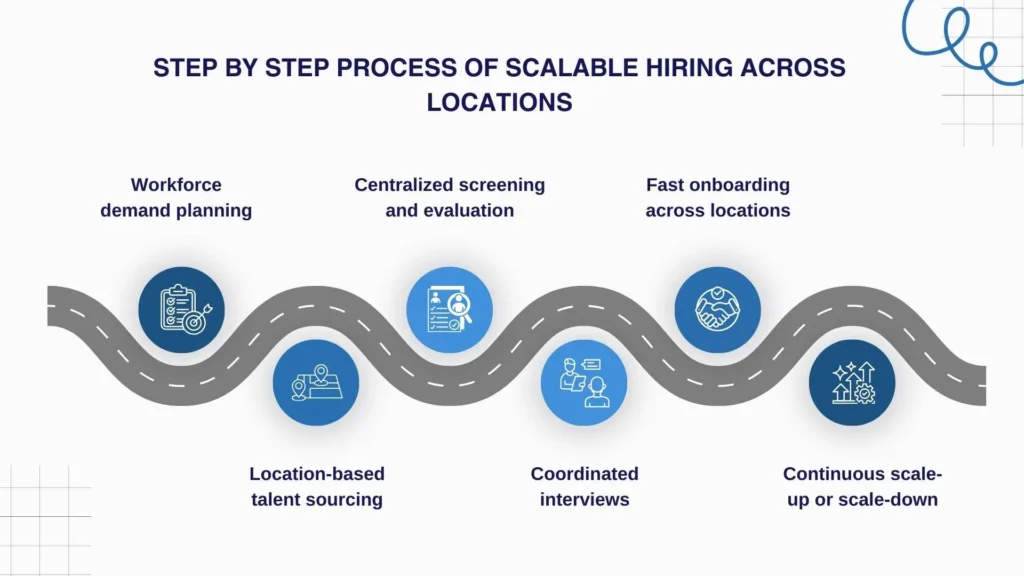
This includes:
- Local recruiter networks familiar with regional talent markets
- Ready candidate pipelines segmented by location and skill
- Standardized screening and interview frameworks
- Centralized coordination with decentralized execution
In other companies that are expanding to new cities, this will help eliminate the necessity to develop local hiring capacity on its own.
Centralized Strategy, Local Execution: The Core Advantage
The fact that staffing partners are one of the strongest but least discussed advantages is their capability to create a balance between central control and local flexibility.
Under Recruitment Process Outsourcing, companies establish central hiring requirements, such as job specifications, evaluation parameters, turnaround time, but the staffing partners carry out hiring in the region with a region specific sourcing strategy.
This ensures:
- Consistent quality of hire across locations
- Faster role fulfillment despite regional differences
- Reduced dependency on internal HR bandwidth
In the case of businesses that employ a large number of people in various locations at the same time, the model avoids bottlenecks and misalignment.
Accessing Diverse Talent Pools Through Location-Based Staffing
Cities and regions have different advantages. Tier-2 cities can offer cost benefits, whereas the metro areas can offer niche or elderly talent. Staffing firms and Tech Recruitment Agencies know these subtleties.
They help organizations:
- Map roles to optimal hiring locations
- Balance cost and skill availability
- Build distributed teams without compromising performance
This is an area-focused strategy that can be used in scalable hiring options that are cost effective and strategic.
Enabling Flexible Workforce Models Across Locations
Multi-location environments do not work with rigid hiring models where demand varies across locations. The staffing partners offer flexibility b:
- contract staffing for short-term or location-specific needs
- project based hiring for regional initiatives or rollouts
- On-Demand Recruitment to scale recruiter capacity instantly
This results in flexibility in that organizations can increase or decrease the size of teams without any long-term commitments, which simplifies dealing with uncertainty and regional periods of high demand.
Cost Control and Predictability in Multi-Location Hiring
Hiring across multiple locations often leads to hidden costs, agency overlap, inconsistent salary offers, prolonged vacancies, and administrative inefficiencies. Staffing partners introduce cost effective hiring solutions by:
- Reducing time-to-hire across regions
- Eliminating redundant recruitment spend
- Standardizing fee structures
- Improving offer-to-join ratios
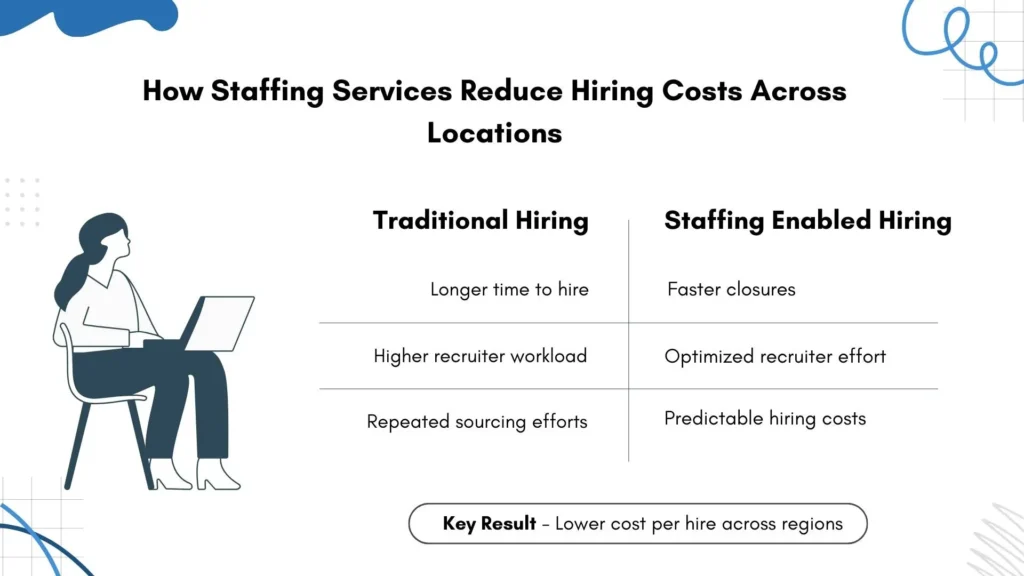
Since staffing companies are already efficient at scale, they can transmit the benefits of scale to their clients, which makes expanding large-scale a financial opportunity.
Automation and Technology as Scale Enablers
Modern staffing partners combine recruitment automation tools in order to coordinate complexity between locations.
These tools support:
- Centralized candidate tracking across regions
- Automated screening and shortlisting
- Interview scheduling across time zones
- Hiring analytics and performance tracking
This is the automation that will make sure that with more hiring volumes or geography there will be no proportional increase in operational effort.
Supporting Skills-Based Hiring Across Regions
The recruitment based on location usually fails when the companies have too strong emphasis on resumes instead of skills. Staffing partners increasingly enable skills-based hiring by:
- Assessing role-specific competencies instead of location bias
- Using standardized skill assessments across regions
- Matching talent to outcomes, not just job titles
This strategy also opens the talent pool to a large scale particularly in the hiring in the emerging cities or the remoteness.
Multi-Location Compliance and Process Consistency
Every location has its compliance requirements like labor regulations, contracts, payroll systems and records. Although businesses do not outsource the law, staffing partners simplify the compliance with operations through:
- Standardizing employment documentation
- Managing contract structures for temporary and project roles
- Ensuring consistent onboarding experiences
This operational consistency is essential for sustainable multi-location growth.
Workforce Planning and Forecasting at Scale
Forecasting is one of the least considered factors in scalable hiring. Staffing partners, do not simply fill positions, but assist organizations to predict the future needs by analyzing:
- Location-wise hiring trends
- Role demand seasonality
- Attrition patterns
- Skill availability shifts
This data enables proactive workforce scaling strategies, preventing last-minute hiring chaos and enabling smoother expansion.
Measuring What Matters in Multi-Location Hiring
The majority of the internal teams have difficulties in monitoring the performance of hiring in different regions. The metrics that are introduced by staffing partners include:
- Time-to-hire by location
- Cost per hire by region
- Quality of hire consistency
- Time to productivity
These lessons can enable leaders to make better decisions regarding the next scaling point and how to streamline the already streamlined hiring process.
Enabling Rapid Expansion Without HR Burnout
Multi-location hiring can cause HR burnout – there are too many jobs, too many stakeholders, and too little time. The operational load of staffing is taken over by the service which undertakes the sourcing, screening, coordination, and follow-ups.
This allows internal teams to focus on:
- Culture integration
- Leadership hiring
- Strategic workforce planning
Scalable hiring is as much about protecting internal capacity as it is about growing headcount.
Adapting to Market Shifts and Location-Specific Demand
Regions are affected by economic changes, funding cycles, and other changes in the market differently. The staffing partners assist the organizations to respond dynamically by:
- Reallocating hiring focus across locations
- Switching between permanent, contract, and project models
- Scaling recruitment capacity up or down instantly
This flexibility is essential to companies that are in a changing or a fast growing environment.
Building a Repeatable Multi-Location Hiring Engine
The final worth of the staffing services is repeatability. After they have processes, tools, and partnerships in place, the companies can:
- Launch hiring in new locations faster
- Maintain consistent talent quality
- Control costs as scale increases
- Adapt hiring models without disruption
This turns the hiring process into a responsive process instead of a growth engine.
Through the integration of local market intelligence, centralized approach, flexible models of workforce, execution through technology and use of data, recruitment agencies and staffing partners help organizations to scale hiring in a seamless manner across several locations without compromising speed, quality, or cost.
FAQ’s
Staffing services provide local talent access, standardized hiring processes, and centralized coordination, allowing companies to scale hiring quickly while adapting to regional market conditions.
Internal HR teams often struggle with varied talent markets, compliance differences, coordination issues, and rising workloads when hiring across multiple locations simultaneously.
Yes, staffing services reduce hiring costs by shortening time-to-hire, minimizing recruitment overhead, improving candidate quality, and offering flexible workforce models.
Staffing agencies use centralized hiring frameworks, standardized screening criteria, and shared performance metrics while executing sourcing locally to ensure consistency across locations.
Recruitment automation tools help manage candidate tracking, screening, interviews, and analytics across regions, ensuring efficient hiring without increasing manual effort.
Companies should use staffing services when entering new locations, experiencing rapid growth, managing fluctuating hiring demand, or when internal HR capacity is stretched.