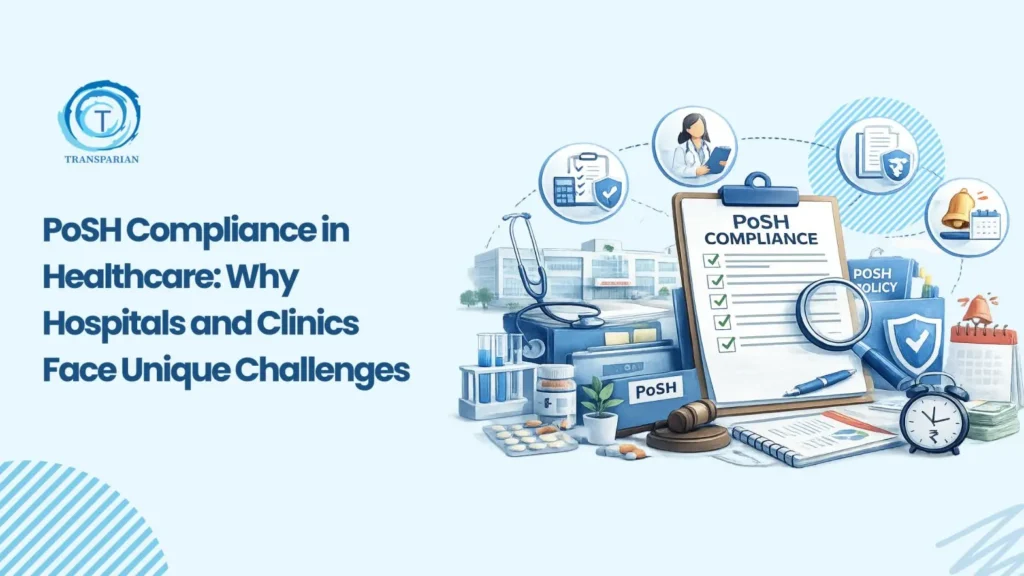
Healthcare is one of the few sectors where someone can be a patient one hour and a bystander to workplace misconduct the next. Hospitals and clinics run around the clock. Staff work across departments, shifts, and hierarchies that do not map neatly onto a nine-to-five office environment. And yet, many healthcare organisations in India treat their PoSH obligations the same way a mid-sized IT company would; a policy document, an annual training session, and an Internal Complaints Committee that exists mostly on paper.
That approach does not hold up in a hospital. The sector has structural realities that make PoSH compliance both more complex and more consequential than in most other industries. This piece covers what those realities are, why generic compliance programmes fail to address them, and what healthcare organisations actually need to do differently.
The Workforce Structure Is Fundamentally Different
Walk through any mid-sized hospital and you will encounter a workforce that no single HR policy was designed to cover cleanly. On any given shift, you might have:
- Permanent nursing staff employed directly by the hospital
- Resident doctors on stipends from a medical college
- Visiting consultants who are neither employees nor contractors in the conventional sense
- Housekeeping and facilities staff supplied by a third-party vendor
- Administrative and billing personnel on fixed-term contracts
- Medical equipment technicians seconded from device companies
Each of these categories sits differently under the PoSH Act, 2013. The law uses a broad definition of “aggrieved woman” and “workplace,” which means the hospital’s obligations extend well beyond its direct payroll. A complaint filed by a contract housekeeping employee about misconduct by a senior doctor is still a PoSH matter. Most hospitals do not have a clear process for handling that kind of cross-category complaint and when they do not, the complaint either goes nowhere or escalates badly.
This is where many healthcare organisations discover their PoSH compliance framework has significant gaps. The ICC was set up for one type of employment relationship. The actual workforce operates across five.
Power Hierarchies Are Steep — and They Run in Multiple Directions
Healthcare has some of the steepest professional hierarchies of any sector. A junior resident is dependent on their attending physician for assessments, training, and career references. A staff nurse may be managed day-to-day by a senior nurse, but her department also falls under a doctor who holds much more institutional authority.
What makes this harder for PoSH training for employees to address is that the power dynamics run in different directions depending on the context. A visiting consultant has no formal authority over permanent staff, but their referrals and patient volume give them significant informal leverage. Administrative staff may outrank clinical staff in one area and report to them in another. These shifting hierarchies create situations where the standard framing of “supervisor and subordinate” breaks down.
For complaint handling, this matters a great deal. A junior doctor who files a complaint against a senior consultant may not trust that the ICC will handle it without institutional bias, especially in a hospital where that consultant brings in significant revenue. That fear is not irrational and it is something a well-structured PoSH framework needs to account for explicitly.
Night Shifts, Isolation, and Unsupervised Environments
Office environments have rhythms. Meetings are scheduled. Most interactions happen when multiple colleagues are present. At the end of the day, the building empties.
Hospitals do not work that way. A night shift in an ICU might have two nurses and one resident doctor on the ward. A female staff member doing overnight rounds in a section of the hospital that has no security cameras may have no practical way to raise an alarm or summon help quickly.
Physical isolation is one of the documented risk factors for workplace harassment across sectors. In healthcare, it is structural, it is built into how the work is organised. Any serious PoSH compliance programme for a hospital needs to account for this directly: which areas of the building present higher risk, what the supervision arrangements look like on night shifts, and whether staff know what to do and who to contact when an incident occurs outside regular working hours.
Patients and Attendants Are a Distinct Category of Risk
This is the challenge that makes healthcare genuinely unlike most other workplaces. A significant proportion of harassment reported in hospitals comes not from colleagues but from patients, their families, or attendants accompanying them.
The PoSH Act’s protections apply to women in the workplace regardless of who the harasser is. A nurse harassed by a patient’s attendant is protected. A female doctor subjected to repeated inappropriate comments by a patient during consultations can file a complaint. But the practical response to a patient-sourced complaint is very different from handling an employee-on-employee matter, and most hospital ICC procedures have no separate protocol for it.
This puts hospitals in a position where they need to maintain safe working environments without the ability to discipline or terminate the person responsible because the responsible party is not an employee. That requires specific guidance, escalation pathways, and in some cases clinical decisions about whether a patient’s treatment should be transferred to another provider. Most hospitals have no formal process for any of this.
A qualified PoSH consultant with sector-specific experience can help design these protocols in a way that protects staff while remaining legally sound and operationally workable.
The ICC Setup Itself Tends to Be Inadequate
The Internal Complaints Committee in most hospitals follows the same flawed template seen across Indian industries. A senior woman employee is named Presiding Officer, two or three members are added, and an external member is appointed. The documentation is filed. The committee never meets.
In a hospital context, this creates specific problems:
- The Presiding Officer is often a senior nurse or administrative head who has no authority in relation to senior doctors making it difficult to conduct a fair inquiry against a medical professional
- ICC members from the clinical side may have ongoing working relationships with respondents that compromise their ability to remain impartial
- The external member is frequently a lawyer or HR professional with no understanding of the hospital environment and the power dynamics within it
None of this is unique to healthcare, but the stakes are higher here because the seniority gaps are sharper and the working relationships are more interdependent. Role-based PoSH training for employees separate tracks for ICC members, managers, and general staff matters more in a hospital setting than almost anywhere else.
Training Reaches Only Part of the Workforce
Most hospitals that conduct PoSH awareness programmes do so for nursing and administrative staff. Doctors particularly senior consultants and those with visiting arrangements are frequently excluded, either because they are not on the direct payroll or because no one wants to create friction with clinicians who are commercially important.
This produces a visible imbalance. The people with the least institutional power receive the training. The people with the most institutional power do not. That is precisely the wrong way around. PoSH compliance for a hospital needs to include doctors specifically, and the training needs to address the particular authority dynamics that clinical settings create rather than using generic corporate examples.
Contract staff and vendor-supplied workers, housekeeping, catering, security present an additional gap. They are present on hospital premises, exposed to the same risks, and often in lower-status roles that make them more vulnerable. Most hospital PoSH programmes treat them as outside scope. Legally, that position is hard to defend.
What Better PoSH Compliance Looks Like for Healthcare
There is no single template that works across all hospital sizes and configurations. A 20-bed clinic in Pune has different practical constraints than a 500-bed tertiary care facility. But some principles hold across the sector:
- The sexual harassment policy needs to explicitly address patient and attendant conduct, not just employee-to-employee scenarios
- ICC composition needs to reflect the actual hierarchy of the institution having a medical professional on the committee is not optional if the complaint population will include cases involving doctors
- Shift-specific protocols need to exist for reporting and first response, including out-of-hours contacts
- Training needs to cover all workforce categories: permanent staff, contract workers, resident doctors, and visiting consultants
- Vendor contracts need to include PoSH obligations, so responsibility for third-party staff is clearly defined
The 5 most common PoSH compliance mistakes organisations make inadequate ICC training, exclusion of non-direct employees, missed annual reports are all present in healthcare, often in more acute form than in other sectors.
Getting the framework right is not just a legal requirement. In a workplace where staff are already managing significant professional pressure, having a clear and credible process for raising complaints is part of how hospitals retain good people.
Let Transparian Simplify Your PoSH Compliance
From ICC constitution and PoSH training for employees to sector-specific policy drafting and annual report filing, Transparian provides expert PoSH Compliance support for hospitals, clinics, and healthcare organisations. With experienced PoSH consultants who understand the unique workforce structures and power dynamics in healthcare, Transparian helps you build a framework that actually works not just one that looks right on paper.
FAQ’s
Yes. Any organisation with 10 or more employees is covered, including hospitals, clinics, nursing homes, and diagnostic centres. The obligation to constitute an ICC, conduct training, and file an annual report applies without exception.
Not directly as employees, but complaints from hospital staff involving visiting consultants still need to be addressed. Hospitals should include consultants in training and have a documented process for handling complaints that involve non-payroll doctors.
Yes. The Act protects women from harassment at the workplace regardless of who the harasser is. Hospitals need specific protocols for patient-sourced complaints since they cannot discipline a patient the way they would an employee.
It needs to cover shift-based environments, patient interactions, out-of-hours reporting, and the steep hierarchy between clinical grades. Generic corporate examples do not translate to a ward setting and reduce the training’s credibility with staff.
In practice, yes. These workers are on hospital premises and can be parties to complaints. PoSH obligations should be written into vendor contracts, and third-party staff should have access to basic awareness and a clear way to raise a complaint.
The report must be filed with the District Officer by January 31 every year. Missing it is a violation under Section 26 of the Act and can attract fines. For healthcare organisations holding regulatory licences, repeated non-compliance carries additional risk.