
In 2025, the role of Virtual HR leaders has evolved far beyond remote workforce management. These professionals now sit at the intersection of technology, strategy, and human capital driving decisions through AI-driven workforce analytics and data-backed insights.
The post-pandemic workplace, shaped by hybrid teams and cloud collaboration, demands agile and informed HR leadership. Today’s Virtual HR solutions blend artificial intelligence, automation, and human judgment to deliver what traditional models could not, real-time insights, smarter decision-making, and scalable employee engagement strategies.
For CHROs, compliance heads, and SME business owners, understanding how AI reshapes HR’s role is no longer optional, it’s a competitive imperative.
AI-Powered Workforce Analytics Explained
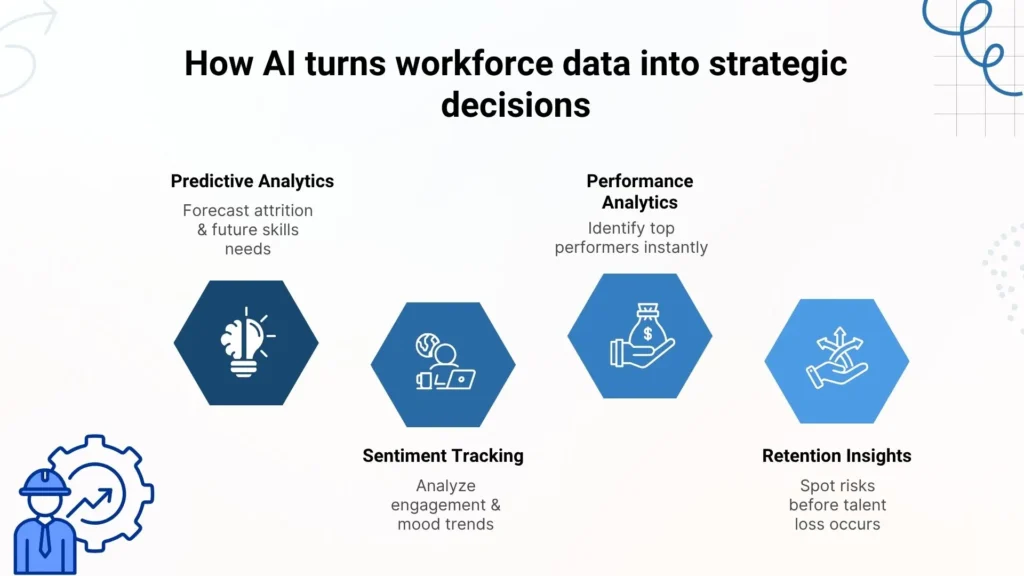
AI-driven workforce analytics are transforming how HR teams understand and manage talent. These tools go beyond dashboards and spreadsheets, tapping into predictive algorithms, behavior analysis, and natural language processing to uncover deep workforce insights.
1. Predictive Analytics for Talent Planning
AI platforms like Workday, SAP SuccessFactors, and Darwinbox (popular among Indian SMEs) are enabling HR leaders to predict attrition risks, identify future skill gaps, and model workforce needs months in advance. Instead of reacting to turnover, Virtual HR leaders can proactively design retention strategies.
2. Sentiment Tracking and Employee Engagement
AI tools now monitor employee sentiment through emails, feedback forms, and collaboration tools. This allows remote HR leadership teams to measure employee satisfaction in real-time pinpointing burnout risks or disengagement trends before they impact productivity.
3. Data-Driven Decision Frameworks
In 2025, AI in HR decision-making is not just about automation, it’s about augmentation. AI translates raw data into actionable insights, enabling HR leaders to guide CEOs with strategic clarity. For example, an AI-driven workforce analytics dashboard can reveal that productivity dips correlate with over-scheduled virtual meetings, prompting HR to redesign hybrid work norms.
Virtual HR Leadership in the AI Era
The modern Virtual HR leader acts as both strategist and technologist. They use AI not just to optimize HR operations but to transform business outcomes.
From Administration to Strategy
Traditional HR focused on compliance and transactions. Virtual HR leaders now advise the C-suite using data-based forecasting, whether it’s predicting talent shortages in tech roles or aligning workforce structure with revenue goals. This shift turns HR from a cost center into a profit enabler.
AI-Enabled Decision Support
With AI in HR decision-making, Virtual HR professionals can simulate the outcomes of different talent strategies. For instance, before implementing a remote-first model, a Fractional CHRO can analyze AI data on engagement, time-tracking, and productivity to predict whether employees will adapt successfully.
Example:
A mid-size IT firm in Bengaluru appointed a Virtual CHRO from Transparian to manage its hybrid workforce. Using AI-based performance analytics, the leader identified that developers working asynchronously had higher task completion rates than those in synchronous teams. The insight led to a company-wide policy shift that boosted project delivery times by 18%.
This example underscores how Virtual HR solutions driven by AI insights can translate directly into measurable business outcomes.
Productivity Transformation through Automation
AI isn’t replacing HR, it’s amplifying it. HR productivity automation has unlocked new efficiencies in routine yet crucial processes.
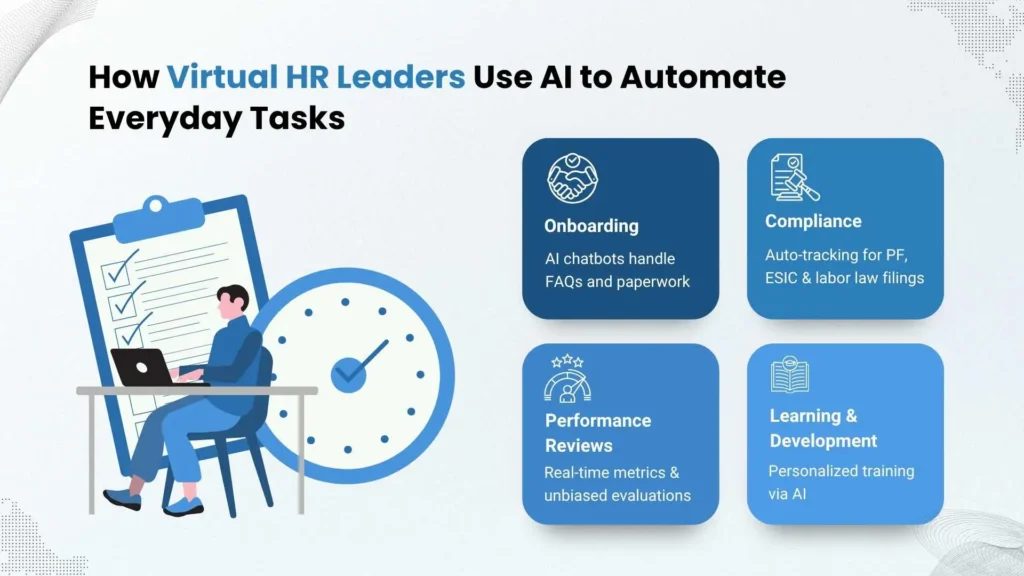
1. Smarter Onboarding and Training
AI chatbots now manage first-day queries, schedule orientation sessions, and recommend learning modules tailored to job roles. This allows Virtual HR leaders to focus on cultural integration and team alignment rather than administrative tasks.
2. Compliance Reporting and Risk Reduction
With automated data validation, AI tools reduce errors in statutory filings and labor compliance reports, a critical advantage for SMEs managing operations across multiple Indian states. Virtual HR leaders use automated alerts to stay ahead of regulatory updates, ensuring zero compliance lapses.
3. Performance Reviews and Feedback Loops
HR productivity automation platforms now use AI to identify top performers based on metrics like project outcomes, client feedback, and collaboration data. Rather than waiting for annual reviews, Virtual HR leaders conduct real-time recognition, improving motivation and retention.
Key Productivity Metrics Improved by AI and Virtual HR:
- 35–45% faster onboarding cycles
- 20–25% reduction in compliance errors
- 15–20% higher employee satisfaction scores
- 10–15% increase in overall HR operational efficiency
Challenges and Strategic Solutions
The integration of AI in HR decision-making isn’t without obstacles. Data privacy, bias, and system interoperability remain top concerns for organizations in India.
1. Data Privacy and Security
AI systems often process sensitive employee data. Virtual HR leaders enforce strict access controls, encryption protocols, and vendor audits to maintain compliance with India’s Digital Personal Data Protection Act (DPDPA 2023).
2. Bias in AI Algorithms
AI tools can unintentionally replicate human biases in hiring or performance assessment. Effective remote HR leadership involves continuous model testing, inclusion of diverse data sets, and transparent evaluation frameworks to prevent discrimination.
3. Integration with Legacy Systems
Many SMEs still operate on traditional HRMS platforms. Here, Fractional CHROs play a critical advisory role mapping integration pathways and ensuring new AI systems enhance, not disrupt, existing workflows.
Strategic Solution Example:
A manufacturing SME in Pune faced data inconsistency across payroll and performance systems. A Virtual HR expert introduced an AI-driven HR automation layer that unified employee data, cutting payroll discrepancies by 40%. This integration improved trust and visibility across departments.
The Future of Virtual HR Leadership (2025–2026 Trends)
As we move into 2026, the next evolution of Virtual HR leadership will center on predictive and generative AI collaboration.
1. Predictive HR Strategy
AI will soon enable HR leaders to simulate workforce scenarios predicting future skill shortages, compensation trends, or the impact of regulatory shifts before they occur. This predictive ability will make HR strategy as data-driven as finance or operations.
2. Generative AI in Employee Experience
Generative AI tools like ChatGPT-based virtual assistants are being embedded in HR service desks, creating personalized employee engagement experiences from answering leave policy queries to suggesting wellness initiatives.
3. The Rise of the Hybrid CHRO
The Fractional CHRO model where experienced HR leaders provide strategic guidance part-time will dominate the SME segment in India. Supported by AI-driven workforce analytics, these leaders will offer enterprise-level insights at startup-friendly costs.
4. AI-Human Collaboration
Despite rapid automation, human judgment remains indispensable. The winning model combines data accuracy from AI with the empathy and intuition of seasoned Virtual HR professionals ensuring decisions are both fair and human-centered.
Why This Matters for CHROs, Compliance Heads, and Business Owners
For business decision-makers in India, the message is clear: Virtual HR leadership powered by AI is not a futuristic concept, it’s a present-day advantage.
- CHROs gain access to sharper analytics and automation that amplify strategic influence.
- Compliance heads ensure end-to-end governance through AI-enabled compliance tracking.
- SME founders can scale HR operations without expanding headcount through cost-efficient Virtual HR solutions.
The result? Data-led decisions, consistent compliance, and measurable gains in employee satisfaction, productivity, and profitability.
Conclusion
In 2025, organizations that combine human leadership with AI intelligence will outpace competitors in adaptability, culture, and innovation. The Virtual HR leader is at the center of this transformation enabling smarter AI-driven workforce analytics, seamless HR productivity automation, and elevated employee engagement.
Whether you’re rethinking workforce strategy, seeking agile HR leadership, or navigating compliance complexity the solution lies in a Virtual HR model that merges technology with expertise.
FAQ’s
A Virtual HR leader operates remotely and uses digital tools and AI-driven workforce analytics to manage and optimize HR functions. Unlike traditional HR heads, they focus on strategic data-based decisions, automation, and AI integration rather than only administrative tasks.
AI in HR decision-making improves accuracy and speed by analyzing patterns in employee data, predicting attrition risks, optimizing hiring strategies, and automating repetitive HR functions such as compliance reporting and onboarding.
SMEs can access experienced HR leadership at lower costs, automate manual processes, and ensure compliance through Virtual HR solutions. This model also improves employee satisfaction, retention, and workforce scalability.
HR productivity automation eliminates time-consuming manual work in payroll, compliance, and employee management. This allows HR leaders to focus on strategic planning and talent development, resulting in higher efficiency and better resource allocation.
Yes. Through AI-enabled compliance dashboards and automated reporting, Virtual HR professionals help companies stay aligned with labor laws, ESIC, PF, and new data protection regulations across multiple states.