
In the post-pandemic world, workforce migration isn’t a one-way tide into the metros anymore. The developing story among HR executives, CXOs, founders and business owners of start-ups is that the future of talent is getting to be in the smaller urban centers. The trend of shifting to recruiting in the tier-2 cities in India is strategically beneficial because organisations reconsider the way, the place and the people they hire.With remote work now ingrained, hybrid models flourishing, and corporates decentralising operations, tapping the tier 2 city talent pool is no longer a backup plan, it’s a core strategy.
In this blog we’ll explore why Tier-2 hiring is becoming work-strategy gold, how it aligns with evolving HR dynamics such as remote hiring India and workforce diversification, and what decision-makers must do today to future-proof talent acquisition.
The Rise of Tier 2 Cities in India as Workforce Hubs
When we speak of Tier-2 cities in India, names like Indore, Coimbatore, Bhubaneswar, Kochi and Chandigarh are increasingly part of the conversation. These cities are now earning their stripes as credible tech and services hubs rather than mere feeders into the big metros. A NASSCOM analysis notes that up to 15% of India’s tech talent pool now resides in tier-2 and tier-3 cities, signaling a shift that’s both broad and deep.
Several critical factors are fueling this rise:
- Rapid infrastructure growth and better internet connectivity.
- Mushrooming tech parks and co-working spaces.
- Government-backed upskilling programs and industry-academia partnerships.
- Adoption of hybrid workforce strategies enables employers to tap talent beyond their physical location.
For example, Indore is now home to several consulting and analytics firms, while Bhubaneswar is evolving as a hub for finance and analytics, thanks in part to strong university pipelines and proactive local governance. Kochi, Jaipur, and Coimbatore are all experiencing similar tech and service sector booms.
Key Advantages for Employers
So what real benefits are organisations reaping when they shift the lens to Tier-2 talent? Here’s a breakdown of what decision-makers are gaining.
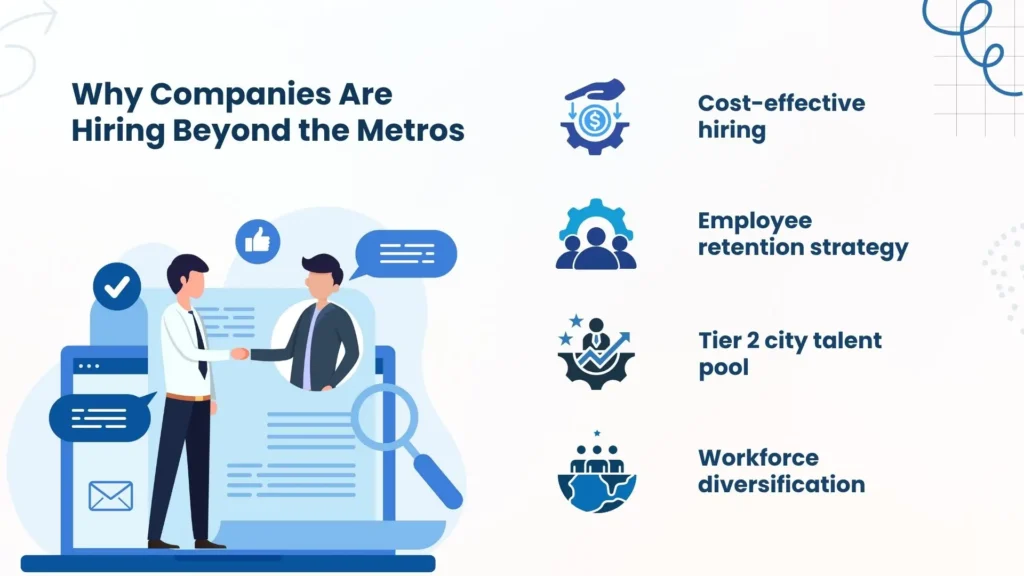
Cost-effectiveness
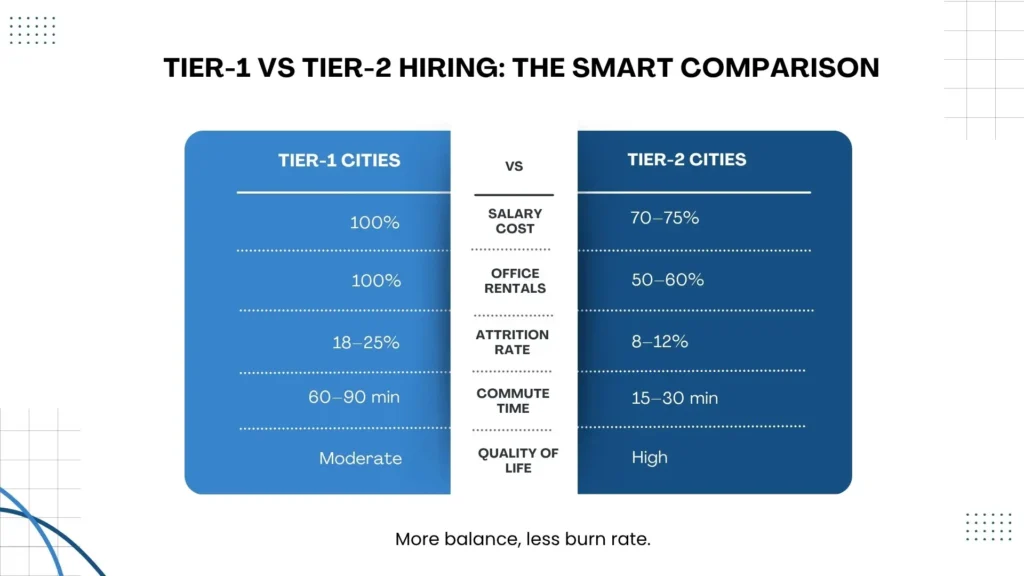
One of the most powerful levers: Through cost-effective hiring, companies are able to optimize both salary budgets and overheads. It has been reported that the talent expenses in Tier-2 cities can be between 25-30 per cent cheaper with real-estate, infrastructure and operational expenses potentially reducing by between 40-50% of those in Tier-1 hubs. This is converted into short-term and quantifiable ROI of companies capacity building, particularly back-office, shared services, tech support or scalable delivery model.
Retention & stability advantage
Interestingly, there is a tendency towards lower attrition in most Tier-2 situations. In the case of GCCs and services arrangements in smaller cities, turnover may be significantly reduced, as indicated in the consulting-firm analysis, because of better standard of living, reduced commuter stress and cheaper living. For organisations looking to build long-term teams rather than rapid churners, this becomes a meaningful differentiation in their employee retention strategy.
Access to skilled and loyal workforce
Tier-2 cities have matured in terms of regional universities, technical institutes and upskilling initiatives. Graduates who would have otherwise migrated are remaining home based – forming an untapped tier 2 city talent pool. A report shows that approximately 60% of the total Indians graduates belong to smaller towns and cities. Furthermore, the cultural benefit: the talent of local areas tend to show greater organisational loyalty and retention when managed accordingly. A benefit of companies seeking consistency in the personnel framework than constantly having to recruit.
Workforce diversification
From an HR lens, hiring across geographies supports workforce diversification both in terms of regional representation and mindset, as well as enabling an employer brand beyond metro-centric models. In particular, in 2025 and further on, when the HR trends are expected to be focused on inclusion, remote working systems, and hybrid + distributed teams, leveraging Tier-2 cities is consistent with the overall strategic needs.
Addressing Employer Concerns
Naturally, any strategic change requires the leaders to consider practical issues of capability, connectivity, productivity and remote management. The following is the way organisations are successfully reducing risks in adopting remote hiring India based in Tier-2 cities.
Connectivity and infrastructure
Although traditionally part of Tier-2 cities, infrastructure has also enhanced in rapid speed: robust broadband penetration, enhanced airport/rail connectivity, coworking and state-led incentives are bridging the divide. For example, NASSCOM reports highlight improved digital enablement across non-metro hubs.
Productivity monitoring & remote work tools
As the hybrid and remote models of the digital world become a reality, companies are using the latest digital HR applications, work-management platforms, performance analytics, cloud-based team-building facilities, which render geographical location less of a factor. This supports the fact that talent location is not as crucial as the systems around it.
Employer-of-Record and staffing models
In situations where the business has legal, onboarding, or other employment-compliance concerns at the geographic level, the expansion can be de-risked by engaging hiring agencies or tech recruitment agencies specialised in Tier-2 situations. These partners introduce operation expertise remote/hybrid hiring and retention plans so that HR leaders can scale distributed teams without putting the entire burden on in-house functionality.
Why Tier 2 Cities in India Should be on Your Radar
Let’s pull out some illustrative examples and industry insights that highlight how organisations are already benefiting from hiring from tier-2 cities in India.
- According to one commentary, companies are increasingly directing new GCCs into smaller towns like Indore, Coimbatore, Jaipur and Chandigarh because they provide “talent arbitrage, availability of human resources especially engineering” plus lower cost.
- The rise of job openings in Tier-2 cities is being tracked via LinkedIn’s “Cities on the Rise” list for example, cities like Visakhapatnam, Ranchi, Vijayawada, Nashik and Raipur are now among the fastest-growing non-metro hubs in India.
- One analytical blog points out that Tier-2 cities often show attrition below 10 % when paired with good L&D programmes, an appealing metric for organisations placing their bets on long-term workforce investments.
For HR heads and startup founders, these real-world signals matter: this is not anecdotal; it’s structural. When you overlay your strategic priorities for 2025 HR trends India 2025 include hybrid working, talent decentralisation and cost resilience, then hiring from Tier-2 cities in India becomes a pillar strategy rather than a nice-to-have.
Embracing hiring from Tier-2 cities in India is not just a tactical move, it’s a strategic stake in the future of talent acquisition. When you combine cost optimization, access to skilled talent, lower attrition, and the right infrastructure for remote/hybrid work, you build a workforce that is resilient, scalable and aligned with 2025 and beyond. For HR leaders, CXOs and founders looking to leap ahead in talent strategy, the message is clear: widen the sourcing lens, engage the tier 2 city talent pool, and build the distributed workforce framework that tomorrow demands.
Strategic Takeaways for HR Leaders and Founders
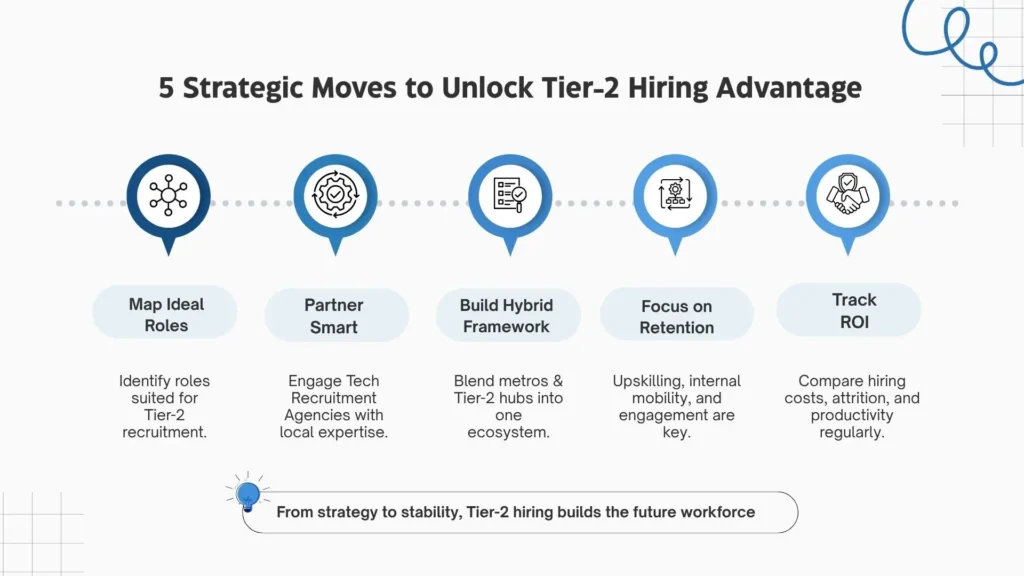
Here’s how you translate the above into actionable steps and strategy design:
- Map your roles and segmentation: Determine which roles are best suited for Tier-2 hiring (repeatable tech support, delivery centres, backend operations, niche and localised skill sets) and which may remain metro-centric (high-end executive leadership).
- Build a distributed hiring strategy: Incorporate Tier-2 city hiring into your hybrid workforce strategy, blending onsite-metro presence with Tier-2 remote hubs. Ensure your recruitment protocols and performance frameworks are location-agnostic yet outcomes-driven.
- Partner with the right recruitment ecosystem: Engage specialised recruitment agencies, staffing services and tech recruitment agencies with experience in Tier-2 city ecosystems, they know local talent buckets, universities, salary benchmarks and retention levers.
- Invest in L&D, engagement & retention: To leverage the workforce advantage (lower attrition, stable loyalty), ensure you have continuous upskilling pathways, internal mobility and alignment with company purpose. That unlocks the full potential of the Tier-2 talent pool.
- Track and benchmark cost-ROI: Monitor total cost of hiring and operating in Tier-2 vs Tier-1 hubs salary savings, infrastructure savings, attrition costs, productivity metrics and tie them back to business outcomes.
- Celebrate workforce diversification: Beyond cost and skill, emphasise the strategic value of geographic diversity in your employer brand. This supports talent attraction, employee engagement and positions you as a modern, inclusive employer.
Conclusion
Embracing hiring from Tier-2 cities in India is not just a tactical move, it’s a strategic stake in the future of talent acquisition. When you combine cost optimization, access to skilled talent, lower attrition, and the right infrastructure for remote/hybrid work, you build a workforce that is resilient, scalable and aligned with 2025 and beyond. For HR leaders, CXOs and founders looking to leap ahead in talent strategy. The message is clear: widen the sourcing lens, engage the tier 2 city talent pool, and build the distributed workforce framework that tomorrow demands.
FAQ’s
Companies are leveraging the tier 2 city talent pool for better retention, reduced salary pressure, and access to technically skilled, loyal employees. Improved infrastructure and remote hiring India models have made it easier to manage distributed teams.
By recruiting from Tier-2 cities, firms can save up to 30 % on salaries and 40 % on operational overheads, achieving cost-effective hiring without compromising on quality or productivity.
Yes. Many Tier-2 cities host strong universities, digital upskilling programs, and tech ecosystems. The workforce is equally qualified, especially in IT, design, finance, and customer support sectors often with better stability and cultural alignment.
Common concerns include internet connectivity, onboarding logistics, and performance monitoring. However, digital HR tools, hybrid work models, and Hiring Agencies or Tech Recruitment Agencies help companies overcome these barriers efficiently.
Align Tier-2 recruitment with your hybrid workforce strategy map suitable roles, build partnerships with Tech Recruitment Agencies, and design retention frameworks. It strengthens agility and aligns with HR trends India 2025.