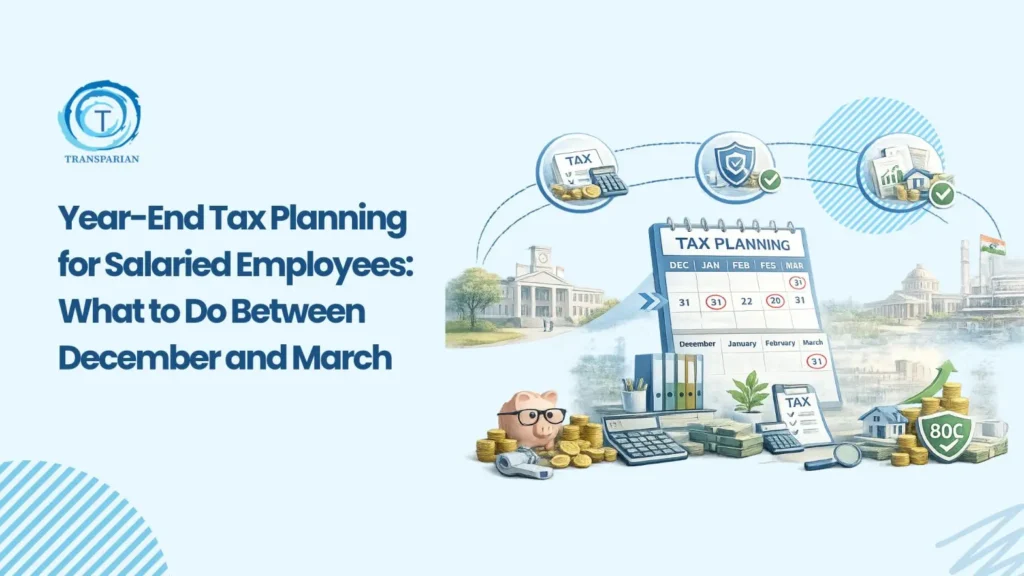
By December, most of your FY 2026-27 numbers are already on your payslips: the salary drawn so far, the TDS deducted, and a fair idea of any bonus still to come. That makes December the right month to sit down with them. Wait until March and all you can do is react.
Year-end tax planning for salaried employees comes down to four jobs: estimate your tax, settle on a regime, submit proofs to your employer, and close the gaps before March 31. This guide takes them month by month.
What Changed on April 1, 2026
FY 2026-27 is the first year under the Income-tax Act, 2025, which replaced the 1961 Act. For planning purposes, two things changed.
The vocabulary did. “Assessment year” and “previous year” give way to “tax year”, so the return you file in 2027 is for Tax Year 2026-27. Section 80C is now Section 123, Section 80D is Section 126, and the new tax regime sits in Section 202. Most people will keep saying 80C for a while, and so does this guide.
The money mostly did not. Slab rates and deduction limits carried over, and the Union Budget 2026 left the slabs alone. The Income-tax Rules, 2026 did change some forms and the HRA city list, covered below.
December: Work Out Where You Stand
Start with three documents: your latest payslip, the projected tax statement from your employer’s payroll portal, and your Form 26AS from the income tax portal, which lists the TDS credited under your PAN.
Then project the full year. Add salary for the remaining months, any bonus or variable pay, interest from deposits, rent if you have a tenant, and capital gains booked so far. Compare the tax on that total with the TDS already deducted and the TDS still to come.
A gap shows up as a heavy deduction in your February or March payslip, when payroll recovers the balance in one or two instalments. Spotting it in December lets you plan for it.
Pick Your Regime With Numbers
Your employer deducts TDS under the regime you declared in April, but that declaration decides only the TDS. The regime you choose when you file your return is the one that counts, and salaried taxpayers can switch from year to year.
A salary of up to ₹12.75 lakh pays no tax under the new regime: the ₹75,000 standard deduction brings taxable income to ₹12 lakh, and the Section 87A rebate cancels the tax on it. For many readers the comparison ends there.
Above that level, run both. Take a ₹15 lakh salary. Under the new regime, taxable income is ₹14.25 lakh and the tax is ₹97,500 including cess. To match that under the old regime, you would need about ₹5.4 lakh of deductions and exemptions on top of the ₹50,000 standard deduction, which means HRA, home loan interest, 80C, 80D and NPS added together. If your claims add up to less, the new regime costs you less.
January: Submit Proofs and Recheck Your HRA
Most employers close the proof window in January or early February, ahead of the final TDS calculation. If you are on the old regime and miss it, TDS goes out as though you had claimed nothing.
The declaration form is now Form 124, which replaced Form 12BB from April 1, 2026. Keep these ready:
- Rent receipts, plus your landlord’s PAN if annual rent is above ₹1 lakh
- Premium receipts for life and health insurance
- The interest certificate for your home loan
- Statements for ELSS, PPF and NPS, and tuition fee receipts
- Salary and TDS details from your previous employer, if you changed jobs this year
The last item matters more than it looks. Without it, each employer calculates TDS as though theirs was your only salary, and the shortfall lands on you when you file.
If you rent in Pune, Bengaluru, Hyderabad or Ahmedabad, recheck your HRA. These cities joined Mumbai, Delhi, Kolkata and Chennai on the metro list from April 1, 2026, which lifts the exemption cap from 40% to 50% of salary. Form 124 also asks for your relationship with the landlord. If you pay rent to a parent, the parent must show that rent as income in their own return. Disclosure alone does not disqualify the claim.
February: Check Your TDS Credits
Employers file the October to December TDS statement by January 31, and the credits usually reach your Form 26AS a few weeks later. Open it in mid-February and match each entry with your payslips. A wrong PAN or a late filing by the employer causes most mismatches, and HR can still file a correction while the year is open. Our guide to reconciling AIS and Form 26AS shows how to read both statements.
The Union Budget is usually presented on February 1. Most of its changes start from April 1, so they rarely touch the current year’s tax. Do not hold back an investment or a regime decision waiting for it.
March: The Last-Mile Checklist
Investments Under the Old Regime
Investments count for FY 2026-27 only if made by March 31, 2027. The Section 80C basket (Section 123) covers EPF, PPF, ELSS, five-year tax-saver deposits, life insurance premiums, home loan principal and tuition fees, up to ₹1.5 lakh in all. Your EPF contribution probably fills a good part of that limit already, so check the room left before you buy anything.
Beyond 80C, an extra ₹50,000 is available for your own NPS contribution. Health insurance under Section 80D (Section 126) gives ₹25,000 for you, your spouse and children and another ₹25,000 for your parents, rising to ₹50,000 where the insured person is a senior citizen.
Match each product to its lock-in: three years for ELSS, five for a tax-saver deposit, fifteen for PPF. A saving of a few thousand rupees does not justify tying up money you may need next year.
On the new regime there is little to buy in March. The standard deduction applies on its own, and the main deduction left for most salaried people is the employer’s NPS contribution, up to 14% of basic salary plus DA. Raise it with HR before April, since it usually needs a change to your salary structure.
Advance Tax and Capital Gains
Advance tax applies when the tax left after TDS will exceed ₹10,000, which happens when rent, interest or capital gains sit on top of your salary. The December 15 instalment takes your total to 75% of the year’s tax and March 15 completes it. Payments made up to March 31 still count as advance tax for the year, though interest can apply for the late instalment. Senior citizens with no business income are exempt.
Long-term gains on equity and equity funds are tax-free up to ₹1.25 lakh a year and taxed at 12.5% above that, while short-term gains are taxed at 20%. The exemption lapses on March 31 and does not carry forward. Some investors sell units carrying up to ₹1.25 lakh of gain and buy them back, which raises their purchase price at no tax cost. Losses booked before March 31 can be set off against gains, and unused losses carry forward for eight years, but only if you file by the due date, as our guide to a missed ITR deadline explains.
After March 31: What You Can Still Fix
Missed your employer’s window? Deductions you could not prove to payroll can be claimed in your return, and excess TDS comes back as an ITR refund. The investment still has to have been made by March 31, and you should keep the proofs.
Salaried taxpayers filing ITR-1 or ITR-2 must file the return for Tax Year 2026-27 by July 31, 2027. Capital gains, more than one house property or foreign assets can move you from ITR-1 to ITR-2, so confirm which ITR form applies before you start, and run through our pre-filing checks before you submit. If you spot a mistake afterwards, a revised return can fix it.
Mistakes That Cost Salaried Taxpayers Money
- Buying insurance or a market-linked plan on March 30 only to claim the deduction, then letting it lapse.
- Adding new 80C products without counting the EPF and home loan principal that already use the ₹1.5 lakh limit.
- Leaving out interest income. Savings and deposit interest is taxable even when the bank deducted no TDS, and it shows in your AIS.
- Treating the regime you told your employer as final, instead of comparing both when you file.
When to Bring in a Tax Professional
One employer, no other income and the new regime? You can handle this yourself. A mid-year job change, ESOPs or RSUs, capital gains across funds and shares, rent from a second flat or foreign assets is where mistakes get expensive. A tax consultant in India can run the regime comparison and the advance tax sums in December, while there is still time to act. After March 31, you can only report what happened.
Let Transparian Simplify Your Salaried Tax Filing
From comparing regimes and collecting proofs to online ITR filing after March 31, Transparian provides dependable ITR filing services for salaried employees. Our tax professionals keep pace with the Income-tax Act, 2025, so you claim what you are entitled to, keep your TDS and AIS records clean, and file on time.
FAQ’s
Year-end tax planning involves reviewing your annual salary, TDS deductions, investments, exemptions and other income to calculate your tax liability before the financial year ends on March 31.
December is a good time to begin. It gives employees enough time to estimate their annual income, compare tax regimes, submit investment proofs and make eligible tax-saving investments before March 31, 2027.
The new tax regime is generally beneficial for employees with fewer deductions and exemptions. The old regime may be more suitable for those claiming substantial deductions through HRA, home loan interest, insurance and eligible investments. Compare both before deciding.
For eligible salaried individuals, income up to ₹12.75 lakh can attract zero income tax under the new regime, considering the ₹75,000 standard deduction and applicable Section 87A rebate.
If your total tax liability exceeds the TDS deducted, you may need to pay the remaining tax. Depending on your other income and applicable advance tax provisions, interest may also apply.
For eligible salaried taxpayers filing ITR-1 or ITR-2, the usual due date is July 31, 2027, subject to any extension announced by the Income Tax Department.