
The way organizations hire today looks nothing like it did a decade ago. The volatile trends in the market, the fast-paced digitalization, the changing workforce demands, and the access to talent worldwide have radically reformed the way organizations attract and retain talent. In such a setting, one-size-fits-all and inflexible hiring methods are struggling to keep up. Businesses today require recruitment systems that are agile, can be scaled efficiently, and are able to be tightly aligned with the business objectives as well as the reality of the workforce. It is here that the flexible models of recruitment have not only been found applicable, but also necessary.
Recruitment flexibility in the modern hiring sector goes way beyond providing temporary jobs or work at home. It is a conceptual change in the talent sourcing, assessment, engagement, and mobilization under shifting business requirements. Since the beginning organizations that are flexible in their hiring practices are in a better position to remain competitive, strong and cost effective.
The Changing Business Landscape and Hiring Complexity
The modern day world of business can be characterized by uncertainty and speed. Companies regularly need to scale teams up or down within finite periods of time due to economic changes, industry disruptions and changing customer needs. Traditional recruitment processes that are used in long-term, permanent hiring can slow down growth and inflate costs.
Meanwhile, there is a dramatic shift in hiring expectations by the candidates. The professionals are more concerned about flexibility, purpose, career mobility, and work-life balance in addition to compensation. Companies which do not match their recruitment strategies with these expectations must risk losing the best talents to other companies which are more agile in achieving their success.
An agile recruitment approach allows organizations to respond proactively rather than reactively, ensuring talent acquisition remains aligned with real-time business priorities.
Understanding Flexible Recruitment Models
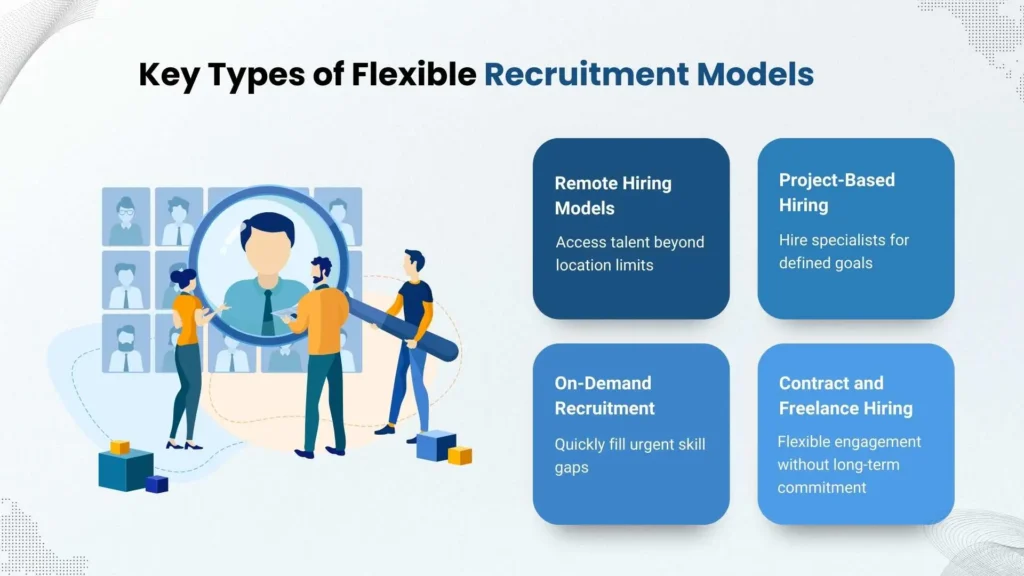
Flexible recruitment models are those frameworks that enable organizations to tailor their hiring strategy to suit the vitality of roles, the timing of projects, financial limitations and the prevailing market environment. Making use of a combination of full-time, contract, freelance, and project-based talent is an option instead of being limited to permanent hiring.
The models frequently make use of cooperation with staffing services, job recruitment agencies, Hiring Agencies and Tech Recruitment Agencies that are specialized in the fast access to niche or high-demand skills. The emphasis is placed on the effective solution of workforce issues rather than filling them.
Why Traditional Hiring Models Are No Longer Enough
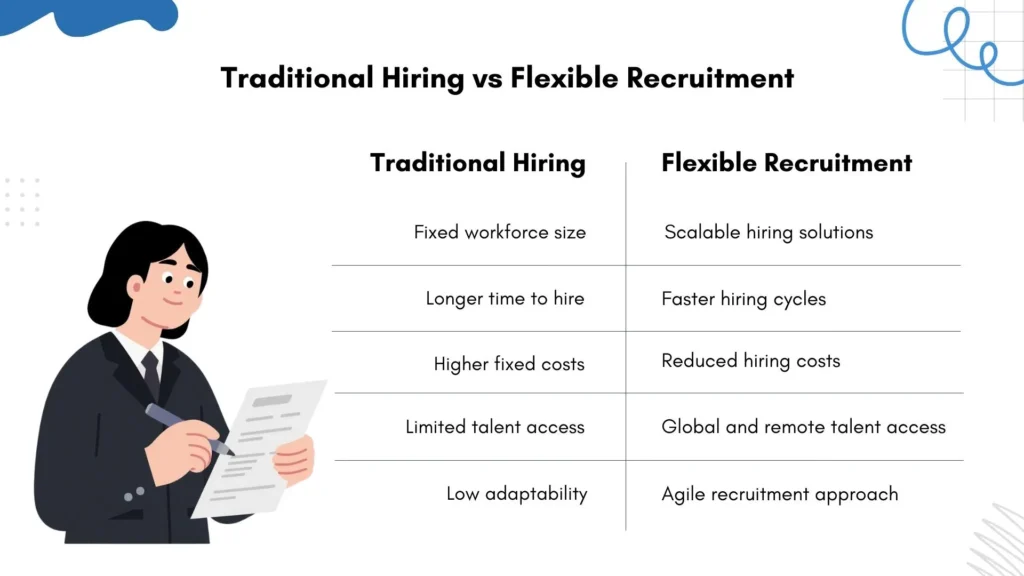
The traditional recruitment patterns presuppose the regular growth and consistent needs in the employees. In practice, the workload, skills gaps and priorities are usually unstable in most of the organizations. Unbending recruitment designs may lead to:
- Longer time-to-hire cycles
- Increment in fixed costs of employment.
- Skill mismatches
- Reduced workforce agility
Flexible hiring structures enable organizations to remain lean while still accessing specialized expertise when needed.
Candidate-Centric Recruitment as a Competitive Advantage
A major theme across modern hiring strategies is the shift toward candidate-centric recruitment. Flexible models allow employers to design roles around candidate preferences without compromising business outcomes.
This includes options such as:
- Hybrid and remote hiring models
- Flexible engagement terms
- Short-term and long-term career pathways
Organizations can also enhance their employer branding by meeting candidates in person, and boost the offer acceptance rate.
Aligning Flexibility with Hiring Trends
The existing trends in hiring show that there is a strong shift towards flexible workforce patterns. Businesses are more interested in:
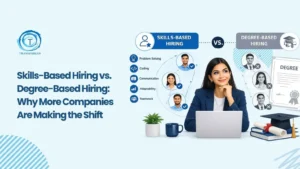
- Skills-based hiring over role-based hiring
- Shorter recruitment cycles
- Data-driven decision-making
The trends are supported with the help of flexible recruitment frameworks that allow making experiments faster, aligning with the talent market, and enhancing optimization.
Project-Based Hiring and Business Agility
Project-based hiring is one of the most effective recruitment flexibilities. Rather than having permanent staff of specialists in a company, it can engage experts to work on particular projects, like digital transformation, product launches and compliance projects.
This approach allows businesses to:
- Control workforce costs
- Access specialized expertise
- Reduce long-term liabilities
Project-based work is also attractive to the workers who like to have various experiences and independence, which increases the pool of talents further.
On-Demand Recruitment and Speed-to-Market
The competitive markets are highly dependent on speed. On-demand recruitment allows the companies to get access to a pre-vetted talent fast via recruitment partners and talent networks.
Through cooperation with trained staffing services and recruitment professionals, organizations are able to:
- Reduce time-to-hire
- Minimize operational delays
- Respond faster to market opportunities
The model is especially useful with quickly growing companies as well as technology-based industries.
Reducing Hiring Costs Without Compromising Quality
Among the misinformation is that flexible recruitment is costly to the organization. As a matter of fact, flexibility usually results in the lowering of the cost of hiring by getting rid of inefficiencies.
Flexible models help organizations:
- Avoid overstaffing
- Reduce recruitment overheads
- Optimize resource utilization
With performance-based engagement structures, the businesses are able to directly match the investments on talent with the performance.
Talent Acquisition Optimization Through Data and Technology
Modern recruitment flexibility is closely tied to talent acquisition optimization. Data analytics, AI-based screening, and automation require organizations to measure the performance of hiring in real-time.
Flexible recruitment systems make it easier to:
- Test different sourcing channels
- Track candidate experience metrics
- Refine hiring strategies continuously
This fact-based strategy aids in long-term workforce management and enhancement of the general hiring performance.
Scalable Hiring Solutions for Growing Organizations
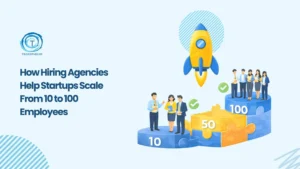
The recruiting demands of companies increase as they expand. It is possible to hire in large numbers and scale their operations with scalable hiring solutions that can help businesses grow without having to restructure tasks several times.
With the help of stretchy recruitment arrangements and block-and-module hiring models, organizations are able to:
- Enter new markets faster
- Support rapid team expansion
- Maintain consistency in hiring quality
Scalability ensures recruitment remains a growth enabler rather than a bottleneck.
Managing Risk and Compliance in Flexible Hiring
Without clear structures, flexible hiring can expose organizations to compliance and classification risks.
Effective flexible recruitment models address this by:
- Defining engagement terms clearly
- Aligning contracts with labor regulations
- Working with compliant recruitment partners
Such a balance is agile but does not interfere with governance.
Building Long-Term Workforce Resilience
Flexibility in hiring is not a tactical choice, it is a strategic one. Organizations that embed adaptability into their hiring philosophy are better prepared for future disruptions.
A flexible recruitment model supports:
- Workforce continuity
- Rapid reskilling initiatives
- Sustainable talent pipelines
The ability of companies to match the recruitment strategies with business flexibility ensures the development of a workforce that is flexible and able to adjust to the changing business needs in the market.
Designing an Effective Recruitment Strategy Around Flexibility
An Effective Recruitment Strategy incorporates flexibility in planning, sourcing, engagement and evaluation. This involves:
- Understanding business demand cycles
- Mapping skills requirements dynamically
- Leveraging diverse talent channels
Recruitment is made more flexible and therefore is not a reactive effort but a continuous process which results in organizations being proactive in addressing talent shortages.
The Future of Recruitment Models
As work models continue to evolve, recruitment flexibility will become a defining factor of organizational success. Companies that embrace adaptable hiring structures today are more likely to attract high-quality talent, control costs, and sustain growth in uncertain conditions.
By combining strategic planning, technology, and people-first practices, flexible recruitment models empower businesses to align talent with opportunity exactly when and where it is needed.
FAQ’s
Flexibility is important because businesses face rapid market changes, evolving skill demands, and higher candidate expectations, making rigid hiring models slow and costly.
They provide scalable hiring solutions by enabling companies to quickly expand or reduce teams without long-term commitments or heavy recruitment overheads.
On-demand recruitment allows companies to source ready talent pools instantly, helping them respond faster to urgent hiring needs and market opportunities.
Staffing services help organizations access pre-vetted talent quickly, reduce time-to-hire, and support on-demand or short-term workforce requirements.
Yes, flexible hiring helps in reducing hiring costs by avoiding overstaffing, lowering recruitment overheads, and aligning talent spend with actual workload.
Most industries benefit from flexibility, especially technology, startups, fast-growing businesses, and project-driven sectors, though models should be customized per industry.