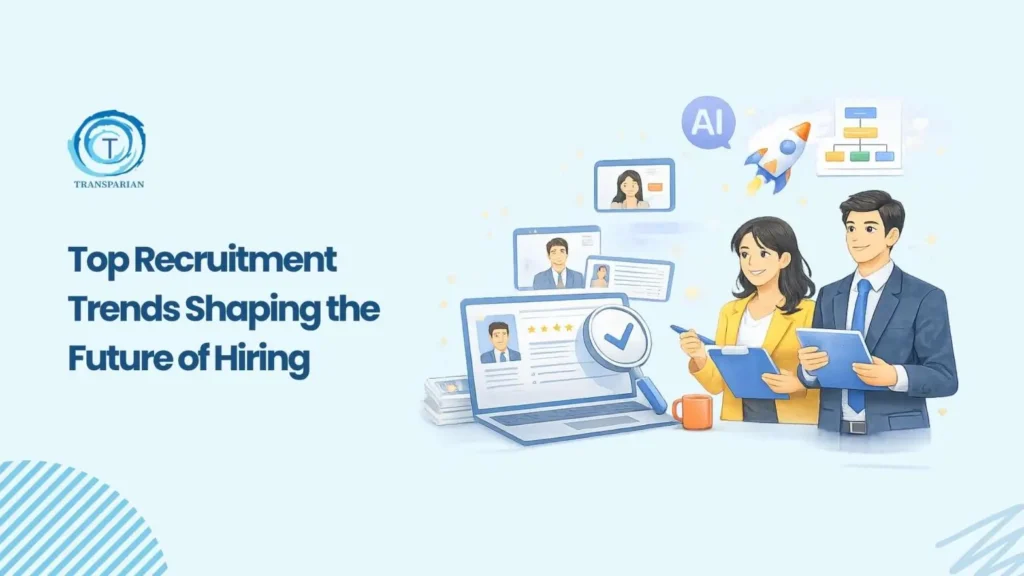
The hiring landscape has never moved faster. What worked in 2022 is already outdated, and what’s emerging today will define which organizations win the war for talent over the next decade. Whether you’re an in-house talent acquisition team, one of the many recruitment agencies adapting to disruption, or a business leaning on hiring agencies to fill critical roles, understanding where the industry is heading isn’t optional. It’s survival.
Here’s a deep dive into the Recruitment Trends that are genuinely reshaping how organizations find, assess, and retain people including the angles most conversations leave out.
AI Is No Longer a Tool, It’s a Team Member
Every recruiter has heard about AI by now. However, there is a very important difference that is being overlooked in the majority of debates: AI has been turned into an efficiency-solving collaborator rather than a volume-solving one. The initial applications of AI were concerned with ranking thousands of CVs in less time. In the future, 2025 and onwards, AI in the recruitment sector will involve autonomous agents capable of handling sourcing pipelines, follow-ups, making interviews, and warm candidates without human intervention, all with an existing database.
Practically, what this entails is:
- Recruiter workflows are being integrated with agentic AI tools, with repetitive decision trees making humans able to focus on building relationships.
- AI chatbots are now able to engage in subtle pre-screening, offloading hiring managers.
- Machine learning models are used to examine time-to-hire, provide acceptance rates and dropout points to keep optimizing the funnel.
The important caveat? One in every three candidates feels that AI chatbots make the hiring experience impersonal. The winning formula isn’t maximum automation, it’s smart automation that preserves the human moments that matter.
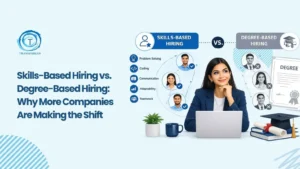
Skills-Based Hiring Is Replacing the Degree Filter
This trend is finally getting the mainstream attention it deserves. Research shows that 90% of organizations using a skills-based hiring method report reducing their mis-hires, and 94% agree that skills-based hiring is more predictive of on-the-job success than resumes.
The shift is straightforward: stop screening people out based on where they studied, and start screening people based on what they can actually do.
Recruitment Trends in this space include:
- Pre-employment assessments replacing initial CV reviews
- Structured, competency-based interview frameworks becoming the norm
- Transferable skills mapping across departments for internal mobility
- Job descriptions being rewritten around outcomes, not qualifications
This shift is helping employers overcome long-standing biases that would sometimes limit the available talent pool, so that they find better qualified, flexible and willing to do things candidates who may not even have the right university or college but at least willing to work.
The CRM Database Problem Nobody Talks About
This is one of the gaps that are totally overlooked by most trend pieces; the candidate database that remains idle within most recruitment agencies and within the in-house teams.
In research, 63% of all placements are based on existing data. When a new job order is received, recruiters will scramble to LinkedIn to get candidates only to realize they have already discovered the same ones in their CRM – mainly because recruiters do not trust their own database.
The result? Companies are spending two times to get the same individuals. The movement that changes this is database hygiene and AI-sourced CRM enrichment – technology that automatically auto-enriches candidate profiles, re-engagement-opportunity notifications, and the correct individual in an existing talent pipeline, before investing in new sourcing avenues. In the case of hiring agencies, this will be a great competitive edge that can be unlocked.
Candidate Experience Is Now a Revenue Metric
The candidate experience has become more than an HR nicety to a business priority that involves actual financial implications. A report by IBM also indicates that firms that focus on improving the candidate experience can improve on the quality of their hires by up to 70%.
- How does having a strong candidate experience work in practice?
- Clear schedules and active communication on all levels.
- One-on-one contact addressing the career aspirations of that candidate.
- Getting rid of ghosting – the art of becoming silent after interviews.
- Quick feedback loops in respect to time of a candidate.
- Applications that are mobile-optimized and do not take 45 minutes to complete.
Too often candidates experience the phenomenon of the vanishing recruiter where a recruiter withdraws from all communication without any explanation, even after an initial interview. Fixing this isn’t just ethical, it protects employer branding and directly impacts talent pipeline quality.
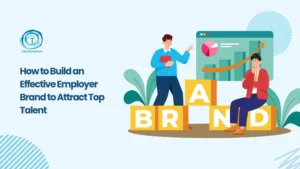
Employer Branding Has Evolved Beyond Job Ads
Employer branding is no longer about posting a few culture videos on LinkedIn. The current applicants, particularly Gen Z, do due diligence prior to application. They browse anonymous reviews, employee-created content and evaluate employee value propositions at several firms prior to making a single application.
A strong EVP should highlight the reasons to join an employer and stick around, but it should not just be a list of selling points, it needs to align directly to the organizational vision, mission, purpose, and values to attract employees with the right cultural and motivational fit.
Recruiting Agencies and internal talent acquisition teams are no longer supposed to communicate EVP, but collaborate in its development. That means:
- Creating content with real employees and not only the marketing team.
- Publishing transparent salary ranges within job postings
- Presenting career advancement opportunities, not role perks.
- Emphasizing mental health care, flexible work arrangements, and authentic inclusion practices.
Green Hiring and ESG Alignment Are Entering the Mainstream
This is a trend most hiring trend roundups quietly skip over, yet it’s accelerating rapidly. Organizations are currently on the hunt to hire candidates whose values are the same as their Environmental, Social, and Governance (ESG) promises. At the same time, job seekers are sifting through employers who have not shown real sustainability behaviors, especially Millennials and Gen Z.
Future employees want more than just a paycheck. The younger generations are going after organizations that have a good mission, are sustainably oriented, and a clear sense of social responsibility. The ability to lead with purpose will help companies to attract more and better engaged candidates and create stronger teams.
In recruitment agencies that will be working in areas such as energy, manufacturing and finance, green hiring literacy is not an optional attribute but a mandatory requirement.
Predictive Analytics and Workforce Planning Are Closing the Reactive Hiring Loop
The old model: a role opens, a job goes live, the search begins. The new model: workforce planning software that forecasts the requirements of roles 6-12 months ahead, and the recruiters are already discussing passive candidates before the job is posted.
Instead of responding to hiring demands, recruiters have been resorting to predictive analytics to create talent pipelines ahead of time. AI takes market data, competitor behavior and internal workforce movement and predicts future jobs and skills requirements to enable hiring groups to recruit passive applicants early, establish relationships and save time-to-hiring when vacancies occur.
The most important metrics that are now monitored by data-driven hiring teams are:
- Source of hire effectiveness by channel
- Candidate drop-off rates at each funnel stage
- Offer acceptance rates segmented by role and seniority
- Predicted retention scores based on onboarding signals
- Diversity hiring ratios tracked across the full pipeline
The Evolving Role of Recruitment Agencies in an AI World
One conversation that’s conspicuously absent from most trend content is what happens to recruitment agencies and hiring agencies as automation deepens. The answer isn’t displacement, it’s specialization.
Clients are increasingly requiring agencies to be more strategic in their involvement and new models of service are emerging, going beyond one recruitment model to provide a number of talent services, including integrating temporary staffing into RPO (Recruitment Process Outsourcing).
Recruitment agencies that will succeed are those that rebrand as strategic talent consultants and not CV-forwarding agents.This means
- Deep market intelligence on compensation benchmarking and talent availability
- Diversity and inclusion consulting embedded in search mandates
- Sector-specific expertise that in-house teams genuinely can’t replicate
- Tech-enabled search processes that compress time-to-fill without sacrificing quality
- Ownership of passive candidate relationship networks built over years
Hiring agencies are also being more and more requested to assist in whole workforce plans – both contingent workforce and long-term succession plans – instead of merely filling specific vacancies.
Hybrid Work Is Non-Negotiable, Not a Perk
Hybrid work arrangements, combining remote and in-office work, have become a new reality in most companies. Flexible working conditions also lead to increased worker satisfaction, increased talent pools that are no longer confined by geographical boundaries and reduced operating costs- and businesses that fail to adapt to it run the risk of losing some of their best staff to more flexible businesses.
For Recruitment Trends watchers, this has a direct implication on talent sourcing strategy. Roles advertised without location flexibility now attract a demonstrably smaller candidate pool. Hiring managers who insist on five-day office mandates for roles that don’t require physical presence are competing with one arm tied behind their back.
The organizations and recruitment agencies that navigate this landscape successfully won’t be the ones who adopted the most tools. They’ll be the ones who understand that technology is the engine, but human judgment, empathy, and strategic thinking remain the steering wheel. Recruitment Trends are pointing in one clear direction: hire smarter, engage deeper, and build relationships that outlast any single job opening.
FAQ’s
The latest recruitment trends include AI-driven hiring, skills-based recruitment, predictive analytics, improved candidate experience, hybrid work models, employer branding, and data-driven workforce planning. These trends help organizations hire faster, reduce costs, and improve talent quality.
AI is transforming recruitment by automating candidate sourcing, resume screening, interview scheduling, and candidate engagement. AI also helps recruiters analyze hiring data, predict hiring needs, and improve time-to-hire.
Employer branding helps organizations attract high-quality candidates by showcasing company culture, growth opportunities, and employee benefits. Strong employer branding reduces hiring costs and improves retention.
Recruitment agencies are evolving from CV providers to strategic talent partners. They now offer market insights, workforce planning, diversity hiring support, and tech-enabled recruitment solutions.
Companies can improve recruitment by adopting AI tools, focusing on candidate experience, using skills-based hiring, strengthening employer branding, and leveraging data-driven hiring decisions.
Data-driven recruitment improves hiring accuracy, reduces time-to-fill, increases offer acceptance rates, and helps organizations make informed talent decisions using real-time insights.