Most CEOs will tell you, if they are being honest, that some of their most expensive mistakes were people’s decisions. A leader who was a perfect match from a resume but not a good fit in the real world. A culture issue that quietly developed over a few months and resulted in exits and poor performance. A people strategy that was only in a document and had not been embedded in the way the business was done.
These are not HR issues. They’re business issues. They don’t often get solved when the CEO and CHRO are in different lanes.
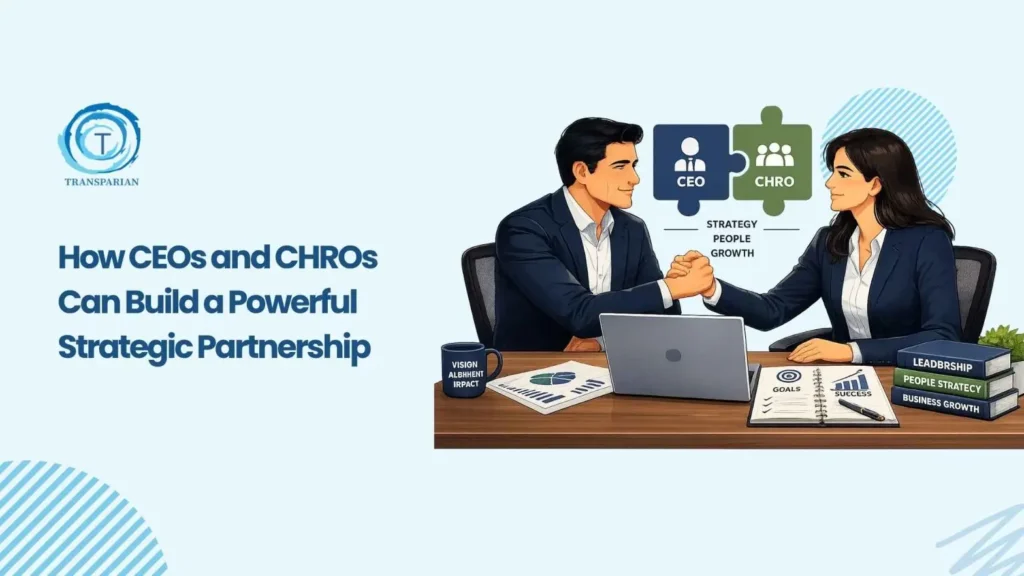
The CEO-CHRO relationship is one of the most important relationships in any expanding organization. If it works, the business makes better decisions on people, culture and leadership. When it does not, HR stays reactive, strategy stays disconnected, and the organization keeps paying the price.
This is what makes the difference.
Why This Relationship Usually Gets Neglected
Most companies have a set up that is predictable. The CEO is responsible for income, investors, and growth agenda. The CHRO is responsible for the HR function, including recruitment cycles, compliance, performance management, and HR policies. Both are busy. Both assume the overlap is handled.
This leads to HR’s being treated as a support department and not a strategic one. By the time a culture problem surfaces or a critical leadership gap appears, the conversation is already reactive. This is a typical development and neither party is to blame. This is primarily due to the fact that the CEO-CHRO partnership was not intentionally established.
What changes in organizations where it is:
- HR is involved in business planning from the start, not briefed afterward
- People decisions and business decisions are made in the same conversation
- The CHRO has visibility into where the business is going and builds the workforce plan around it
- The CEO understands what the people function actually needs to operate well
That alignment does not happen by default. It has to be set up intentionally.
What the CEO Needs to Bring to the Table
The CEO sets the conditions for this partnership. If the CHRO is excluded from leadership discussions or brought in only to execute decisions already made, the relationship will stay transactional.
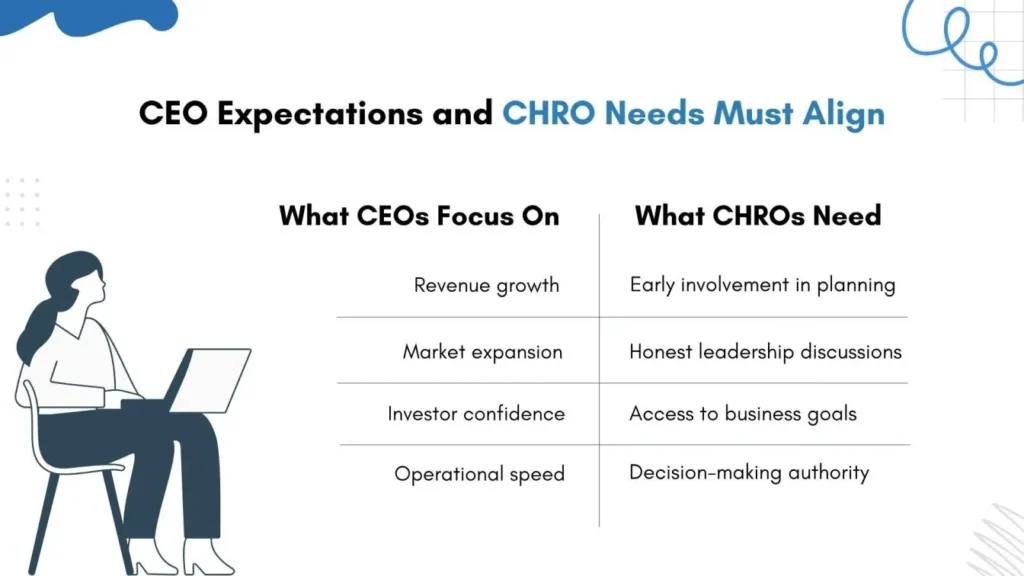
Give the CHRO a real seat at the table. Not as an HR representative but as a peer who understands the business direction. Revenue targets, expansion plans, product bets, all of these have workforce implications. A CHRO who is present when those decisions are being made can build a talent strategy around them instead of reacting after the fact.
Share the uncomfortable information. Leadership tensions, underperforming executives, teams where morale is low — CEOs sometimes assume HR already knows, or they protect the CHRO from the full picture. A strategic partnership requires honest information in both directions. Without that, the CHRO is working with incomplete data and their recommendations will show it.
Let the CHRO push back. This is where a lot of CEO-CHRO relationships stall. If the CHRO raises a concern about a hiring decision or flags that a restructure carries serious retention risk, and the CEO overrides it without engagement, that dynamic will not repeat itself. The CHRO will start self-censoring. The CEO will stop hearing what they actually need to hear.
Measure HR on business outcomes. Attrition rate and time-to-fill are useful numbers, but if those are the only metrics the CEO tracks, the CHRO’s role will stay operational. The more useful questions are whether the leadership bench is getting stronger, whether culture is surviving growth, and whether the people function is keeping pace with where the business is going.
What the CHRO Needs to Bring to the Table
The CHRO also has to step into the partnership, not just respond to it.
Know the business, not just HR.. The best CHROs know the P&L, they understand which business units are growing, which are under pressure, and they can tell the CEO what the business issues are in terms of people implications before the CEO has to ask. It’s a move that makes the CHRO a real business partner, not just an HR operator, that’s what makes a difference.
Bring data that the business actually uses. Engagement scores and attrition percentages matter, but they are lagging indicators. If a CHRO can add value as a leader who understands leadership capability gaps, compensation positioning or organizational design risks, then they are adding something that you can’t easily find elsewhere.
Present the people in business terms. As a leader, you might find it difficult to understand how culture and employee experience relate. The CHRO’s role is to make them real: How much does it cost when there’s a retention issue? What does low trust in leadership look like in terms of decisions being made? What happens to execution when managers aren’t even? When these conversations are not discussed as business variables, they don’t play out the same as HR conversations.
Be direct about risk. Telling a CEO that a hiring plan is unrealistic, or that a decision will damage morale in teams the company can least afford to lose, is not comfortable. However, that’s the role of a strategic CHRO. Leaders who have had such candid collaboration are proactive about safeguarding it.
The Structures That Make It Work in Practice
Beyond intentions, this partnership needs structure. A few things that make a consistent difference:
- Regular one-on-ones that go beyond operational updates. Protected time for honest conversations about where the organization is struggling and what the people function needs from leadership.
- Shared definition of success. If the CEO measures HR on headcount stability and the CHRO measures it on leadership quality and culture health, they will keep talking past each other. Three to five agreed outcomes, reviewed quarterly, change that dynamic.
- CHRO presence in business planning, not just HR planning. Workforce planning that is disconnected from business planning is just a headcount spreadsheet. The CHRO needs to be part of the conversation where business direction is set.
- A feedback loop that runs both ways. The CEO should be able to tell the CHRO when HR is too slow or too process-focused. The CHRO should be able to tell the CEO when a business decision carries people’s risk. Both need the safety to do that without it damaging the relationship.
When the Gap Gets Expensive
The cost of a weak CEO-CHRO partnership tends to be invisible until it is not. Employee attrition in key functions. Leadership decisions that felt right at the time but created problems three months later. A culture that shifted during a growth phase and nobody caught it in time.
These outcomes are not always traceable back to the CEO-CHRO dynamic but often, when you look closely, that is exactly where the gap was. The people function was either not close enough to the business to flag the risk, or it was not trusted enough for its input to change anything.
Getting this right does not require a large or expensive HR team. It requires a CHRO who thinks like a business leader and a CEO who treats people strategy as part of business strategy.
What to Do When You Do Not Have a Full-Time CHRO
Many startup companies require this sort of HR leadership before they can afford to hire an HR for full-time duties. The overhead and commitment of a full-time CHRO hire does not always match the stage the business is at.
This is where the Fractional CHRO model has proven to be a viable solution. A Fractional CHRO serves the same strategic role and has the same presence as a full-time hire, but with less cost. They participate in leadership meetings, participate in workforce planning, identify persons at risk early and influence the CEO-CHRO relationship even before a new permanent CHRO is in place.
For companies navigating growth, restructuring, or a leadership transition, CHRO on demand services offer the flexibility to bring in senior HR leadership at the right time, for the right scope.
The Partnership Is Worth Building
Companies where the CEO and CHRO operate as genuine partners make faster leadership decisions, retain people better, and build cultures that survive growth. The partnership is not complicated to describe trust, honest communication, shared goals, and a CEO who treats people’s decisions as business decisions. What makes it hard is that it has to be built deliberately, not assumed.
Start with the conversation. Agree on what success looks like. Make the time for it. The returns on getting this right tend to show up in ways that matter more than most other investments a leadership team can make.
Let Transparian Strengthen Your HR Leadership
From building a people strategy that aligns with business goals to providing experienced senior HR oversight at the right stage, Transparian offers Fractional CHRO, Virtual CHRO, and Outsourced CHRO services for startups, SMEs, and scaling businesses. If your business needs strategic HR leadership without a full-time hire, we can help.
FAQ’s
The CEO and CHRO relationship is important because it connects business strategy with people strategy. Strong alignment helps companies improve leadership decisions, workforce planning, employee retention, and organizational culture.
CEOs and CHROs can work together effectively through regular strategic discussions, shared business goals, transparent communication, and involving HR in business planning from the beginning.
A CHRO supports business strategy by aligning talent planning, leadership development, organizational structure, and workforce capabilities with company growth objectives.
A strategic CHRO helps growth by identifying workforce risks early, improving leadership quality, building scalable HR systems, and strengthening employee engagement during expansion.
Companies can strengthen the partnership by setting shared goals, scheduling strategic one-on-ones, encouraging honest feedback, and measuring HR impact through business outcomes.
Companies should consider CHRO on demand services during rapid growth, restructuring, leadership transitions, scaling challenges, or when they need strategic HR leadership without full-time overhead.