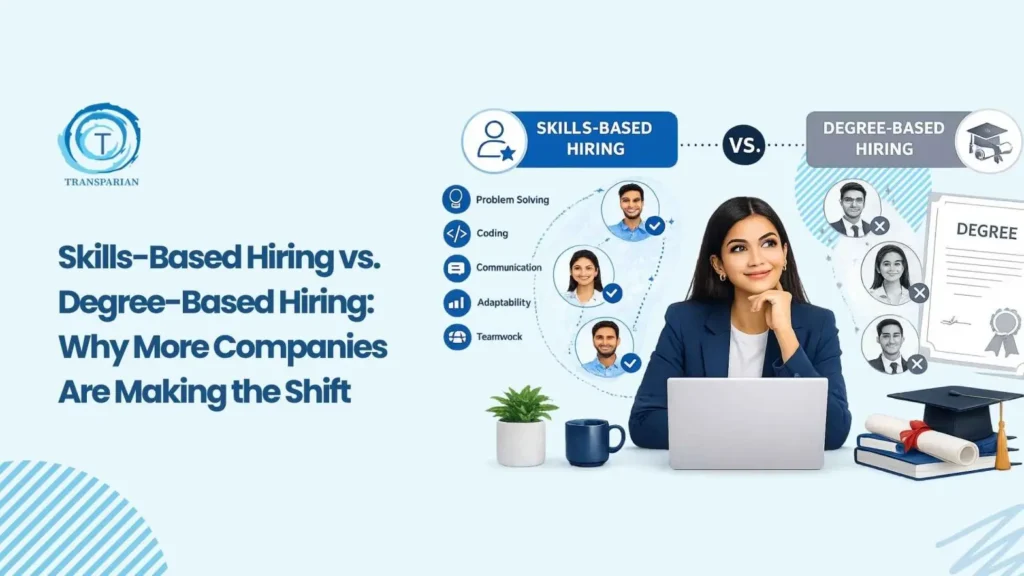
For years, the bachelor’s degree sat at the top of almost every job description, not because it was always relevant, but because it was easy. A degree requirement gave hiring teams a quick way to filter hundreds of applications down to a manageable shortlist. Nobody had to justify it. It was just how things were done.
That logic is unravelling fast. Companies across industries are quietly stripping degree requirements from job postings and replacing them with something more direct: can you do the job or not?
This isn’t a new idea. But it’s gaining real traction now, and it’s worth understanding why and what it actually takes to make the shift work.
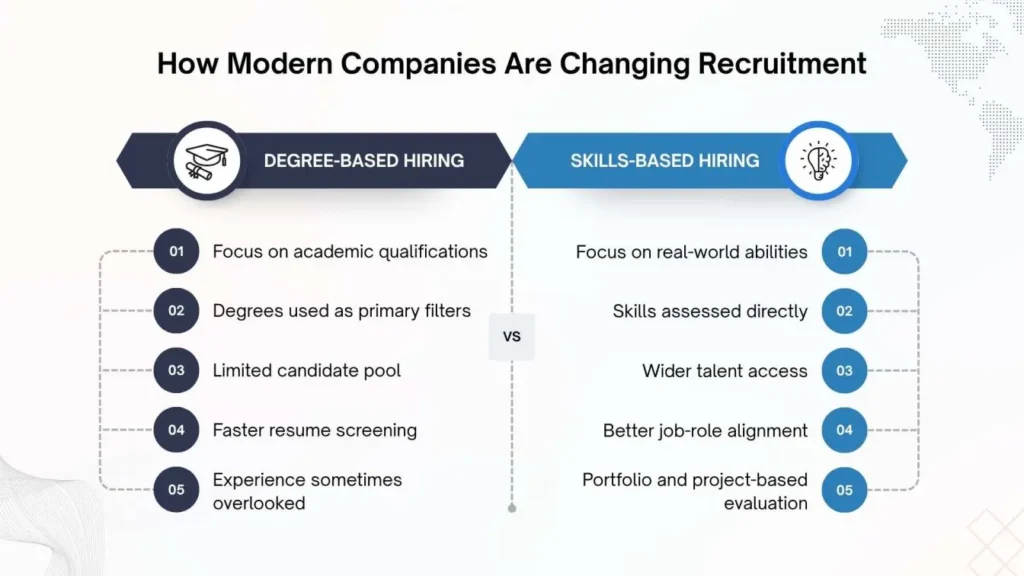
What Degree-Based Hiring Actually Filters For
The case for requiring a degree was always a proxy argument. A degree didn’t tell you whether someone could write clean code or manage a difficult client. What it signalled was: this person can commit to a long-term goal, follow structured learning, and survive an institution’s expectations.
That’s a real signal. But it’s a weak one when you’re trying to assess job-specific capability.
The bigger problem is what degree filtering screens out. A significant portion of talented candidates, people who built skills through bootcamps, self-directed learning, apprenticeships, or years of hands-on experience never make it past the first filter. Not because they can’t do the job, but because they didn’t sit in a classroom for four years.
When your talent pool is shrinking and roles are taking longer to fill, that trade-off stops making sense.
The Business Case for Skills-Based Hiring
Research from LinkedIn and other sources consistently shows that skills-based hiring produces better hires than credential-matching. Companies using structured competency assessments report fewer mis-hires, faster ramp times, and stronger retention, particularly for roles where the actual work is technical, practical, or client-facing.
IBM, Apple, Google, and Accenture are among the large employers that have removed degree requirements from significant portions of their roles. The reasoning isn’t ideological. It’s operational. If someone can demonstrate the skills the role needs, the path they took to get there is secondary.
For hiring teams, the implication is straightforward:
- Evaluate what the role actually requires to be done well
- Design assessments that test those specific things
- Open sourcing to candidates who have the skills, regardless of how they developed them
The result is a wider, often more diverse candidate pool and hires who were evaluated against criteria that actually predict performance.
Where Degree Requirements Still Belong
Skills-based hiring isn’t the right answer for every role, and it’s worth being direct about that.
There are professions where a formal qualification isn’t a filter, it’s a legal requirement. Medicine, law, structural engineering, accounting, pharmacy. In these fields, the degree or its regulatory equivalent is non-negotiable, and it should be.
Beyond those regulated professions, there are roles where the depth of knowledge required is genuinely best acquired through extended formal education, certain research positions, specialised finance roles, academic appointments. The degree isn’t a proxy here; it’s actually the thing.
The honest question every hiring team should ask before writing a job brief: what does success in this role genuinely require, and does a degree actually signal that or is it just a shortcut we’ve always used?
What the Shift Actually Involves
Removing the degree checkbox from a job posting is step one. The harder work is building something better to replace it.
Competency mapping comes first. Before the job description gets written, you define the specific skills, knowledge, and behaviours that distinguish strong performers in the role. Not vague attributes like “strong communicator” assessable competencies tied to the actual work.
From there, the hiring process is redesigned around testing those competencies directly. Depending on the role, that might include:
- Skills assessments or practical tests (writing samples, case exercises, coding challenges)
- Structured interviews with consistent scoring rubrics
- Portfolio or work sample reviews for creative and technical roles
- Paid project work for senior hires where an assessment alone isn’t enough
The goal is to shift evaluation from “where did you study” to “what can you actually do.” That requires more upfront design, but it tends to produce more reliable hiring decisions and reduces the cost of a bad hire down the line.
The Practical Challenges
Hiring manager habits are harder to change than policies. Even after formal degree requirements are removed, interviewers often default to informal credential preferences. A job posting can change overnight; the interviewer ‘s mindset takes longer. This is one of the most common gaps when companies roll out skills-based approaches without accompanying training.
Assessments have to be well-designed to be useful. Generic skills tests bought off the shelf frequently don’t reflect what a specific role actually demands. Building assessments that are relevant, fair, and not easily gamed takes real effort. Done poorly, they just add friction to the process without improving selection.
Compensation structures often need a rethink. In many organisations, pay bands and career levels were built with the assumption that entry-level hires have degrees. When you start hiring people without them, you sometimes run into structural inconsistencies that need to be addressed.
Compliance and documentation requirements vary. For companies operating across multiple regions, changes to hiring criteria need to be documented carefully to demonstrate job-relevance and fairness. This is worth checking before rolling out any new assessment approach.
None of these are blockers. They’re just things worth planning for before the first job posting goes live without the degree requirement.
Where Diversity Sits in This Conversation
One of the more significant outcomes of moving to skills-based hiring is what it does to candidate demographics. Degree requirements have historically correlated with economic background as much as capability. When you remove them, you reach candidates who would otherwise have self-selected out, people who are entirely capable but who never saw the role as relevant to them.
This isn’t just about fairness (though that matters). It’s about access to talent. Companies that have made the shift consistently report broader, more diverse shortlists which in a competitive hiring market is a practical advantage, not a secondary benefit.
How to Start
If you’re considering piloting this approach, the sequence that tends to work is:
Start with two or three roles where the skills are clearly definable and the degree requirement has historically been a formality. Roles in customer operations, sales, digital marketing, or junior tech positions are often good candidates. Define what success looks like in specific, observable terms. Build or adapt assessments that test for those things. Track outcomes; quality of hire, performance at 6 months, retention and compare them against previous cohorts.
The evidence you build internally is far more persuasive to sceptical hiring managers than any external case study.
Over time, the goal is to make competency frameworks the default starting point for every hire, not a credential checklist, not gut feel, not a degree as a stand-in for capability. For teams that also rely on flexible recruitment models, building these frameworks in advance also makes it easier to brief an external partner effectively.
The Broader Picture
Degree requirements weren’t arbitrary. They reflected a time when formal education was the main route to building workplace-relevant knowledge. That’s less true now than it was twenty years ago and the labour market is gradually catching up to that reality.
Skills-based hiring isn’t a revolution. It’s a recalibration. The question was always whether someone can do the job. A degree was one way of trying to answer that. There are better ways, and more recruitment teams are finding them.
Let Transparian Simplify Your Hiring Process
From building competency frameworks to sourcing and screening the right candidates, Transparian provides end-to-end recruitment support for businesses that want to hire smarter, not just faster. With deep expertise in both skills-based hiring approaches and traditional talent acquisition, Transparian helps growing organisations build teams that actually perform.
FAQ’s
Skills-based hiring is a recruitment approach where employers evaluate candidates based on their actual abilities, competencies, and work experience instead of focusing mainly on academic degrees. Companies use assessments, portfolios, practical tasks, and structured interviews to measure job readiness.
Many companies are removing degree requirements to access a wider talent pool and hire candidates with proven skills. Employers are finding that practical experience, certifications, and real-world performance often predict success better than formal education alone.
Skills-based hiring helps businesses improve hiring accuracy, reduce talent shortages, increase workforce diversity, and lower employee turnover. It also allows companies to identify candidates who can perform the job effectively from day one.
Industries such as technology, digital marketing, customer support, sales, design, data analytics, and creative services commonly use skills-based hiring because practical abilities can be tested directly through assessments and portfolios.
Companies assess skills through coding tests, writing assignments, case studies, role-play exercises, portfolio reviews, technical interviews, and practical job simulations designed around real workplace tasks.
Businesses can start by reviewing job descriptions, removing unnecessary degree requirements, defining role-specific competencies, introducing practical assessments, and training hiring managers to evaluate candidates consistently.