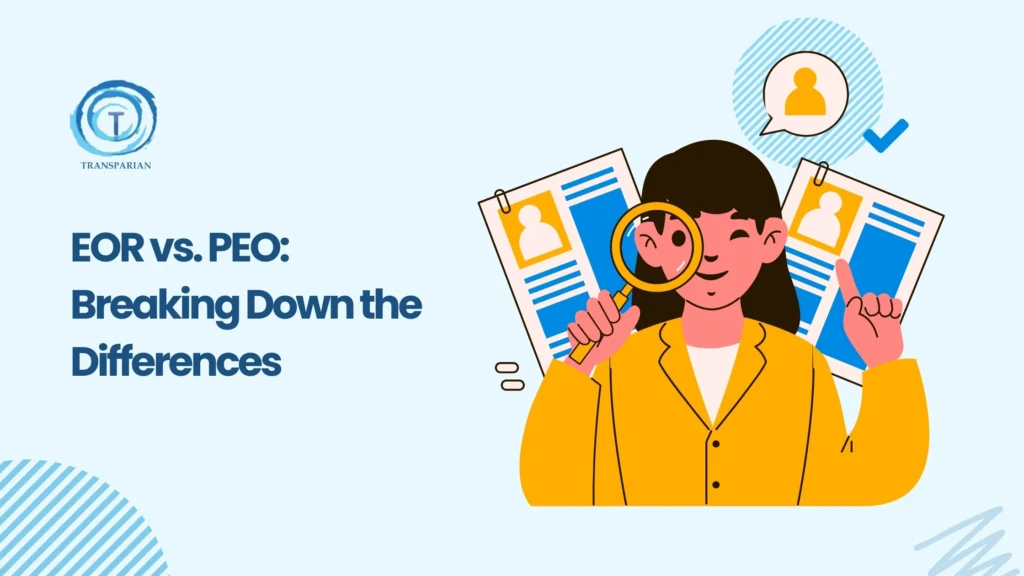
When businesses expand across borders or consider streamlining their HR processes, they have two common choices; an Employer of Record (EOR) and a Professional Employer Organization (PEO). Although both models simplify employment/payroll and compliance, they work in quite different ways. Understanding the differences between these two approaches can help leaders choose the right strategy for international hiring, HR compliance, and sustainable growth.
Understanding EOR and PEO
At the core, an employer of record (EOR company) is a third-party organization that becomes the legal employer of an employee on behalf of another company. This setup enables businesses to hire globally without establishing a local legal entity. EORs handle all statutory responsibilities, including multi-country compliance, payroll processing, taxes, and risk management in HR. Popular with businesses aiming for international hiring and seeking to onboard talent rapidly, the EOR model offers agility and scalability.
On the other hand, a Professional Employer Organization (PEO) operates under a co-employment model. While your business and the PEO share employer responsibilities, you must have a registered entity in the country of employment. A PEO generally facilitates the process of outsourcing HR services, including facilitating payroll, taxes, employee leasing, and HR compliance and benefits, without the possibility of getting around local entity requirements.
The Key Difference Between EOR and PEO
The most critical difference lies in entity requirements:
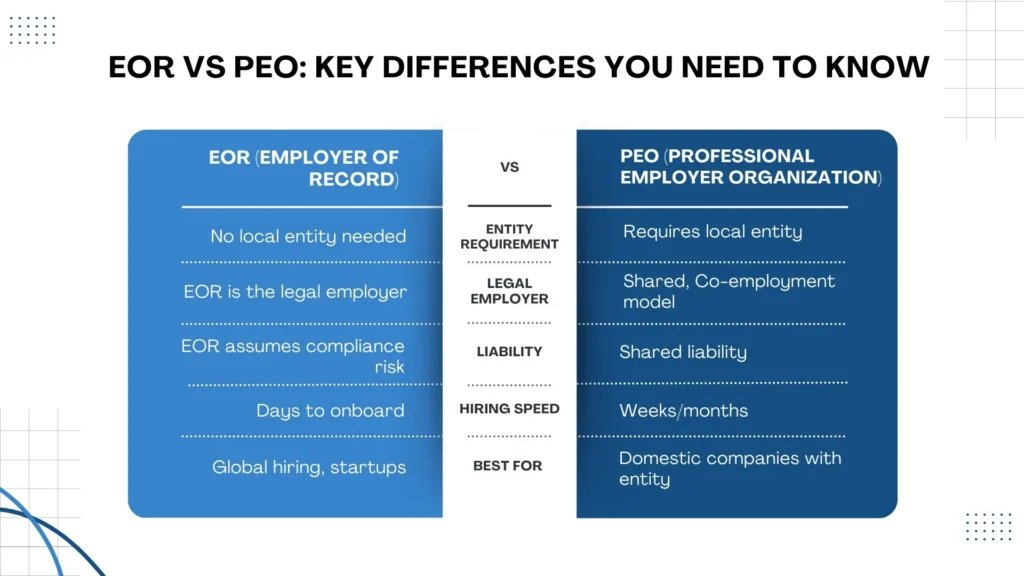
- An EOR company can hire employees on your behalf even if you don’t have a local entity.
- POE demands that you have a legal entity in place and the PEO becomes your HR compliance partner as a part of that legal entity.
In simple terms, EOR undertakes end-to-end employment whereas PEO is an HR outsourcing service to those who already have a presence in a market.
Cost Structures: EOR vs. PEO
A cost comparison of EOR and PEO is another area that tends to be overlooked.
- EOR services usually charge a flat monthly fee per employee or a percentage of payroll. It can consist of payroll administration, benefits, contracts, and statutory filing.
- PEOs, by contrast, may charge based on payroll percentages plus administrative fees, which can add complexity to cost forecasting.
Startups need simple budgeting strategies and as such EOR among startups is common. PEOs tend to be cheaper when established firms with established business operations in the locals want to maintain a stable foundation.
Compliance and Risk Management
Going global presents firms to labor laws risks, issues to tax and possible punishment. An employer on record becomes the legal employer and thus most items of compliance risk are assumed by the employer on record. This approach strengthens risk management in HR by reducing exposure to misclassification and non-compliance penalties.
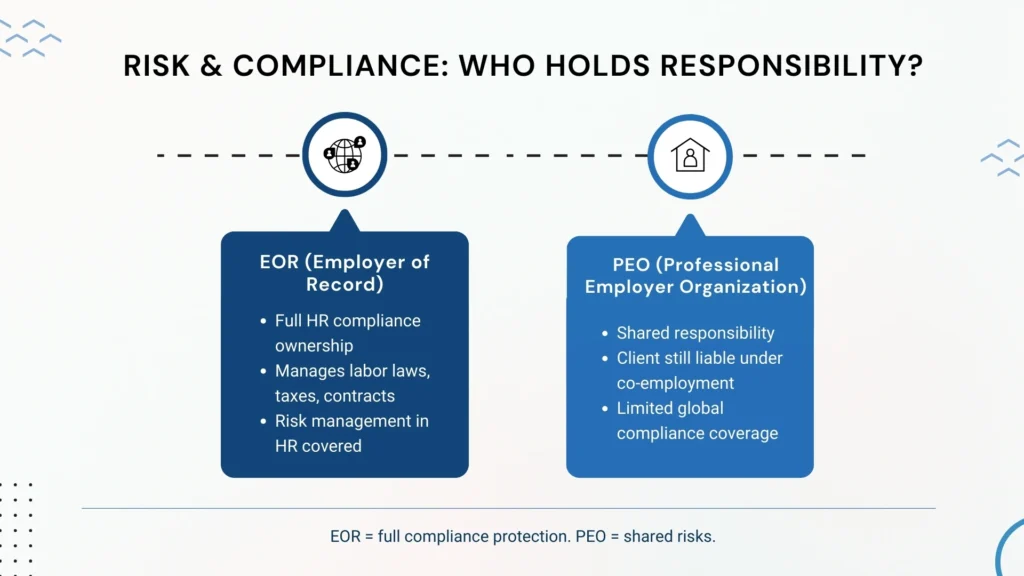
A PEO also helps with compliance but does not take on full legal responsibility. It does not impose full liability limiting the roles of the company partly because it is based on the co-employment model.
When global compliance is a top priority, an international EOR is the more risk-averse option.
Employee Experience and Benefits
The other angle that people have missed in a number of comparisons is the employee experience. Employees desire an easy transition to work in a company, prompt payments and appealing benefits. With an EOR company, workers gain access to standardized international employee benefits such as health insurance, pension contributions, or paid leave that comply with local laws.
PEOs also manage benefits, but since they depend on the client’s entity, benefit offerings may vary. Remote workforce management with EOR can allow your globally distributed teams to feel equally supported throughout different countries.
Onboarding Remote Teams
The contemporary workforce is more and more dispersed. Companies are now looking to have solutions in order to onboard remote teams across the borders. When using an EOR service, companies will be able to hire workers across regions without being concerned about multi-country compliance.
For example, if a startup wants to hire developers in India, designers in Poland, and marketers in Brazil, a global EOR can onboard all of them within weeks. A PEO would, however, need to set up its entities in each of these locations prior to hiring.
Scalability and Flexibility
- EOR services are ideal when companies want agility. They enable companies to experiment in new markets, employ employees within a short period. Also scale up and down without having to make any investments in infrastructures.
- PEOs are more organised in stable operations. They suit companies that already possess their entities and need to outsource their HR functionalities but they do not need to benefit from the flexibility of cross-border hiring.
For dynamic industries like IT or tech, the flexibility of an employer of record often aligns better with growth cycles.
Industry-Specific Considerations
Different industries have unique requirements.
- Tech startups benefit from EOR for startups, since they often prioritize speed-to-hire and may not want to delay expansion with local incorporation.
- Manufacturing or healthcare companies, with heavy regulatory requirements, may prefer PEOs for established domestic teams.
- Financial services firms with cross-border teams often lean toward global EOR providers for compliance-heavy roles.
Transitioning Between Models
Little is said of what occurs when a firm has grown beyond one model and finds it necessary to move into a different model.
- Moving from a PEO to an EOR: Companies expanding abroad may switch if they need hires in countries where they lack entities.
- Moving from an EOR to a PEO: Once a company sets up an entity in a region, they may transition from EOR to PEO for cost savings and deeper local HR support.
A clear migration roadmap can minimize disruption during such transitions.
Tax Implications
Taxation is one of the spheres that are overlooked. Employers of record, payroll taxes, social contributions and deductions are taken care of by the provider. This also assists companies to shun the incidents of doubling taxes and the hazards of misclassification.
PEOs also manage payroll and tax filings, but since the client owns the entity, they remain partially liable for errors. Multinational organizations, who already have multiple jurisdictions internationally, can also find multi-country compliance less complex using an international EOR.
HR Outsourcing Services in the Future of Work
The increasing popularity of remote-first companies is changing the established working models. Organizations are turning to HR outsourcing services such as EORS as a way of cutting on the administrative load in the quest to concentrate on the core strategy.
Trends shaping the future include:
- AI integration in compliance tracking
- Broader access to remote workforce management solutions
- Expansion of employer of record services into new industries
- Hybrid models where companies use both PEO and EOR depending on region
These trends are signs of how, in the future, globalization and remote working are set to become the standard and that EORs and PEOs are going to develop further.
Final Thoughts
Choosing between an EOR company and a PEO depends on your business goals, structure, and geographic strategy. Whether you are entering new markets, want to focus on speed or are planning onboarding new remote employees, an EOR provides flexibility and compliance. A PEO can take care of HR and benefits management and streamline processes in the case you already have entities.
Knowing the co-employment model, how employee leasing fits in and the multi- country compliance dynamics, a company can make a well-informed choice that reflects their workforce strategy. Whether leveraging employer of record services or partnering with a PEO, the goal remains the same: simplifying HR while building resilient, engaged global teams.
FAQ’s
An Employer of Record (EOR) becomes the legal employer, handling compliance, payroll, and contracts without requiring entity setup. A PEO works on a co-employment model, sharing HR responsibilities but requiring your company to already have a local entity.
EOR for startups is usually a better choice since it allows quick onboarding remote teams without investing in entity registration. PEOs are better for established companies with existing entities.
Employee leasing is when workers are legally employed by a third party but managed by your company. It’s similar to how both EOR services and PEOs operate, though EOR takes on full legal responsibility.
Yes. Companies often transition from PEO to EOR when expanding globally. An international EOR helps ensure smooth hiring in new regions without delays from entity setup.
Costs depend on scale. EOR services may be slightly higher per employee but save money by avoiding incorporation and compliance risks. PEOs can be cheaper if you already have entities.