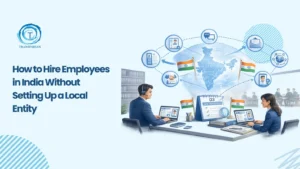

Expanding or hiring in India offers access to one of the world’s largest talent pools but it also comes with regulatory complexity, administrative overload, and high setup costs.These are the setbacks that make growth stall even before it starts in the case of many global companies and companies that are rapidly expanding. An Employer of Record model is a solution that comes in here as a viable and scalable option.
Through employers of record, companies are able to recruit employees in India with ease, cheaply and in a very quick time without establishing a local company in India. In addition to compliance, EOR services access quantifiable time, financial, and operational working efficiency savings and allow smarter workforce choices.
Why Hiring in India Is Time-Consuming and Expensive Without an EOR
Before understanding how eor services saves resources,it’s important to understand the common problems businesses face when hiring directly in India:
- Lengthy company incorporation timelines
- Complex india labor law compliance requirements
- Multi-layered payroll regulations
- Statutory filings, audits, and penalties
- High dependency on legal, HR, and finance teams
The establishment of a local organization can be several months, and the compliance fee continues even if you hire just one employee. This is not an agile or cost-effective path to the Indian market as startups and global teams testing the market may do.
Fast Market Entry Without Entity Setup
One of the biggest advantages of using eor services is fast market entry. Businesses are able to begin hiring within days instead of months of registering a company, opening bank accounts and assigning directors.
An EOR becomes the legal employer on paper while you retain full control over:
- Day-to-day work
- Performance management
- Team structure
- Business outcomes
The practice will enable firms to react to market demands in a shorter time, recruit very important talent within a small amount of time, and prevent loss of opportunity due to administrative delays.
Cost-Effective Hiring by Eliminating Fixed Overheads
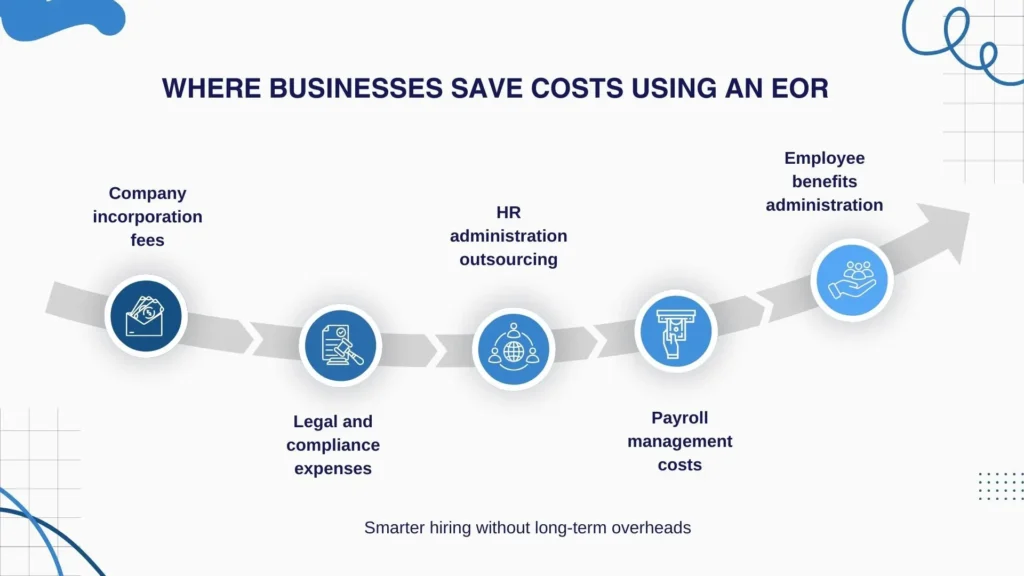
Entity setup is not only time-sensitive, but it is also costly. Legal retainers, incorporation and accounting teams, audits and compliance tools are costly to put together. These fixed overheads are eliminated with cost effective hiring with an EOR model.
Instead, businesses pay a predictable fee that covers:
- Employment compliance
- Payroll execution
- Statutory contributions
- HR administration
This model can particularly be important in firms that prefer flexibility without having to make financial commitments that may last in the long term.
Simplifying India Labor Law Compliance
The employment laws in India contain various labor codes, rules in different Indian states, and the changing legislative demands. Managing india labor law compliance internally often requires dedicated experts and constant monitoring.
An EOR assumes responsibility for:
- Employment contracts
- Statutory registrations
- Compliance with labor codes
- Adherence to local employment norms
When the compliance risk is transferred to the EOR, the businesses will save money and bandwidth in their management as well as avoid payments, litigation and regulatory ambiguity.
Payroll Management and Salary Processing Made Easy
Accurate payroll management in India involves more than just paying salaries. It contains tax deductions, statutory contributions, filings and documentation. Mistakes may result in penalties, dissatisfaction among employees, and publicity.
Through an EOR:
- salary processing in india is automated and compliant
- TDS, PF, ESIC, and professional tax are handled correctly
- Payslips, filings, and records are maintained systematically
This helps to save repetitive expenses and time of operation, as it does not require any in-house payroll teams or third-party coordination.
Faster and Compliant Onboarding of Employees
Rapid hiring is important, whereas compliant hiring is more important. By having onboarding employees done by an EOR, organizations do not experience procrastination through documentation errors or lack of statutory registration.
EOR-led onboarding typically includes:
- Employment contracts aligned with Indian law
- Employee verification and documentation
- Statutory enrollment from day one
This would make the new employees productive sooner and their business compliant initially.
HR Administration Outsourcing That Actually Reduces Load
Managing HR internally for a small or distributed team often becomes inefficient. hr administration outsourcing through an EOR centralizes all employment-related processes under one system.
This covers:
- Leave management
- Policy administration
- Employee lifecycle documentation
- Compliance reporting
By eliminating duplicated HR actions, the leadership teams will be able to concentrate on the increase, strategy, and customer deliverables rather than paperwork.
Employee Benefits Administration Without Complexity
In order to attract and retain talented employees in India, competitive advantages are necessary. The benefits administration process is, however, challenging and expensive to handle in compliance.
Through employee benefits administration handled by an EOR, companies can offer:
- Statutory benefits
- Health insurance options
- Leave entitlements aligned with law
Employees get benefits that are fixed according to the local market, and organizations do not have to bear the cost of operating in the local market through working with vendors and regulatory regulations.
Enabling Cross Border Hiring at Scale
For global companies, cross border hiring is often slowed by unfamiliar regulations and employment risks. This is made easier by a global eor which serves as a linkage between the global headquarters and the local employment laws.
This allows companies to:
- Hire Indian talent without local entities
- Maintain global consistency in HR practices
- Ensure local legal compliance
The outcome is an expedited international growth at reduced risk and less administrative expenses.
Flexible Workforce Expansion Without Long-Term Commitments
Businesses don’t always know how long they’ll need a team or how fast they’ll scale.
With an EOR:
- Teams can scale up or down easily
- No long-term entity maintenance costs
- Workforce changes don’t trigger legal restructuring
This is best suited in project based hiring, market testing and seasonal staffing requirements.
A Smarter Startup Expansion Strategy
Cash flow and speed are vital to startups. An expansion plan of any startup usually incorporates staffing a venture prior to investing in infrastructure.
Using an EOR allows startups to:
- Enter India with minimal capital investment
- Validate the market before setting up an entity
- Focus funds on product and growth instead of admin
This minimizes the rate of burn as expansion opportunities are maintained.
Understanding the Real Time and Cost Impact of EOR Services
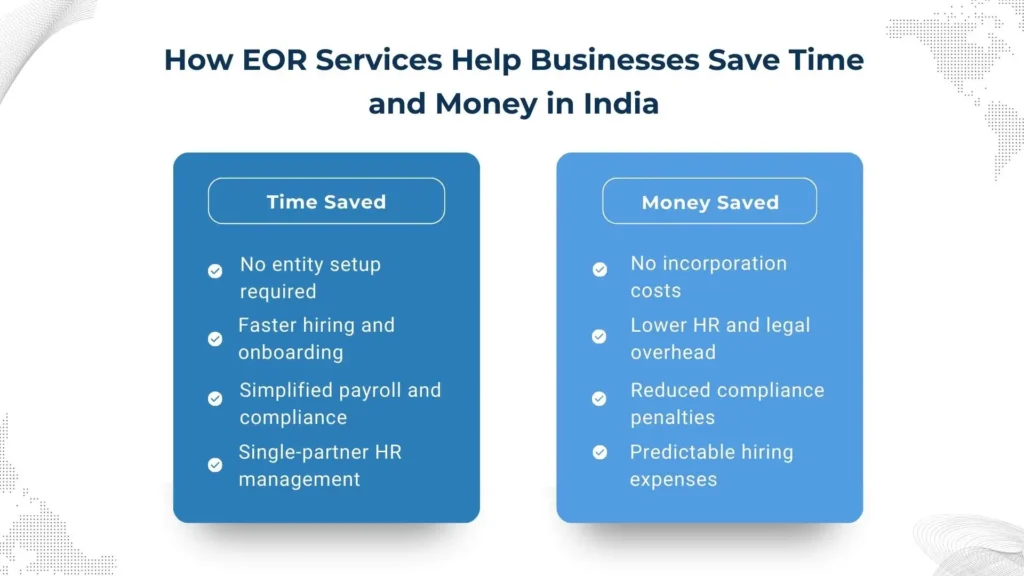
While the advantages of EOR models are often discussed in theory, the real value lies in how time and cost savings accumulate across daily operations. Businesses save money not through a single change, but through a combination of efficiencies working together.
Cost savings typically come from:
- Eliminating company incorporation and legal setup expenses
- Avoiding the need for in-house HR, payroll, and compliance teams
- Reducing exposure to penalties caused by regulatory errors
- Lower overheads when hiring small or distributed teams
Time savings are realized through:
- Immediate hiring without entity registration
- Faster employee onboarding and documentation
- Streamlined payroll and statutory filings
- Centralized employment management under one partner
Over time, these efficiencies compound, allowing leadership teams to focus on growth initiatives instead of administrative problem-solving. This makes the EOR model not just a hiring solution, but a strategic operational advantage.
Transitioning From EOR to Entity: A Scalable Path
Another commonly missed topic is what happens after growth. EOR models don’t lock businesses in permanently. Many companies use EOR as a launchpad, later transitioning to their own entity once scale justifies it.
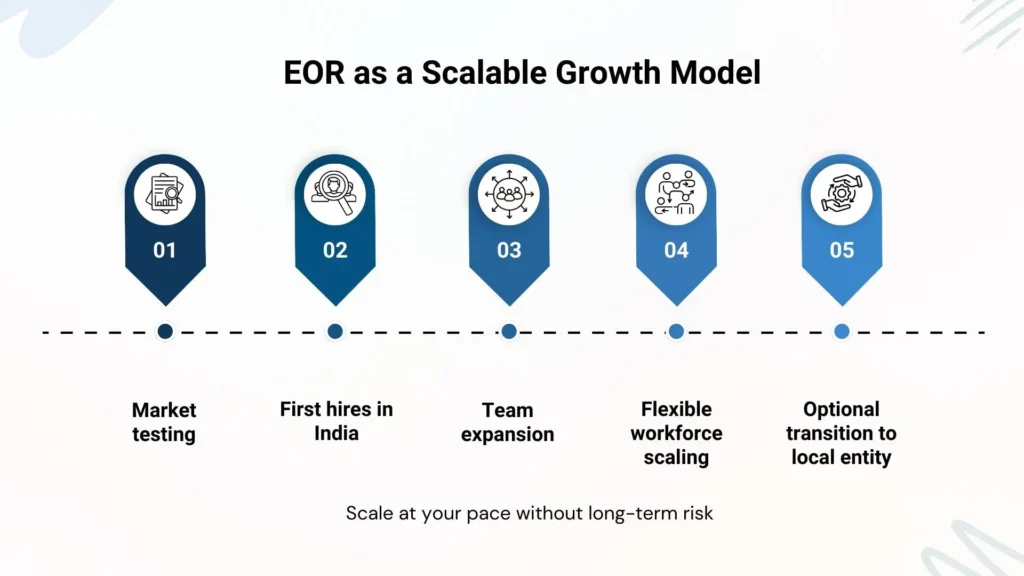
This phased approach:
- Minimizes upfront risk
- Preserves capital
- Allows data-driven expansion decisions
By combining speed, compliance, and cost control, employer of record solutions have become one of the most effective ways for businesses to save time and money in India, while staying flexible, compliant, and growth-focused.
FAQ’s
An employer of record is a third-party entity that legally employs workers on your behalf in India. The EOR handles compliance, payroll, and statutory obligations, while you manage the employee’s day-to-day work and performance.
EOR services eliminate the need for company incorporation, statutory registrations, and complex documentation. Businesses can hire and onboard employees in days instead of months, enabling faster execution and decision-making.
EORs remove costs related to legal setup, HR teams, compliance consultants, and penalties. This makes hiring more predictable and supports cost effective hiring, especially for small or distributed teams.
An EOR ensures full india labor law compliance by managing employment contracts, statutory filings, labor codes, and local regulations. This reduces legal risk and protects businesses from compliance-related penalties.
Absolutely. EORs support a flexible startup expansion strategy by allowing founders to test the Indian market, hire key talent quickly, and conserve capital without committing to long-term infrastructure.
Yes. A global eor enables seamless cross border hiring by bridging international business needs with local employment laws, making it easier to build global teams without legal complexity.