There’s no single headcount number where a company suddenly “needs” a CHRO. Founders wait for a clear signal, a specific employee count, a funding round, a board directive and that signal rarely shows up cleanly. What actually happens is quieter. HR decisions that used to be simple start taking longer. Managers start handling the same situation in three different ways. And the founder, still doing most of the people work personally, starts wondering why it feels harder than it should.
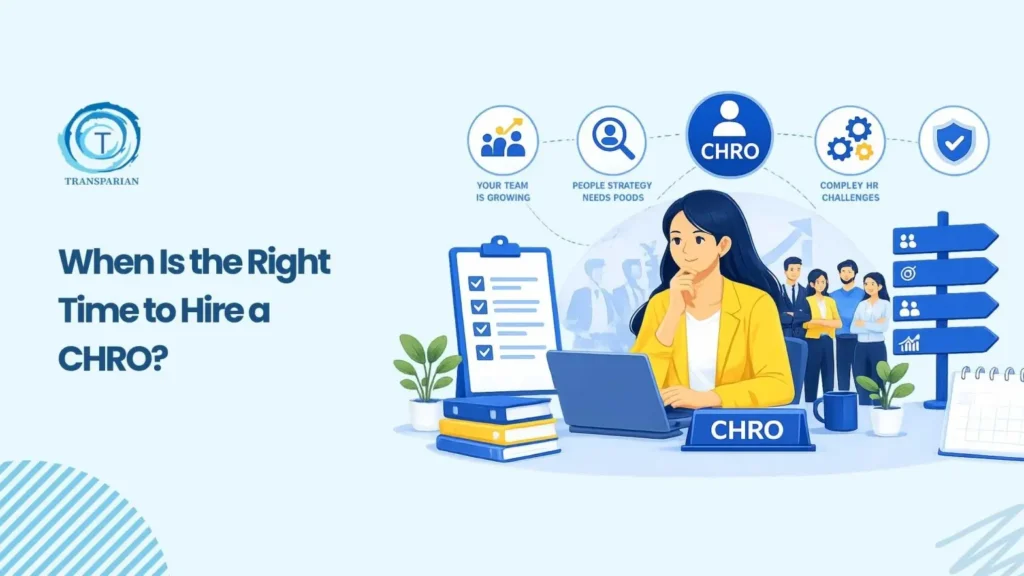
The honest answer to “when should we hire a CHRO” isn’t a number. It’s a set of signals that show up well before most companies think they’re ready.
Why Headcount Alone Isn’t the Right Trigger
It’s tempting to tie this decision to a round number; 50 employees, 100 employees, 200 employees. But two companies at the same headcount can be in completely different positions. A 60-person engineering team with low turnover and a stable leadership bench doesn’t have the same urgency as a 60-person company scaling across three cities with a hiring plan that doubles headcount in a year.
What actually determines readiness isn’t size, it’s complexity. A company hiring across multiple states, managing a mix of full-time employees and contract workers, or preparing for a fundraise has already crossed into territory where informal HR breaks down, regardless of what the org chart says.
The Signals That Actually Matter
Rather than watching a headcount counter, it helps to watch for these instead:
- The founder is still personally involved in every hiring decision. Not just final approvals, actual involvement in screening, negotiating, and onboarding. This is fine at 15 people. Past 40 or 50, it’s usually a sign that HR ownership hasn’t been handed off, and it’s quietly eating into time that should be going toward the business itself.
- Managers are inconsistent with feedback and performance conversations. One manager documents everything and follows a clear process. Another handles it entirely by instinct. Without a shared framework, this inconsistency becomes one of the biggest hidden drivers of employee attrition and it’s almost never visible until it shows up in exit interviews.
- Compensation decisions are made ad hoc. Early hires negotiated their own pay. Later hires were benchmarked against market data nobody else received. By the time this gap becomes visible internally, it’s already caused resentment and it’s far more expensive to fix retroactively than to prevent.
- Compliance is being handled reactively. PF and ESIC registrations happened because a filing deadline forced the issue, not because someone was tracking thresholds proactively. A PoSH audit hasn’t been done, or the Internal Committee exists on paper but hasn’t actually met.
- There’s a fundraiser, M&A conversation, or board expectation on the horizon. Investors and acquirers look closely at HR maturity during diligence. Undocumented policies, inconsistent contracts, and compliance gaps slow deals down which is exactly why fractional HR leadership during M&A has become common practice rather than a nice-to-have.
If two or more of these sound familiar, that’s usually the real signal, not a number on a spreadsheet.
Why Founders Wait Longer Than They Should
Most founders don’t delay hiring HR leadership out of neglect. It’s usually one of three things:
Cost concerns. A full-time CHRO is a significant executive hire, and at 60 or 80 employees, that cost can feel disproportionate to the company’s stage. This is a reasonable concern, it’s also exactly the gap that fractional CHRO models were built to solve.
Uncertainty about what the role actually does. Founders who’ve only worked with operational HR, payroll, leave management, and onboarding sometimes don’t have a clear picture of what strategic HR leadership looks like day to day. It’s easier to delay a decision when the value isn’t fully visible yet.
A belief that things are “working fine.” This is the trickiest one, because it’s often true, until it isn’t. Culture, retention, and compliance all tend to hold together reasonably well right up until the point they don’t, and the shift from fine to fractured can happen faster than leadership expects.
What Changes Once a CHRO Is in Place
The clearest way to think about timing is to look at what a CHRO actually does differently from operational HR, because the gap becomes obvious once you see it side by side.
Organizational design becomes deliberate. Instead of reporting lines forming organically as people get hired, a CHRO builds a structure that matches where the business is actually headed over the next 12 to 24 months.
Compensation becomes a system, not a series of negotiations. Pay bands, leveling, and benchmarking get built before inconsistency becomes entrenched which is far easier than correcting it after the fact.
Compliance becomes proactive. Thresholds for PF, ESIC, and state-specific labour codes get tracked ahead of time instead of discovered when a deadline is already close. PoSH compliance moves from a paper requirement to an actual functioning process.
Manager capability gets built intentionally. New managers get trained on feedback and performance conversations before they’re thrown into the role, rather than learning through trial and error at the team’s expense.
CEO and CHRO alignment becomes a working partnership. Instead of the founder carrying every person’s decision alone, there’s a genuine partnership where HR strategy is tied directly to business strategy, not bolted on separately.
Full-Time, Fractional, or Virtual — Does the Model Matter?
Once the timing signals are clear, the next question is usually about format. A full-time CHRO makes sense once a company has the scale and budget to justify a dedicated executive seat. But for most companies between 50 and 250 employees, the more practical starting point is a fractional or on-demand CHRO experienced leadership brought in at the right cadence, without the overhead of a full-time hire.
There’s also a meaningful difference between HR support that produces reports and dashboards, and HR leadership that actually drives change. Plenty of companies bring in consultants who diagnose problems thoroughly and then stop there. The more useful model is action-oriented someone who implements the org design, builds the compensation framework, and closes the compliance gaps, rather than just describing them.
Whichever format a company chooses, the underlying question stays the same: is HR still being run informally, patched together as problems come up? Or is someone actually building the systems ahead of growth?
The Real Answer to “When”
If there’s one honest takeaway here, it’s this: the right time to hire a CHRO is almost always earlier than it feels. Waiting for a clear, unmistakable sign usually means waiting until the cost of not having one has already shown up in attrition, in a compliance notice, in a founder stretched too thin to focus on the business itself.
The companies that scale cleanly aren’t the ones who avoided these problems by luck. They’re the ones who brought in strategic HR leadership while there was still room to build deliberately, instead of repairing things under pressure after the fact.
Let Transparian Simplify Your Journey to Strategic HR Leadership
From building the right organizational structure to putting compliance, compensation, and manager capability in place before growth outpaces them, Transparian provides expert Fractional CHRO Services for founders and business owners scaling their teams. Explore more insights on our CHRO Advisory Blogs to see how the right HR leadership, brought in at the right time, helps growing businesses stay ahead of problems instead of reacting to them.
FAQ’s
A company should consider hiring a CHRO when workforce complexity begins to outpace informal HR processes. Common indicators include rapid hiring, increasing employee turnover, inconsistent performance management, compensation challenges, and growing compliance responsibilities.
A Chief Human Resources Officer (CHRO) aligns people strategy with business goals. Their responsibilities typically include workforce planning, organizational design, talent management, compensation strategy, leadership development, employee engagement, and HR compliance oversight.
Your business may need a CHRO if founders are heavily involved in HR decisions, managers handle employee issues inconsistently, hiring processes lack structure, or compliance and retention challenges are becoming more frequent.
Yes. SMEs often benefit from CHRO expertise because it helps establish scalable HR systems, compensation frameworks, compliance processes, and leadership development programs before growth creates larger organizational challenges.
A CHRO can improve retention by implementing structured career development programs, fair compensation practices, performance management systems, leadership training, and employee engagement initiatives that address the root causes of attrition.
Rapid growth often creates challenges related to hiring, organizational structure, culture, and compliance. A CHRO helps build scalable people processes that support expansion while maintaining workforce productivity and employee experience.