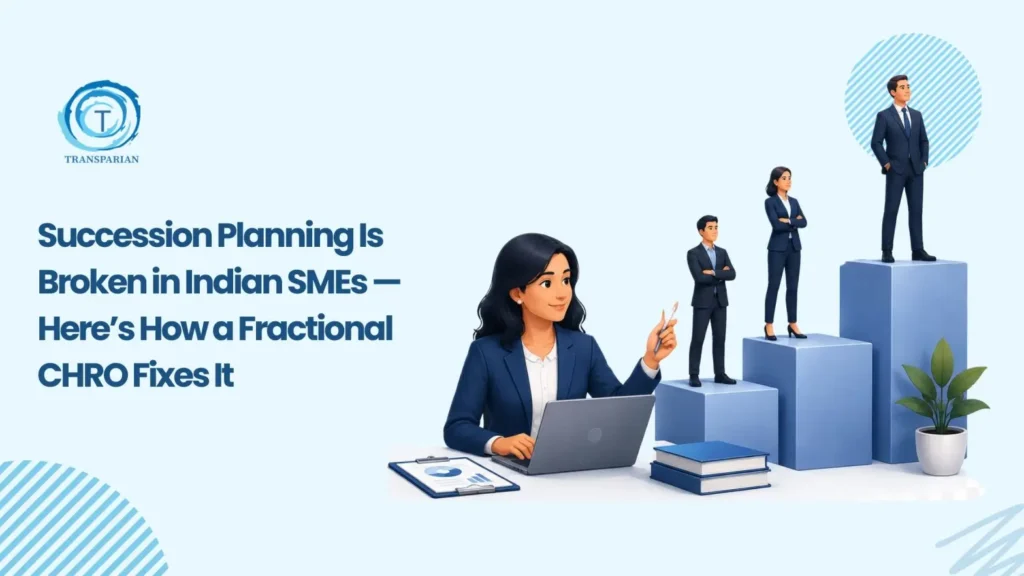
Ask most Indian SME founders who would run the company if they stepped away for six months, and the honest answer is usually silence or a name followed by “but they’re not really ready yet.” Succession planning exists as a concept everyone agrees is important and almost nobody has actually built. It sits somewhere on a to-do list, permanently below whatever is urgent that quarter.
This isn’t a leadership failure. It’s a structural one. Most SMEs simply don’t have anyone whose job it is to think about organizational continuity and that gap is exactly where a fractional CHRO earns its keep.
Why Succession Planning Keeps Getting Skipped
Succession planning has a specific problem: it never feels urgent until it’s suddenly critical. Founders are focused on revenue, hiring for immediate roles, and putting out whatever fire is closest. Planning for a leadership gap that might happen in two or three years loses every time to a customer escalation happening today.
There’s also a more uncomfortable reason it gets avoided. Talking about succession forces a founder to confront questions they’d rather not sit with what happens if a key leader leaves, what happens if the founder themselves needs to step back, who’s actually irreplaceable versus who just seems that way because no one has tested the alternative. It’s easier to defer the conversation than have it.
The result is predictable:
- One or two people hold institutional knowledge that exists nowhere else
- Departures of senior leaders create genuine panic instead of a managed transition
- Promotions happen reactively, filling a gap rather than following any real development path
- The founder becomes the single point of failure for decisions that should sit with a broader leadership bench
What “Broken” Succession Planning Actually Looks Like
It rarely looks like total absence. Most SMEs have some version of succession thinking, it’s just informal, undocumented, and dependent entirely on memory. A few common patterns show up again and again:
The designated successor who was never actually developed. A founder has someone in mind for a critical role, but that person has never been given the exposure, mentoring, or stretch assignments that would actually prepare them. The plan exists as an idea, not a process.
Knowledge concentrated in one or two people. Client relationships, vendor negotiations, and operational know-how live in someone’s head rather than in any documented system. If that person leaves, the knowledge leaves with them.
No bench for middle management. Companies often plan succession for the top one or two roles and completely ignore the layer beneath, the managers who would need to step up if senior leaders moved on. This is usually where attrition does the most damage, because it’s rarely visible until it’s already happened, much like the broader pattern behind unmanaged employee attrition.
Succession treated as an HR document, not a business strategy. Even when a succession plan technically exists, it often sits in a folder, disconnected from actual performance reviews, development conversations, or business planning. It was built once and never revisited.
Why This Is Especially Risky for Indian SMEs
A few dynamics make this sharper in the Indian SME context specifically. Many SMEs are still closely tied to a founder or a small founding team, so the line between “company knowledge” and “founder’s personal knowledge” is blurry at best. Family-run businesses face an added layer, succession isn’t just an operational question but a personal and generational one, which makes it even easier to postpone.
There’s also the growth-stage timing problem. Companies scaling from 50 to 200 employees are adding management layers faster than they’re developing the people meant to fill them. And for SMEs preparing for a fundraise or acquisition, weak succession planning is a real red flag during diligence investors and acquirers specifically look for dependency risk, and a company visibly built around one or two irreplaceable people reads as exactly that.
How a Fractional CHRO Actually Fixes This
This is where the shape of the fix matters as much as the fix itself. Succession planning doesn’t need a full-time executive sitting on it permanently, it needs someone with the right expertise building the framework and then keeping it alive through regular review. That’s precisely the gap a fractional CHRO is built to close.
They start by mapping actual risk, not assumed risk. Rather than guessing which roles matter most, a CHRO identifies where the company is genuinely exposed which roles have no backup, which knowledge exists in only one person’s head, which departures would actually stall the business versus just cause short-term disruption.
They build development paths tied to real roles, not vague potential. Instead of a loosely mentioned successor, high-potential employees get specific stretch assignments, structured mentoring, and visibility into the decisions they’d eventually need to make. This connects directly to the kind of intentional manager development that’s often missing entirely in fast-scaling companies.
They document what currently lives only in memory. Client relationships, vendor terms, operational processes, the things that would create chaos if a key person left suddenly get captured systematically, so continuity doesn’t depend on any single individual staying forever.
They tie succession planning to performance reviews, not a separate process. Instead of a document that gets built once and forgotten, succession becomes part of the regular rhythm of talent conversations, revisited as the business and its people evolve.
They bring in outside objectivity. A founder evaluating “who could step into my role” is rarely neutral about it, consciously or not. A fractional CHRO can assess the leadership bench without the emotional weight a founder inevitably carries into that evaluation, and without the internal politics that can distort how existing HR or department heads see the same question.
This is also where the difference between advisory that produces reports and advisory that produces results really shows up. Plenty of consultants can hand over a “succession framework” document. Fewer actually implement it, revisit it, and make sure it survives past the initial engagement which is the entire point of action-oriented CHRO support rather than a one-time diagnostic.
What Good Succession Planning Actually Looks Like in Practice
It’s worth being concrete about what “fixed” looks like, because it’s less dramatic than it sounds:
- Every critical role has at least one identified internal successor with an active development plan, not just a name on a list
- Key operational and client knowledge is documented somewhere other than one person’s memory
- Middle management has a visible bench, not just the top layer
- Succession is reviewed on a regular cadence — tied to performance cycles, not left dormant for years
- The founder is no longer the single point of failure for decisions that should sit with a broader leadership team
None of this requires a massive HR department. It requires someone whose job includes actually paying attention to this which, for most SMEs, is exactly the space a fractional or on-demand CHRO model fills without the cost of a full-time executive hire.
The Real Cost of Leaving It Broken
Succession planning is one of those problems that’s genuinely cheap to prevent and expensive to fix after the fact. A well-built plan costs some structured time and attention. An unplanned departure of a key leader costs weeks of disruption, rushed hiring under pressure, and often the loss of institutional knowledge that took years to build in the first place.
Indian SMEs that treat succession as a real business function not a document that exists to satisfy a checklist end up with something far more valuable than a contingency plan. They end up with a leadership bench that can actually absorb growth, transitions, and the inevitable moments when a key person moves on. That’s not a luxury reserved for large enterprises. It’s exactly the kind of structural work a fractional CHRO is designed to bring to a company long before it’s forced to learn the lesson the hard way.
Let Transparian Simplify Your Journey to Strategic HR Leadership
From building a real succession bench to putting compliance, compensation, and manager capability in place before growth outpaces them, Transparian provides expert Fractional CHRO Services for founders and business owners scaling their teams.
FAQ’s
Most SMEs don’t have anyone whose job it is to own organizational continuity. Founders stay focused on immediate priorities, so succession planning gets pushed down the list until a departure forces the issue.
It usually shows up as one or two people holding all the institutional knowledge, a “successor” who was never actually developed, no bench for middle management, and a plan that exists on paper but isn’t tied to real performance reviews.
A fractional CHRO maps real dependency risk, builds development paths for identified successors, documents knowledge that currently lives only in one person’s memory, and ties succession reviews to the regular performance cycle instead of leaving them dormant.
Yes. Companies scaling from 50 to 200 employees often add management layers faster than they develop people to fill them, which makes succession gaps more likely, not less, as headcount grows.
No. Succession planning needs the right expertise applied consistently, not a permanent full-time executive. A fractional or on-demand CHRO can build the framework and keep it active through regular review at a fraction of full-time cost.