
Ten years ago, the HR head at a mid-sized Indian company spent most of the week on attendance exceptions, offer letters, and the annual appraisal cycle. If payroll ran on time and no labour inspector called, HR had done its job.
That version of the role still exists, but it no longer matches what leadership teams expect. The CHRO now sits closer to the CEO and CFO than to the admin desk. Founders deciding whether to build the role or bring it in part-time need to see how far it has moved.
Where HR Used to Sit
For a long time, HR in India was a support function. It processed decisions made elsewhere. A typical week looked like this:
- Maintaining employee records and leave balances
- Collecting payroll inputs and handling statutory filings
- Coordinating hiring after a manager had already decided to hire
- Running the appraisal cycle and organizing festival events
Nobody was wrong to run it this way. Companies were smaller, hiring moved slowly, and people costs were easier to predict. Orderly was enough.
What Pushed the Role Forward
Four pressures arrived close together, and all of them landed on HR.
Talent became expensive and mobile. Skilled people in technology, manufacturing, healthcare, and finance now get offers from several cities and, more often, from abroad. A weak manager or an unclear promotion path can cost a company its best people within a year.
Compliance got heavier. The new Labour Codes, PoSH obligations, state-specific rules, and closer scrutiny of contract labour mean compliance can’t be a once-a-year clean-up. Someone has to own it every month.
Employment models multiplied. One company may now run permanent staff, contract workers, EOR hires, and remote employees at the same time. Each group carries different obligations and different culture risks.
Boards started asking about people. Leadership depth, attrition, and dependence on one or two individuals now come up in funding and diligence conversations.
What a CHRO Does Today
The title has barely changed. The work has. In a growth-stage Indian company, a working CHRO typically owns:
- Workforce planning tied to the revenue plan, so hiring follows the business
- Organization design, including reporting lines and when to add a management layer
- Pay structure and bands, so offers stay consistent as headcount grows
- Leadership development and succession planning
- Compliance oversight across labour law, PoSH, and the contract workforce
- Retention, measured and managed instead of hoped for
None of that is administrative. Each item moves cost, speed, risk, or retention, which are the same four things the CEO already watches.
The CEO Relationship Changed First
You can see the shift most clearly in who the CHRO talks to. In the older model, HR sent numbers upward once a quarter. Today the CHRO is in the room when next year’s targets are set, because those targets decide who gets hired, who gets promoted, and which teams get rebuilt.
A strong CEO and CHRO partnership depends on shared targets, regular working sessions, and clear ownership of people decisions on both sides.
Attrition Became a Strategy Question
Attrition used to be a percentage in a monthly report. A CHRO asks sharper questions: who is leaving, under which managers, after how many months, and what each exit costs to replace.
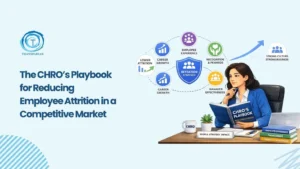
The answers usually point to a short list of fixable causes, such as unclear growth paths, inconsistent managers, and pay that hasn’t kept up with the market. A structured CHRO strategy to reduce employee attrition works on each one in turn and tracks the results.
Deals and Due Diligence
Mergers and acquisitions expose weak HR faster than anything else. Two cultures meet, pay structures collide, roles overlap, and employees treat every rumour as fact. A CHRO with deal experience plans for those problems before signing, and fractional HR leadership in M&A gives companies that experience without a full-time hire.
Companies with no deal in sight benefit too. Clean org charts and documented policies speed up diligence whenever an investor or buyer shows up.
What This Means for Indian SMEs
Large enterprises have had CHROs for decades. The change is happening in the 50 to 500 employee range, where founders still approve hires personally and HR is one or two people. These companies face enterprise-level compliance and talent pressure on a startup-sized HR budget.
The first fix is often a better-designed HR function rather than a bigger one. That means clear roles, a pay structure, a compliance calendar, and a leader who can say no to a hire that doesn’t fit the plan.
Why Many Companies Rent the Role Before Building It
A full-time CHRO is a serious executive hire. For a company with 60 to 250 employees, the salary and the scope of work often don’t match. That gap explains the growth of fractional CHRO services in India, where an experienced leader works a set number of days each month.
The model holds up for a few reasons:
- Cost follows the work needed, so a fractional CHRO reduces HR costs while keeping senior judgment in the room
- Experience from other companies carries over, which is why a fractional CHRO often beats a full-time hire for SMEs
- Availability can rise during a hiring push or an acquisition and drop afterward
- The internal HR team learns the systems and keeps running them after the engagement ends
Reports Don’t Change Anything
Some HR advisory work ends with a thick deck of findings. The company then has the same problems with better documentation. The role has only moved forward when someone owns the follow-through, which is the case for action-oriented CHRO services that implement changes, review them, and adjust.
When you compare CHRO consulting services, ask these before signing:
- Who will do the work, and how many days a month will they spend on it?
- What changes in the first 90 days, and how will we know?
- How do you handle compliance gaps you find along the way?
- What does the handover look like when the engagement ends?
Signs Your HR Function Still Runs as Admin
- The founder approves every hire, even past 40 employees
- Offers are negotiated case by case with no pay bands
- Managers handle poor performance in their own way
- Compliance gets attention only when a deadline is close
- Nobody can say who would step in if a senior leader resigned next month
If three or more of these fit, the gap is probably structural, and an outsourced CHRO is often the fastest way to close it.
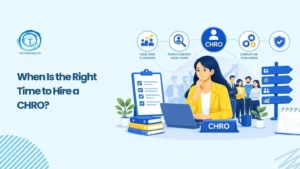
The pattern repeats across growing companies. The right moment for when to hire a CHRO arrives earlier than most founders expect, scaling from 20 to 200 employees pushes informal HR past its limit, and succession planning in Indian SMEs rarely starts without someone owning it.
What Comes Next
Expect the role to take on more data work: headcount forecasts, attrition models, and skills planning that finance and operations both rely on. The CHRO who can read those numbers and act on them will keep gaining influence inside the company.
Need a CHRO Without the Full-Time Cost?
Transparian’s CHRO services give growing companies experienced HR leadership for org design, compensation, compliance, and succession, without a full-time executive hire.
FAQ’s
The role has moved from administration to business leadership. A decade ago, HR mostly handled records, payroll inputs, and appraisals. Today a CHRO plans workforce size against revenue targets, designs the organization, sets pay structures, and owns compliance and succession.
An HR manager runs the day-to-day work: hiring coordination, onboarding, leave, payroll inputs, and employee queries. A CHRO owns people strategy and answers for outcomes such as retention, leadership depth, and compliance risk. The CHRO decides what the HR team should build, while the HR manager makes sure it runs. Many growing companies need both.
A CHRO connects people decisions to business goals. Typical responsibilities include workforce planning, organization design, pay bands, leadership development, succession planning, and compliance oversight. The CHRO also advises the CEO on which hires, promotions, and restructures support the plan. In smaller companies, much of the first year goes into building frameworks that did not exist before.
In most cases, yes, because you pay for the days and scope you actually need rather than a full executive package. The comparison should also include the cost of the problems left unfixed, such as avoidable attrition and compliance penalties. Pricing depends on seniority, scope, and time commitment.
There is no fixed headcount. Watch for signals instead: the founder still approves every hire, pay is negotiated case by case, managers handle performance differently, and nobody can name a successor for key roles. A funding round or acquisition on the horizon is another trigger. If several of these apply, bring in CHRO-level support.