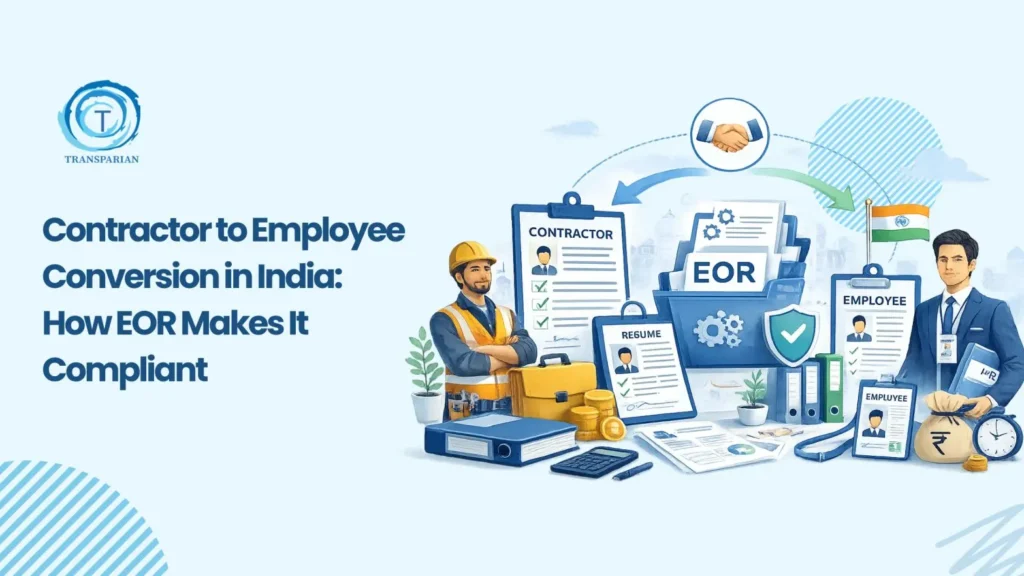
Converting a contractor to an employee in India means issuing a proper employment contract, enrolling the person under Provident Fund and ESI, setting up TDS on salary, and addressing any compliance gap from the contractor period. For foreign companies without a registered entity, EOR services take on legal employer status and manage the full conversion, making the transition compliant without requiring entity registration.
The pressure to make this switch has been building. Not because companies suddenly decided to do the right thing, but because the contractor model many relied on for flexibility is drawing more scrutiny than it used to.
Why Contractor Arrangements Get Converted
Most contractor relationships in India start reasonably enough. A company needs a specific skill for a defined project, brings someone in on a fixed-term arrangement, and plans to wrap it up when the work is done. The problem is that a lot of these arrangements do not end when the project does.
The person stays on. The work becomes more ongoing and central to operations. The company starts treating them like an employee in practice (setting their schedule, supervising their work, integrating them into internal systems) while the paperwork still says contractor. That gap between the legal form and the functional reality is where misclassification risk builds.
Other triggers exist too. A fundraising round or acquisition almost always surfaces workforce structure questions. Investors and acquirers want to understand whether the people doing the work are employed correctly, and finding a dozen long-running contractor arrangements in the data room creates problems that can slow a deal or affect its terms. Many companies convert contractors to employees specifically to clean this up before a transaction.
Sometimes the employee themselves asks for it. Contractors in India miss out on PF contributions, ESI coverage, gratuity eligibility, and the legal protections that come with employment status. People who have been with a company for years often want that stability, and keeping them means offering it.
What Regulators Actually Look At
Indian tax and labor authorities assess employment status based on substance, not paperwork. A person described as a contractor on a services agreement but working full-time hours under close supervision, on work that is core to the company’s operations, will typically be treated as an employee for regulatory purposes regardless of what the contract says.
The legal and financial compliance consequences of getting this wrong are not limited to future obligations. A reclassification can apply retrospectively, covering the full period of engagement. That means back PF contributions, penalty interest under Section 7Q of the EPF Act, damages under Section 14B for delays, back ESI contributions, and potential TDS liability on payments that were treated as contractor fees.
For most companies, the cost of conversion done correctly is lower than the cost of a forced reclassification. Converting proactively also gives the company control over the process, including the timing, the structure, and how any historical exposure is handled.
What Conversion Actually Involves
This is not just tearing up the contractor agreement and issuing an offer letter. It means establishing a proper employment relationship from scratch, with all the statutory registrations and obligations that come with it.
The core compliance requirements for a contractor-to-employee conversion:
- Employment contract compliant with the applicable state’s Shops and Establishments Act
- PF enrollment and UAN generation, with employer and employee contributions at 12% of applicable wages
- ESI registration where the employee’s gross salary is within the coverage ceiling and the establishment is in a notified area
- TDS setup based on estimated annual income and investment declarations collected via Form 12BB
- Professional tax deduction where applicable in the employee’s state of work
- Leave policy, notice period, and termination provisions as required under the applicable statute
The gratuity question comes up often. An employee’s gratuity eligibility under the Payment of Gratuity Act begins from the date of employment, not from when they started working for the company as a contractor. This matters and should be communicated clearly before the conversion happens, not after.
The Backdated Liability Question
Most companies converting contractors want to understand their exposure for the period before the conversion. The answer depends on how the contractor arrangement was structured.
If the person was self-employed, working for multiple clients without direct supervision, the historical exposure is usually limited. If the arrangement looks like employment in substance, the exposure is more significant. That assessment should happen as part of the conversion process. Issuing a new employment contract going forward does not close the historical question if the prior arrangement was effectively employment.
This is also why timing matters. The longer a misclassified arrangement runs, the larger the potential retroactive liability. Converting sooner limits the window.
Where EOR Fits In
For foreign companies, the conversion process has an additional constraint: they cannot employ people in India directly without a registered entity. The co-employment model under an EOR arrangement solves this.
The EOR becomes the legal employer of the converted employee in India. They issue the employment contract, carry the statutory registrations, process payroll with correct deductions, and file returns with EPFO, ESIC, and the Income Tax Department each month. The foreign company keeps full control of the person’s work. From the employee’s perspective, they have a proper employment relationship with statutory benefits and a clear legal structure.
For the conversion itself, the EOR handles the full employee onboarding process for the new employment relationship, collecting KYC documents, generating the UAN, registering under ESIC where applicable, and setting up professional tax in the relevant state. The company manages none of these registrations directly.
The EOR also covers the employment lifecycle beyond the conversion date. Salary revisions, statutory filings, and eventual exits are all handled in a way that stays legally sound throughout. How this plays out end to end is covered in the guide on EOR services from onboarding to exit management.
What Changes for the Employee
Companies sometimes underestimate this side of the conversion. Under a contractor arrangement, fees are paid gross with no statutory deductions. Under employment, PF, professional tax, and TDS apply from the first payroll. Depending on how the compensation is restructured, take-home can look different even if the total cost to company is higher.
Most employees who want the conversion understand this. The conversation about what the net-of-deductions salary looks like, when gratuity eligibility begins, and what leave entitlements apply needs to happen before the contract is signed, not after. A converted employee who feels the numbers came as a surprise is a retention problem waiting to happen, even if the employment relationship is objectively better for them.
What Companies Get Wrong
A few things come up consistently when conversions go poorly.
The most common is using the same figure from the contractor fee as the employment salary, without accounting for the employer-side statutory contributions that sit on top. The total cost of employment is higher than the contractor fee it replaces, and this needs to be in the budget before the offer goes out.
The second is skipping the backdated assessment. Issuing an employment contract going forward is not the same as addressing historical exposure. If the prior arrangement had characteristics of employment, that needs to be assessed before the conversion closes, not filed away as someone else’s problem.
The third is treating the process as purely administrative. A person who has been with the company for a significant period has expectations. How the company handles the transition says something real about how it operates. Handled well, it is a retention moment. Handled carelessly, it is a resignation letter waiting to be written.
Let Transparian Simplify Your Global Hiring
From managing contractor-to-employee conversions to handling PF, ESI, and TDS filings for every new hire, Transparian provides reliable EOR services for companies hiring in India without a local entity. Through accurate payroll processing and experienced HR compliance support, Transparian helps businesses hire compliantly, stay audit-ready, and scale with confidence.
FAQ’s
It’s the process of moving someone from an independent contractor arrangement to formal employment, with a proper employment contract, PF and ESI enrollment, TDS setup, and statutory leave and notice period provisions under Indian labor law.
Not always, but if an arrangement functions like employment, tax and labor authorities can reclassify it regardless of what the contract says. Companies usually convert proactively to avoid forced reclassification and the backdated liability that comes with it.
Under employment, TDS applies to salary under Section 192 of the Income Tax Act, requiring investment declarations and monthly tax deductions. Contractor fees are taxed under different sections at flat rates. The calculation method changes entirely at conversion.
From the employment start date. The five-year gratuity eligibility clock under the Payment of Gratuity Act begins when the employment relationship formally starts, not from the original contractor engagement date.
Two to three weeks for most conversions, covering contract issuance, PF and ESI enrollment, UAN generation, and payroll setup. Timelines can extend if KYC documents are delayed or state-specific registrations are involved.
It typically changes. Contractor fees are paid gross; salary has statutory deductions including PF, professional tax, and TDS. Total cost to company usually rises. Net salary depends on how the compensation is restructured and what declared investments reduce TDS to.