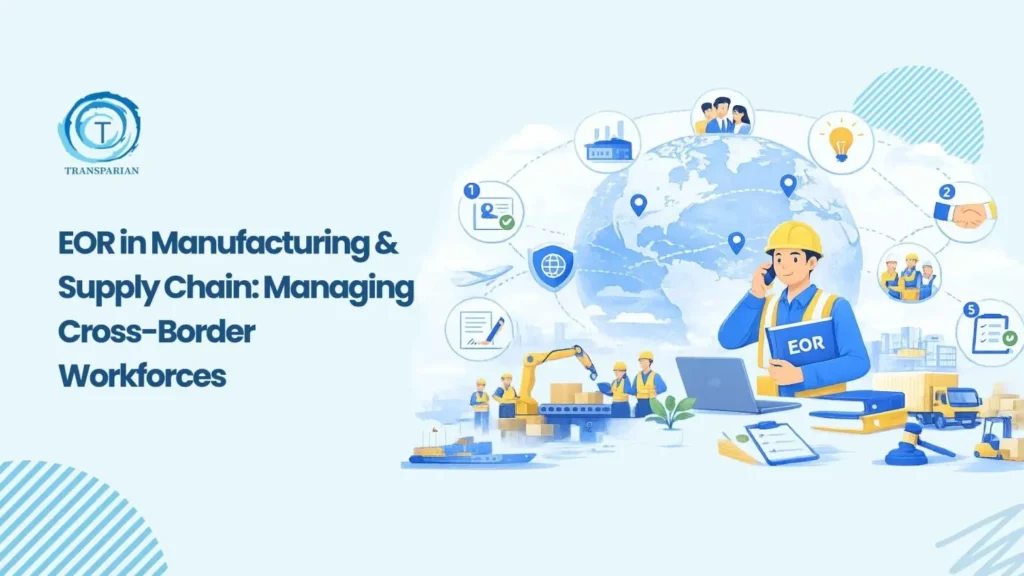
Manufacturing has always been a global game. Raw materials come from one country, components from another, assembly happens somewhere else, and the finished product ends up in a market that may be different from all of them. What has changed is that the workforce supporting this chain is increasingly spread across borders in ways that go beyond the factory floor and the employment compliance complexity that comes with that has quietly become one of the harder operational problems HR and supply chain teams are dealing with.
Hiring locally in one country is manageable. Hiring across five or six countries simultaneously, with different labor codes, payroll obligations, statutory contributions, and worker classification rules in each, is a different challenge altogether. This is where EOR services have started appearing on the radar of operations and HR teams in manufacturing, not as an abstract HR solution, but as a practical answer to a very specific logistics problem.
What Makes Manufacturing Workforces Different
Most industries that use EOR are doing so because they have knowledge workers in new markets, a developer in Bangalore, a sales lead in Singapore, a finance analyst working remotely. Manufacturing and supply chain have that too, but they also have something else: large, mixed workforces that combine permanent employees, contract workers, project-based specialists, and third-party labor across multiple geographies simultaneously.
A mid-sized manufacturing company might have permanent production staff at its home plant, a procurement team spread across Southeast Asia, contract engineers supporting a new facility ramp-up in India, and quality specialists embedded with suppliers in different countries. Managing employment compliance across all of these, in each country where they sit, with the right structure for each worker type, is genuinely hard. Most HR teams are not set up to handle that kind of complexity without outside support.
The Compliance Layer That Gets Ignored Until Something Goes Wrong
Cross-border manufacturing operations tend to focus relentlessly on the physical supply chain, logistics timelines, inventory buffers, supplier quality, customs clearance. The employment compliance side of the cross-border workforce rarely gets the same attention. It usually surfaces when something breaks: a tax authority in a market where the company has been using contractors starts asking questions, a worker dispute escalates in a country where the employment contract turns out not to be legally sound, or an acquisition due diligence process uncovers a workforce structure that looks nothing like what local labor law requires.
The specific obligations vary by country, but the common threads across most manufacturing markets include:
- Statutory contributions — provident fund equivalents, social insurance, professional tax
- Proper employment contracts for each country, not translated versions of the home country template
- Worker classification that holds up under regulatory scrutiny
- Correct payroll processing with the right deductions filed on schedule
- Leave, notice periods, and termination procedures that comply with local law
Each of these looks straightforward in isolation. Across four or five countries with different rules, they add up to a significant compliance management burden, one that most manufacturing HR teams are already stretched to carry.
The Contractor Problem in Manufacturing
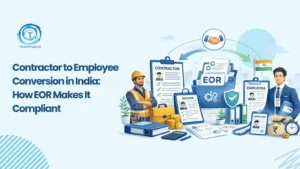
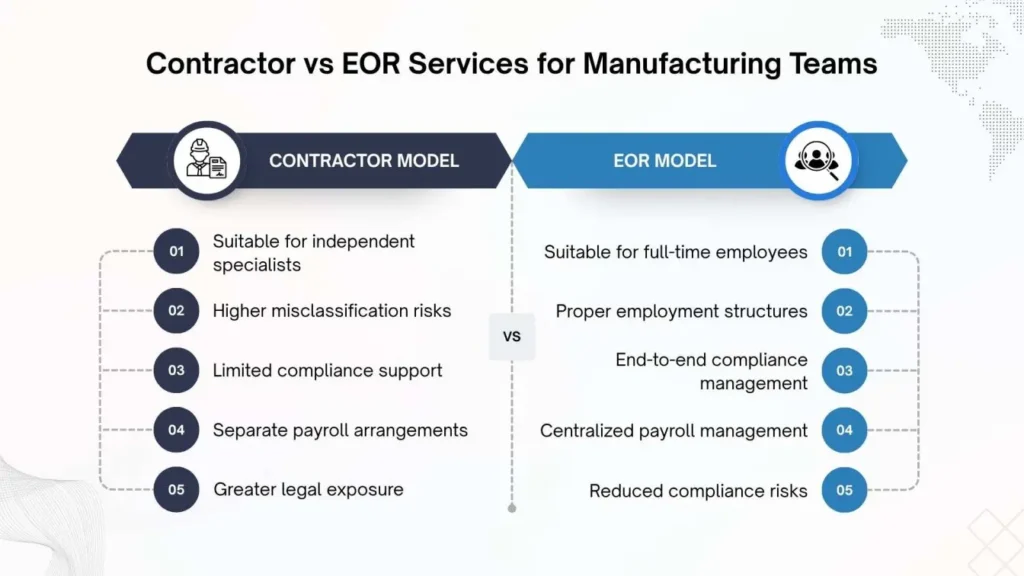
Manufacturing and supply chain operations lean heavily on contract and project-based labor. Some of that is entirely legitimate, a specialist brought in to commission a new production line, a quality auditor embedded with a supplier for six months, a project manager overseeing a facility expansion. But a lot of manufacturing companies also use contractor arrangements as a structural default, even for roles that look and function exactly like regular employment.
This is where misclassification risk becomes a real problem. Labor authorities in markets like India have grown significantly more attentive to arrangements where someone is called a contractor but works fixed hours, under close supervision, on work that’s integral to the company’s core operations. Getting reclassified means back taxes, penalty interest, retroactive statutory benefit obligations, and potential reputational exposure, none of which manufacturing companies plan for in their cost models.
EOR doesn’t eliminate the use of contractors where contractor arrangements are genuinely appropriate. What it does is give companies a proper employment structure for roles that function like employment, so the arrangement is legally sound from the start and doesn’t become a liability later.
Where EOR Fits in a Manufacturing Workforce Model
The clearest use cases in manufacturing tend to cluster around a few scenarios:
- Market entry without entity setup. When a company is setting up a new manufacturing presence or supply chain hub in a country, hiring the initial team, procurement leads, operations managers, supplier relationship managers often needs to happen before the legal entity is registered. EOR bridges that gap so the people can start working while the entity setup runs in parallel.
- Project-based specialist teams. Engineers, quality specialists, and technical consultants working on a defined project in a country where the company has no permanent presence are a natural fit for an EOR structure rather than contractor agreements.
- Supply chain and procurement roles. Many companies have people embedded in supplier markets managing vendor relationships, running quality checks, coordinating logistics without having a formal entity in that country. EOR gives those employees proper employment status and statutory protection.
- Rapid headcount scaling. Manufacturing operations can need to scale headcount fast, particularly when a new contract is won or a new facility comes online. EOR significantly compresses the time to hire versus waiting for entity registration.
What EOR is not, in this context, is a replacement for outsourcing the work entirely. The comparison between EOR and traditional outsourcing matters here because manufacturing companies often already use outsourcing extensively. The difference is operational control outsourcing hands over the function and the people, EOR keeps both under your direction while solving only the legal employment structure problem.
Managing the Full Employment Lifecycle Across Markets
One thing that gets underestimated when companies first look at EOR is how much of the value sits outside the initial hire. Getting someone onto payroll is the easy part. The harder part is managing the full employment lifecycle, performance processes, leave management, salary changes, statutory compliance through the year, and eventually exits in a way that holds up legally in each country.
In manufacturing, where workforce composition changes frequently and project-based engagements end and begin regularly, the exit and transition side of employment is especially important. Poorly managed terminations in countries with strong worker protection law can result in significant costs. A good EOR handles the full employment lifecycle from onboarding to exit in a way that keeps the company protected at every stage, not just at the point of hire.
Equally important is what happens during audits, inspections, and due diligence processes. Manufacturing companies are acquired, merge, and attract investment regularly. In each of those scenarios, the structure of the cross-border workforce gets examined closely. An EOR-managed workforce, with properly drafted contracts and clean statutory filings, holds up under that scrutiny in a way that a loosely structured contractor arrangement typically does not.
India as a Manufacturing and Supply Chain Hub
India deserves specific mention because of how central it has become to global manufacturing and supply chain strategies. The country’s manufacturing sector has expanded significantly over the past few years, driven by electronics, pharmaceuticals, automotive components, chemicals, and industrial goods. Global companies that previously kept India at the edges of their supply chains are now treating it as a primary production and procurement hub.
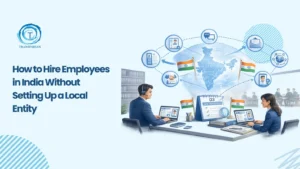
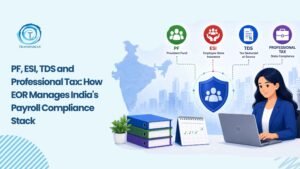
Hiring in India as a foreign company without a local entity used to mean a long wait for registration or a reliance on contractor arrangements that carried real risk. EOR gives manufacturing companies a direct route to saving time and cost while entering or expanding in the Indian market with proper employment structures, correct statutory filings, and payroll that handles PF, ESIC, TDS, and professional tax accurately from month one.
India’s labor compliance environment is also notably state-specific, which adds a layer of complexity that companies unfamiliar with the market consistently underestimate. Professional tax rates differ by state. Some statutory obligations vary depending on establishment size and location. Getting this right requires someone with actual on-the-ground knowledge of how compliance works in practice, not just what the legislation says in theory.
Let Transparian Simplify Your Global Hiring
From drafting compliant employment contracts to managing payroll, PF, and ESIC filings for every cross-border hire, Transparian provides reliable EOR services for manufacturing and supply chain companies looking to build teams in India without setting up a local entity. Through dependable global employment support and experienced HR compliance experts, Transparian helps growing businesses hire faster, stay compliant, and scale confidently across borders.
FAQ’s
Employer of Record (EOR) services help manufacturing and supply chain companies legally hire employees in other countries without establishing a local entity. An EOR manages employment contracts, payroll, statutory compliance, tax deductions, and employee benefits while allowing businesses to retain day-to-day control over their workforce.
An EOR simplifies cross-border hiring by handling local labor law compliance, payroll processing, statutory contributions, and onboarding requirements. This enables manufacturing companies to expand into new markets quickly while reducing legal and administrative complexities.
Yes. Through EOR services, foreign manufacturing companies can legally hire employees in India without establishing a local entity. The EOR acts as the legal employer and manages payroll, PF, ESIC, TDS, and other statutory obligations on behalf of the company.
Yes. An EOR manages payroll processing, tax deductions, statutory contributions, leave compliance, and employee benefits based on local employment laws. This helps businesses maintain accurate and timely compliance across multiple jurisdictions.
Common challenges include country-specific employment contracts, payroll regulations, social security contributions, worker classification requirements, termination laws, and statutory filings. Managing these across multiple countries can become resource-intensive without specialized support.
EOR services ensure employment contracts, payroll records, and statutory filings are properly maintained and compliant with local regulations. This creates a well-documented workforce structure that can withstand audits, acquisitions, and regulatory inspections more effectively.