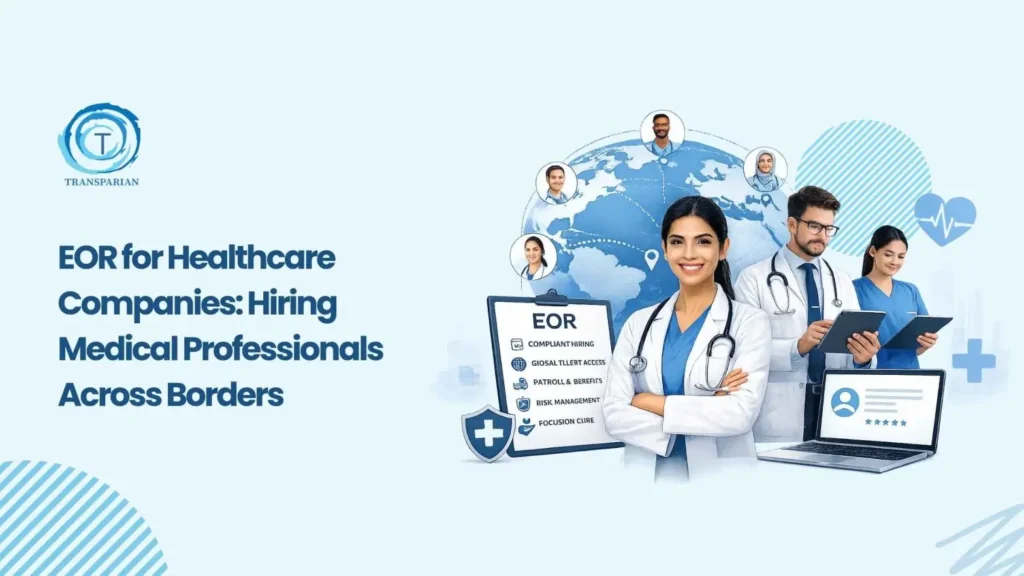
Healthcare as an industry has always had a local, hands-on character to it. But the businesses that support healthcare diagnostics companies, telemedicine platforms, clinical research organizations, health-tech startups, medical device firms are increasingly operating across borders. And when they try to hire the right medical talent in a new country, they run into a wall.
It is not that the talent is hard to find. Across markets like India, Southeast Asia, and parts of Eastern Europe, there is a deep pool of qualified physicians, nurses, radiologists, lab scientists, and allied health professionals. The problem is getting them onto payroll legally, compliantly, and without spending six months setting up a local entity first.
That is the gap EOR services were built to close and for healthcare companies specifically, they solve a set of problems that goes beyond the standard hiring headaches.
Why Hiring Medical Professionals Is More Complicated
When a software company hires a developer in another country, the compliance challenges are mostly about employment contracts, payroll, and tax. That is manageable. Healthcare hiring carries all of those challenges plus a few that are specific to the sector.
Professional licensing is the obvious one. A radiologist qualified in India may not be automatically recognized in another jurisdiction, and vice versa. Employment contracts for medical roles often need to reflect the scope of practice allowed under local regulations, which varies significantly from country to country. If your organization is a telemedicine platform or a clinical research company, you also need to be clear about what the employee can and cannot do under their license in the country where they sit.
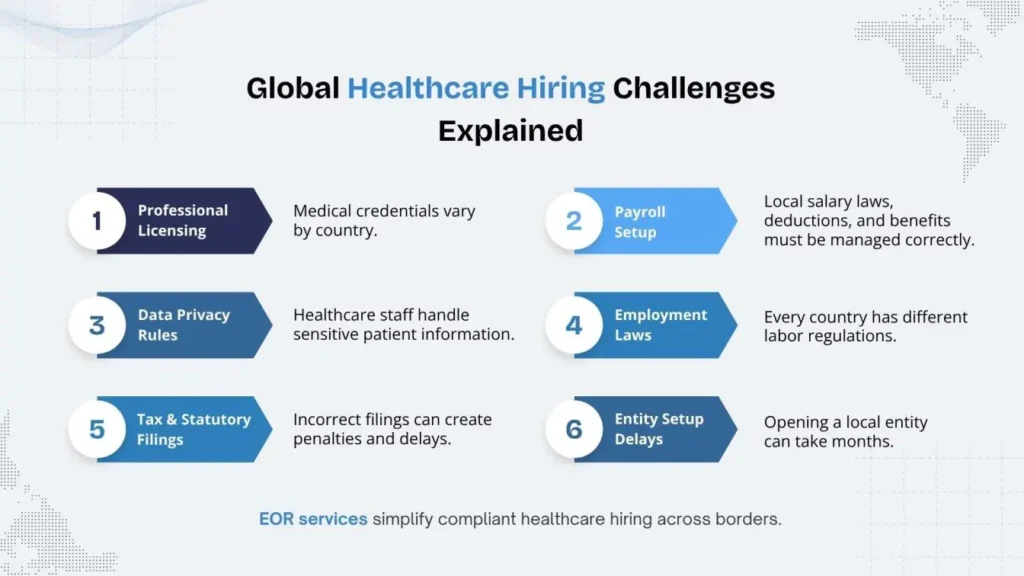
Then there is data sensitivity. Healthcare employees routinely handle patient records, diagnostic data, and clinical trial information, all of which fall under strict data protection regimes. When your employee is in one country and your organization is incorporated in another, the question of which regulations govern that data handling gets complicated fast.
And of course, there is the standard complexity of legal and financial compliance that comes with international employment tax withholding, provident fund, social security contributions, mandatory benefits, termination procedures. Getting any of it wrong creates real liability.
What EOR Does in This Context
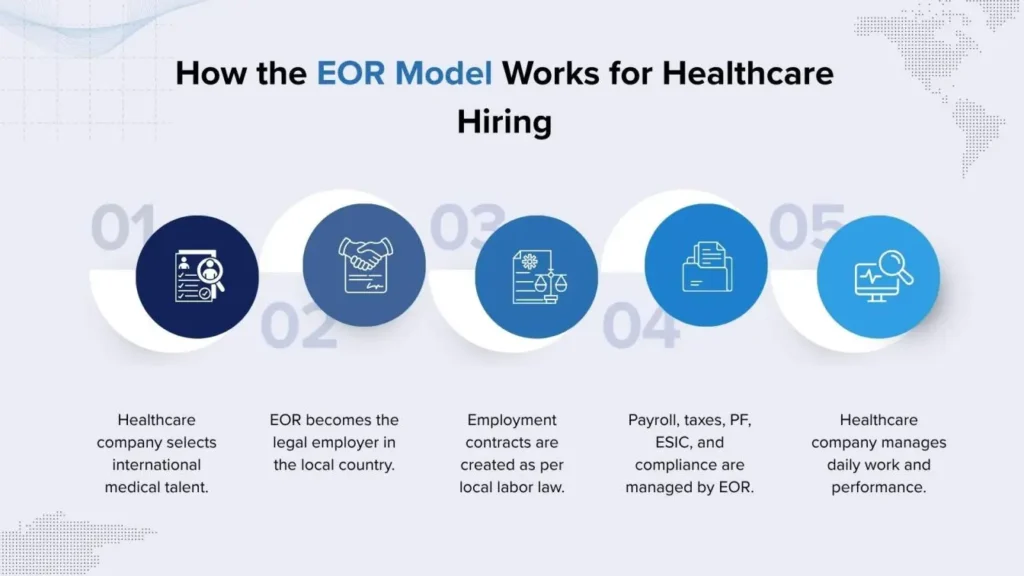
An Employer of Record becomes the legal employer of your worker in the country where they are based. You keep full control of what that person does day to day, their role, their performance, their place in your org structure. The EOR handles the employment layer: contracts drafted to local law, payroll processed accurately each month, statutory filings submitted on time, and all the HR administration that comes with it.
For healthcare companies, this matters in a few specific ways:
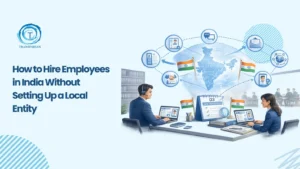
- No legal entity needed. Setting up a subsidiary or branch office typically takes three to six months and comes with ongoing compliance obligations even after registration. If you are testing a new market, running a time-limited clinical trial, or building a small remote diagnostics team, that setup cost and timeline is hard to justify. EOR removes that requirement entirely.
- Faster time to hire. With an EOR in place, a qualified candidate can be employed and payroll-ready in one to two weeks from contract signing. For organizations racing to staff a clinical rollout or fill a critical research position, that speed matters.
- Contracts that hold up. Country-specific employment agreements for medical roles need to account for local labor law, professional licensing requirements, and sector-specific obligations. An experienced EOR drafts agreements that are legally sound in the country where the employee works, not just translated versions of your standard contract.
The Compliance Challenges EOR Takes Off Your Plate
For healthcare companies hiring internationally, the compliance obligations stack up quickly. An EOR handles all of the following:
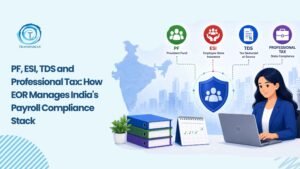
- Provident Fund (PF), ESIC, and professional tax contributions
- Income tax deductions and TDS filings
- Employment contracts aligned with local labor law
- Statutory leave entitlements and benefit administration
- Monthly payroll processing with accurate deductions
- Annual returns, Form 24Q, and other statutory filings
This is not work that should fall to an HR generalist who is already managing a global team. And it definitely should not fall to the finance team trying to interpret foreign tax codes from a spreadsheet.
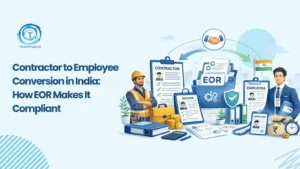
Beyond the administrative side, there is also the question of employment risk, specifically misclassification. A number of healthcare companies hire clinical and research professionals as independent contractors to avoid the complexity of formal employment. That works until it does not. Misclassification findings can result in back taxes, penalties, and retrospective benefit obligations, and regulators in markets like India have been paying closer attention to this. An EOR structure puts the engagement on solid legal ground from the start.
The Co-Employment Model and What It Means for Healthcare
One thing worth understanding clearly is how the co-employment model works, because it comes up often in healthcare hiring conversations.
Under this model, the EOR is the employer of record on paper responsible for contracts, payroll, compliance, and statutory obligations. The client company directs the actual work. The employee has a clear employment relationship, full statutory benefits, and the security of a proper contract. The client company retains operational control without carrying the compliance burden.
For medical professionals, this structure actually works well. It gives them a formal employment relationship with all the protections that come with it, which matters for skilled professionals who have options. And it gives the healthcare company a compliant way to engage that talent without either misclassifying them as contractors or investing in a local entity before they are ready.
What to Think About When Evaluating an EOR for Healthcare Roles
Not every EOR has the experience to handle healthcare hiring well. A few things are worth checking:
- Does the EOR have experience in regulated industries, where employee credentials and confidentiality obligations are part of the picture?
- Can they draft employment contracts that reflect professional licensing requirements, not just standard labor law provisions?
- How do they handle employee onboarding for roles that require credential verification before the engagement starts?
- What does their payroll accuracy record look like, and how do they handle errors when they occur?
- Are they set up to support global talent acquisition in the specific markets you are entering, or are they primarily a generalist provider?
Speed is often cited as the main EOR benefit, and it is a genuine one. But for healthcare companies, the more important factor is accuracy knowing that the contracts, the payroll, and the compliance filings are correct in a sector where errors have consequences beyond a financial penalty.
A Note on the India Opportunity for Healthcare Companies
India deserves specific mention here, because it sits at the intersection of several trends that healthcare organizations are actively trying to capitalize on.
The country has one of the largest pools of qualified medical and clinical research professionals in the world. Demand for telemedicine, diagnostics, and clinical trial support has grown steadily. Health-tech investment has brought dozens of international organizations into the market. And for companies that want to hire in India without the overhead of entity registration for a pilot program, a research team, or a remote specialist function, the EOR model is the most practical route.
The compliance environment in India is detailed and state-specific, which is why having a partner with genuine on-the-ground expertise matters. Payroll in India is not just salary plus deductions; it involves PF, ESIC, professional tax, and a set of statutory returns that need to be filed accurately every month, on time, without exception.
Let Transparian Handle the Employment Side of Your Healthcare Hiring
From employment contracts and payroll processing to statutory filings and compliance management, Transparian provides end-to-end EOR support for organizations hiring in India, including healthcare companies bringing on clinical, research, and allied health professionals. With 20+ years of HR and compliance experience, Transparian acts as the legal employer so you can focus on building the team and doing the work.
FAQ’s
An Employer of Record (EOR) is a third-party organization that legally employs healthcare professionals on behalf of another company. The EOR manages payroll, compliance, taxes, employment contracts, and statutory benefits while the healthcare company oversees the employee’s day-to-day work.
An EOR service helps healthcare companies hire medical professionals across borders without setting up a local entity. It handles local labor law compliance, payroll processing, tax deductions, onboarding, and employment documentation in the employee’s country.
Yes, healthcare organizations can hire doctors, nurses, clinical researchers, radiologists, and allied health professionals in India through an EOR company. The EOR ensures compliant employment, statutory benefits, and accurate payroll management.
Healthcare hiring involves additional compliance requirements such as professional licensing, patient data protection, credential verification, and country-specific regulations for medical practice. These legal and operational complexities make compliant international hiring more challenging.
An EOR company processes salaries, tax deductions, statutory contributions, reimbursements, and employee benefits according to local labor laws. This ensures accurate and timely payroll for healthcare employees in different countries.
Healthcare companies should choose an EOR provider with experience in regulated industries, strong payroll accuracy, knowledge of healthcare compliance, credential verification processes, and expertise in local employment laws.